avg —
Cherry Kompot without a Water Bath

Instructions
I prepare the ingredients for cherry compote without sterilization. I rinse the cherries, dry them, and remove any rotten or wormy fruits. I leave the pits in – they give the flavour a characteristic "almond" note.
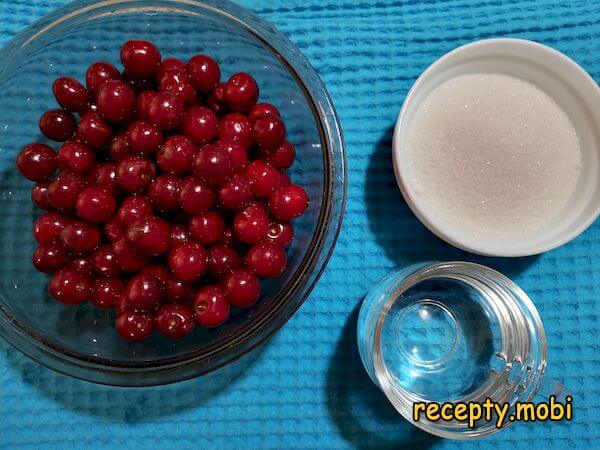
I wash the jars with baking soda and rinse them well. Soda removes grease and residue. I transfer 500 g of cherries into each three-litre jar.
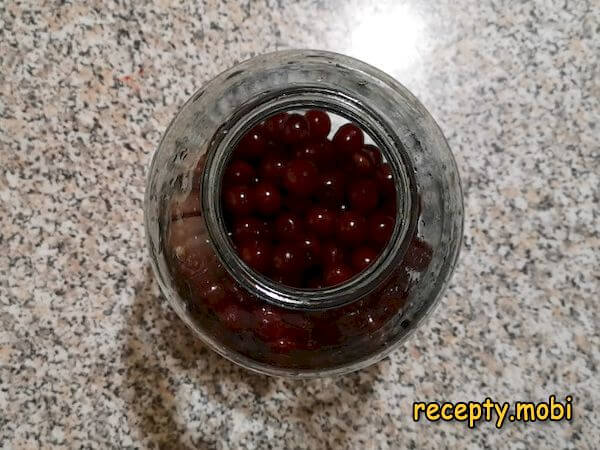
I bring the water to a boil and fill the jars of cherries to the top with it. I cover the neck with a sterilized lid. I leave it to infuse for about 15 minutes – the cherries will release their aroma and colour.
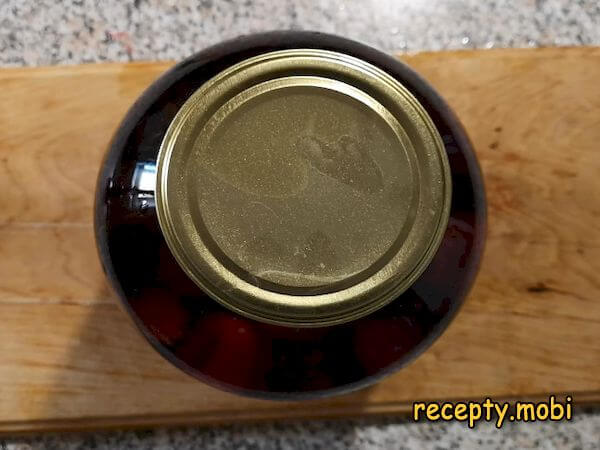
Using a special lid (with holes), I drain the liquid from the jars into a saucepan. If you don't have such a lid, you can strain it through cheesecloth. I cover the jars with sterilized lids.
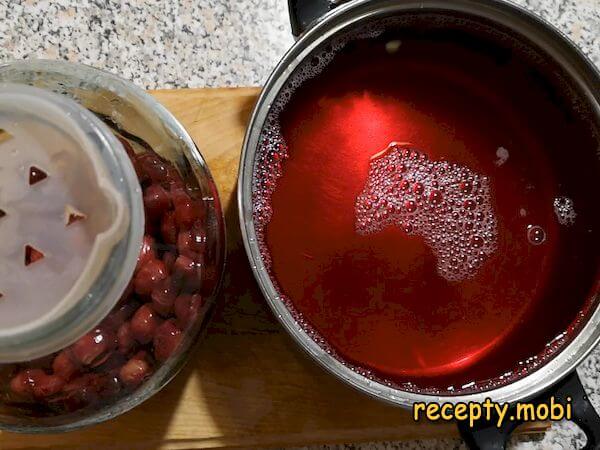
I put the saucepan with the liquid on the heat and bring it to a boil. While the liquid is coming to a boil, I pour 300 g of sugar into each jar of cherries and cover them with lids.
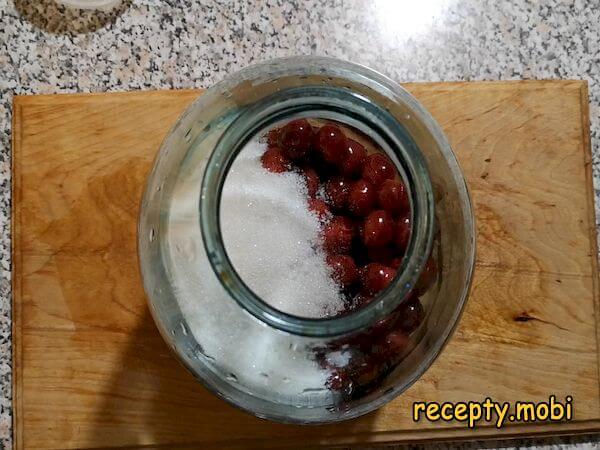
As soon as the liquid comes to a boil, I pour it over the cherries with sugar. This double "pour" acts as a self-sterilization of the contents.
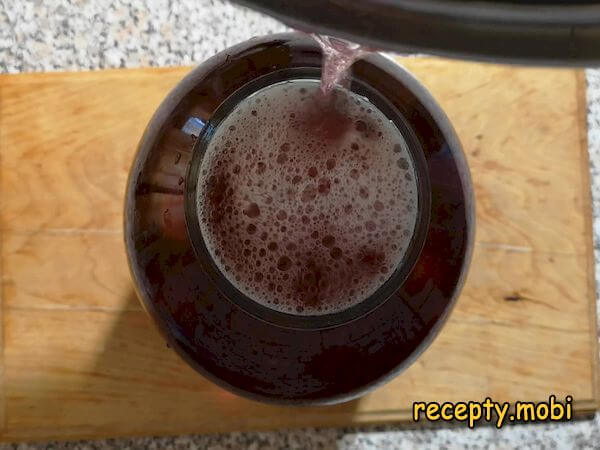
I cover the jars with lids and seal them right away.
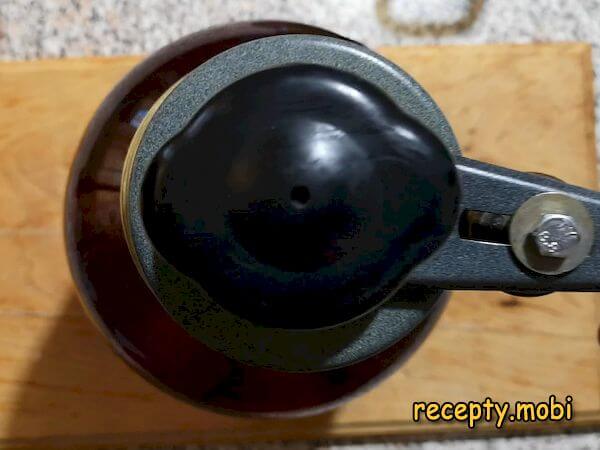
I turn the sealed jars upside down for 12 hours – during this time "heat-curing" takes place and the seal is checked for tightness.
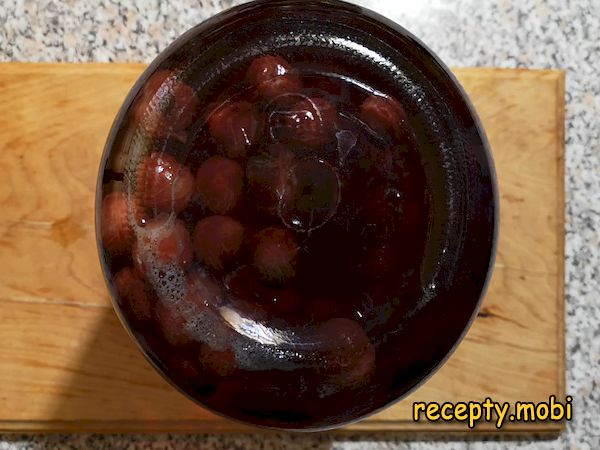
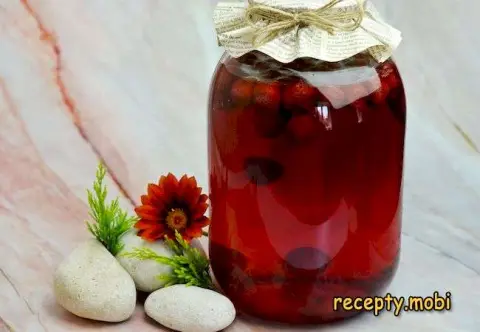
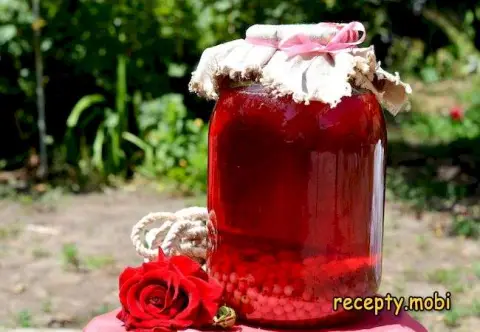
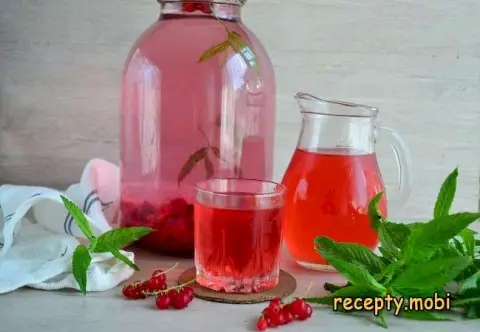
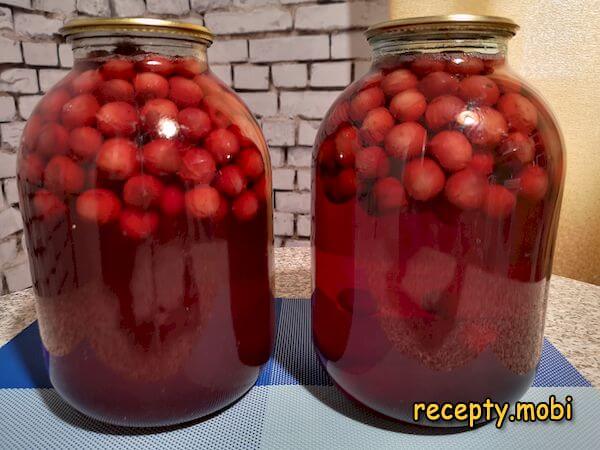
The cherry compote for winter without sterilization is ready. Once it has cooled, I move the jars to the cellar for storage.


Tips
- 1
Choose ripe cherries, but not overripe ones – overripe fruit quickly falls apart in the compote. Varieties with firm flesh are best (Vladimirskaya, Lyubskaya, Shubinka).
- 2
You can leave the pits in or remove them. With pits there is an "almond" note to the flavour and it keeps longer. Without pits it is more delicate, but the shelf life is reduced to 6 months (toxins from the pits do not build up).
- 3
The double-pour method is the key to making it "without sterilization". The first pour warms the jars and the cherries, and the second (with sugar) locks in the result.
- 4
Turn the jars upside down for 12 hours – this checks the seal and provides extra sterilization of the lids from the inside with the hot syrup. The principle works for all berry compotes without sterilization.
Proportions for 1, 2, and 3 Liter Jars
Here is the math for the most common jar sizes, with the same ratio as in the main recipe: roughly 170 g of sour cherries and 100 g of sugar per liter of jar volume.
| Jar | Sour cherries | Sugar | Water, approx. |
|---|---|---|---|
| 1 L (4 cups) | 170 g | 100 g | 0.8 L |
| 2 L (8 cups) | 350 g | 200 g | 1.6 L |
| 3 L (12 cups) | 500 g | 300 g | 2.5 L |
In the ingredient list of the main recipe the water comes with a margin, 3 L per jar: some of it boils away while the syrup cooks, and in reality about 2.5 L ends up in the jar. Sugar can move within a range of 250-400 g per 3-liter jar: the more tart the fruit and the sweeter your taste, the closer you go to the upper end. For smaller jars simply take one third or two thirds of the amounts.
Why It Works Without Sterilization: the Double-Fill Method
There is no secret here, three factors work at once.
- The acidic environment. A sour cherry preserve sits at a pH of about 3.2-3.6, and most bacteria simply cannot grow in that much acid.
- Double heating. The first fill of boiling water warms the fruit and the jar walls over 15 minutes, and the second one, this time with boiling syrup, finishes off the microflora on the surface of the fruit.
- Airtight sealing and slow cooling ing under a blanket, which keeps working as gentle pasteurization for another 12 hours.
I close any acidic berries and fruit the same way: currants, gooseberries, cherry plums, tart plums and apples.
One more thing: the method does not change shelf life, the limits set by the pits (up to a year in a cool cellar and up to six months in an apartment) apply with any way of sealing.
Compote from Shpanka and Sweet Cherries
The Shpanka cherry (a sweet-sour cherry hybrid) is larger and noticeably sweeter than a regular sour cherry, so I put in less sugar. The technique is the same double fill as in the main recipe, so I keep the steps short, differences only. Proportions are for a 3-liter jar.
- Shpanka cherries: 600 g
- Sugar: 250 g
- Water: about 2.4 L
- Sort the Shpanka cherries, remove the stems, and wash the fruit. I take 600 g, a bit more than with sour cherries: Shpanka is large and packs loosely in the jar.
- Pour the fruit into a sterile 3-liter jar, fill with boiling water right up to the neck, and let it stand under a sterile lid for 15 minutes.
- Drain the infusion into a pot through a lid with holes, add 250 g of sugar, and boil the syrup for 2-3 minutes, stirring, until fully dissolved.
- Pour the boiling syrup back in up to the very brim, seal at once, turn the jar upside down, and wrap it in a blanket for 12 hours.
Good to know: with pure sweet cherries do exactly the same, with one adjustment. They are nearly bland, so add 1/3-1/2 tsp of citric acid (2-4 g) to the syrup per 3-liter jar: the sweeter the fruit and the warmer your storage spot, the closer to the upper end. My substitute for the acid: a handful (50-70 g) of red currants straight in with the fruit. For sweet cherries 200 g of sugar is enough. The same insurance is needed for very sweet Shpanka with no tartness at all.
Mixed Fruit Compote with Sour Cherries
Sour cherries get along beautifully with red currants and apples: the currants add a bright tang and a deep ruby color, while apple makes the flavor softer. The technique is once again the same, so I only spell out the differences. Proportions are for a 3-liter jar.
- Sour cherries: 400 g
- Red currants: 150 g (or 2 medium apples, about 300 g)
- Sugar: 350 g for the currant version, 300 g for the apple one
- Water: about 2.2-2.3 L
- Sort and wash the sour cherries. Put the currants in right on their stems, that way they do not burst. Cut the apples into wedges 1.5-2 cm thick, remove the core, keep the peel on.
- Load the cherries and the add-in into a sterile jar, fill with boiling water up to the neck, and let stand under a lid for 15 minutes.
- Drain the infusion into a pot, add the sugar (350 g if the jar holds currants, 300 g if apples), and boil the syrup for 2 minutes.
- Pour the syrup back in up to the very brim, seal, turn upside down, and wrap for 12 hours.
Good to know: the currant version is the showiest in color but also the most tart, hence 50 g of extra sugar. The apple one comes out mellower: by winter the wedges soak up the cherry juice, and in my family they get eaten before the drink itself is finished.
Common Mistakes
Nearly every bulging lid and cloudy jar comes down to one of six causes.
| Mistake | What happens | How to fix it |
|---|---|---|
| Boiling water poured straight into a cold jar | The glass cracks from the temperature shock | Warm the jar first: rinse it with hot water or pour the boiling water in stages over a spoon placed inside |
| Jar not topped up to the neck with boiling water | Air stays under the lid and the preserve ferments | Fill with syrup up to the very brim, so a little spills over the neck as you seal |
| Lid crimped on too loosely | Air seeps in and the lid bulges within 1-2 weeks | Check the seam: turn the jar over, and if the neck stays dry the seal is airtight; re-crimp an unreliable lid right away |
| Jar not inverted and not wrapped | The jar cools too fast and self-pasteurization never finishes | Always 12 hours upside down under a blanket, it is a mandatory part of the method, not a ritual |
| Too little sugar in the syrup | The syrup is "empty" and the preserve turns sour at room temperature | Store a jar with weak syrup only in the fridge or the cellar |
| Fruit with cracks and worm holes | The drink turns cloudy and sediment settles at the bottom | Sort the cherries one by one; send bruised and damaged fruit to juice or jam |
Video

FAQ
With pits or without – which is better? +
Both options have their pros and cons. With pits: a characteristic "almond" note to the flavour (the pit contains amygdalin, which gives the aroma), it keeps longer (up to 1 year), and it is more convenient to prepare (less work). The downsides: the inside of the pits contains hydrocyanic acid – after a year to a year and a half it begins to "migrate" into the syrup, so compote with pits should not be stored for longer than 1 year. Without pits: a more delicate flavour and the compote is easier to drink, but the shelf life is 6–8 months. For children, only without pits (for safety). For long-term storage, with pits.
How long does the finished compote keep? +
In a cellar or cool pantry (10–15 °C), with pits it keeps up to 1 year and without pits up to 8 months. In a flat at room temperature, 6 and 4 months respectively. Once opened, 3–5 days in the fridge. Signs of spoilage: cloudy syrup, a bulging lid, "hissing" on opening, a sour smell – throw such compote away. With the correct technique the sealed jars cure successfully and only become tastier over time – the sugar dissolves completely and the cherries give all their flavour to the syrup.
Why is citric acid not added? +
Cherries are quite acidic on their own (pH 3.2–3.8), and their own acidity is enough for preserving. Citric acid would be "unnecessary" – the compote would become too sour and more sugar would be needed to balance it. If the cherries are very sweet (cultivated varieties such as "Chocolate" or "Festivalnaya"), you can add 1/4 tsp of citric acid per jar as a safeguard. But this is not essential. The double-pour method by itself provides the necessary sterilization.
Can I use frozen cherries? +
Yes, but the result will be a little different. Frozen cherries release their juice straight away, so a single pour of boiling syrup is enough (instead of a double one). Take 600 g of frozen cherries per jar (more than fresh – they will "shrink down"). It is better to remove the pits before freezing. Add slightly less sugar (250 g) – frozen berries often contain a little "of their own" syrup. The shelf life is shorter, up to 6 months. Use them in the winter season when fresh cherries are not available.
How much sugar per 3-liter jar, and can I use less? +
My standard is 300 g: the flavor comes out rich but not cloying. If you like it more tart, feel free to go down to 250 g, the compote will take it. But 200 g per 3 L is what I consider the floor for apartment storage: sugar, together with the fruit's own acid, insures the jar against souring. And keep the reverse move in mind: a concentrated sweet drink can simply be diluted with boiled water in winter.
Can I seal the compote with no sugar at all? +
I do not take that risk with the double fill: a sugar-free drink is temperamental in room-temperature storage. If sugar is off the table for dietary reasons, pour boiling water over the cherries once and sterilize the jars in a pot of water: 15 minutes for 1-liter jars, 25-30 minutes for 3-liter ones from the moment the water boils. Keep such jars in the cellar or the fridge, and finish an opened one within 2 days. You can always sweeten a serving right in the glass with honey or a sugar substitute.
Which lids to use: crimp-on or twist-off? +
Both types work, the only thing that matters is an airtight seal. I take tin crimp-on lids new, with the rubber ring intact, and boil them for 2-3 minutes before sealing. Twist-off lids can be reused, but only with no dents, no rust, and an undamaged inner coating, otherwise the seam will not hold. Plastic snap-on lids are out of the question: they give no vacuum, and the preserve will ferment.
Do I need to sort the cherries and soak them against worms? +
Sorting is a must, and I advise soaking if the cherries come from your own tree with no spraying: cherry fruit fly larvae often hide in those. Dissolve 1 tablespoon of salt in 1 liter of cold water, cover the fruit with it for 30 minutes, and the larvae will float to the surface. After that rinse the cherries thoroughly in 2-3 changes of water to wash off the salt, and only then load them into the jars.
When is the compote ready to drink after sealing? +
Technically you can drink it as soon as it has fully cooled, it does not have to sit for weeks. But in the first days the flavor is watery: the fruit has not yet given up its juice and color. The true rich cherry flavor shows up after 3-4 weeks, and the drink hits its peak at about a month and a half: sealed in July, it has fully opened up by September. That is why I never open the first jars before fall.
- Comment
or post as a guest
Be the first to comment.