avg —
Marinated Cornichons for Winter

Instructions
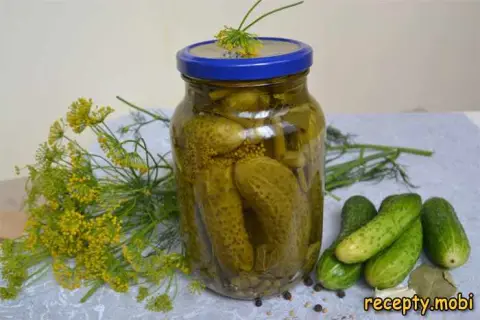
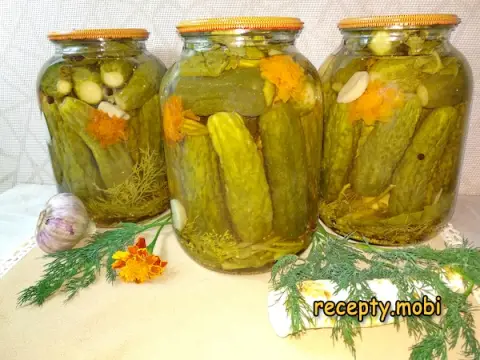
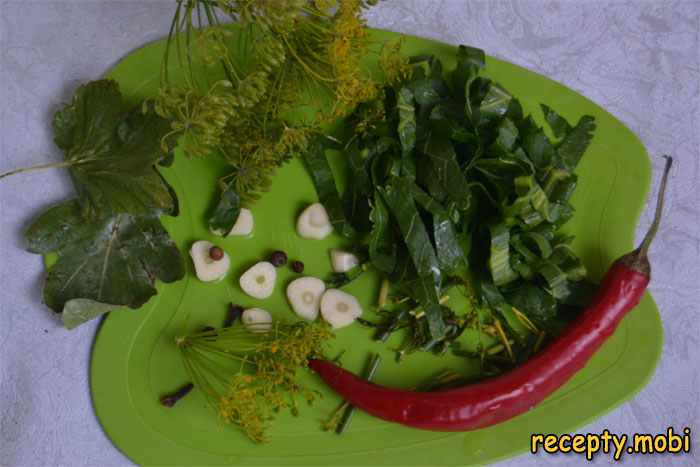
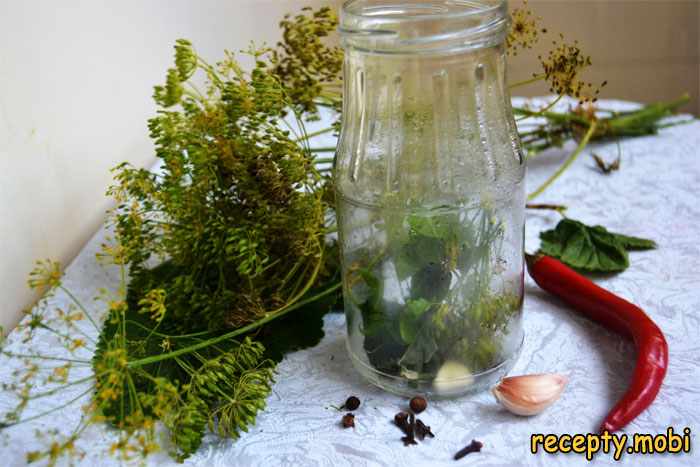
We begin by sterilizing the containers in which we will pickle the appetizer. First, wash the jars in water with baking soda, then rinse them well. After that, sterilize them by whichever method is convenient for you. The lids should also be sterilized or boiled. Wash and chop the horseradish leaf and the dill. Peel the garlic and slice it into wedges. Wash the currant and oak leaves. If you like, add a piece of bitter pepper to the greens prepared for the preserve.
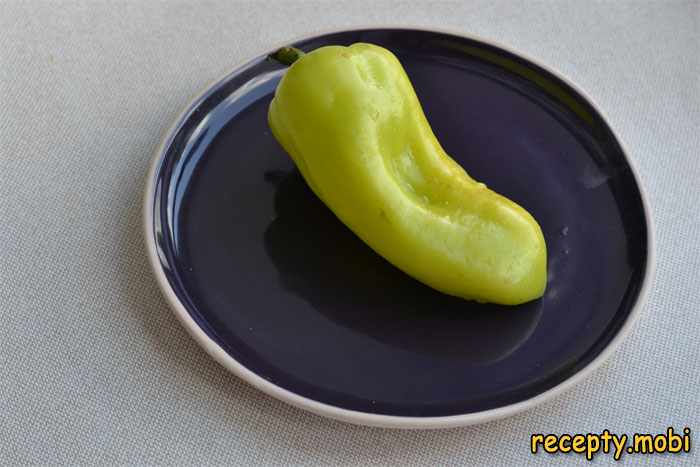
For aroma, add the sweet pepper cut into rings or simply into small pieces.
Place the prepared herbs and garlic in the jar, adding the peppercorns and clove buds as well.
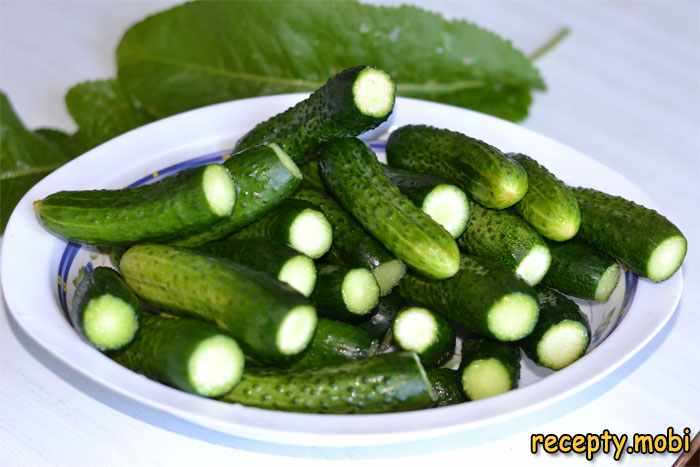
On the fragrant bed of greens and spices, lay out the cucumbers. First trim off their tails together with a small piece of the flesh.
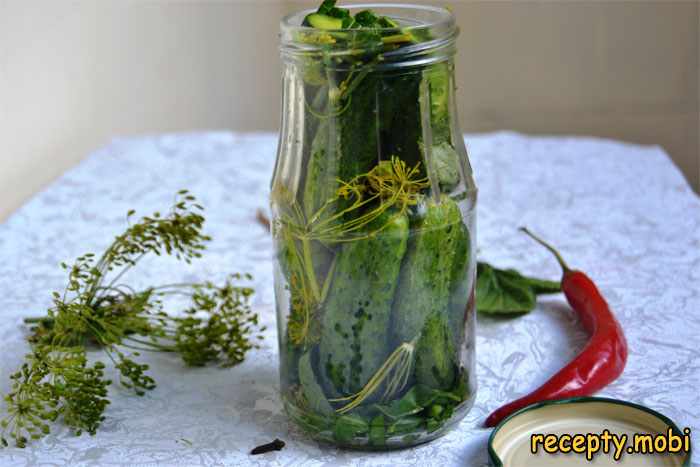
Stand the cucumbers upright in the jar in rows, tucking aromatic dill umbels between them. Sprinkle a pinch of mustard seeds into each jar. Once the jar is filled with greens and cucumbers, pour boiling water from the kettle over everything. Cover the jar necks with sterilized lids and wrap them in a towel for 10 minutes. Drain the water into a saucepan. Add a few tablespoons of water and bring it back to the boil. Pour the boiling water into the jars. Cover them with lids and a towel and leave to warm through for another 10 minutes. The third pour will be the marinade. For this, add a few tablespoons of water to the water you drained into the saucepan, along with the salt and sugar. Boil everything for 3 minutes, then pour 2 tablespoons of vinegar into the marinade. Pour the boiling marinade, now with the vinegar, into the jars.
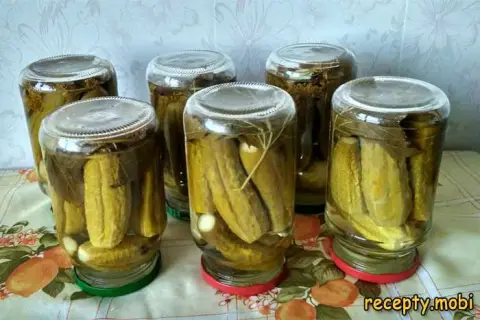
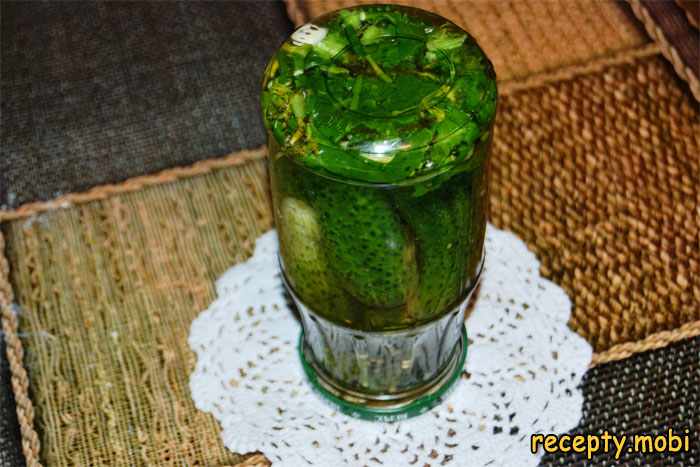
Seal the jars airtight with a special canning key or with screw-top lids, then check the seal by turning the jar upside down. If no marinade leaks out, turn the jars onto their lids, wrap them in a warm blanket and leave them to cool for 12–24 hours. Slow cooling under the "fur coat" gives extra sterilization and a crisper texture to the gherkins. Once fully cooled, move them to a cool, dark place for storage.


Which Cucumbers to Use: Cornichons, Pickling Babies, and Just Small Ones
Not every small cucumber is created equal. This recipe calls for cornichon-type fruit (also known as gherkins): dense, small-seeded, with thick flesh and no hollow spots. Market vendors often sell ordinary cucumbers picked early under the cornichon label, so let's get the terms straight.
| Type | Size | What it is | Does it work for this recipe |
|---|---|---|---|
| Pickling babies | 3-5 cm | Tiny fruit picked 1-2 days after flowering | Yes, they turn out delicate, but you will need noticeably more of them per jar |
| Cornichons | 5-9 cm | Fruit of dedicated cultivars picked underripe: bumpy skin with tiny spines, firm flesh | Perfect, this is the recipe's core size |
| Mini salad cucumbers | 6-10 cm | Smooth, glossy greenhouse cucumbers with thin skin | No: the skin cannot handle the hot fill, the flesh turns mushy |
| Underripe garden cucumbers | 5-9 cm | Regular pickling cultivars picked ahead of time | Use with caution: they often develop hollows and go soft |
In these cultivars (Parisian cornichon, plus Syn Polka and Liliput, both Russian cultivars, and their kin) the fruit grows slowly, holds its 5-9 cm for a long time without overgrowing, and has time to build up density. An underripe cucumber of a regular cultivar looks the same on the outside, but its flesh is loose and watery, and after marinating it will most likely end up soft and hollow inside.
If you are buying at the market:
- ask for the cultivar name;
- press the fruit: a proper one is firm as a radish;
- the skin should be bumpy, with tiny spines;
- smooth and glossy means a salad cucumber, do not use it for preserving.
Cornichon Brine: Proportions for 0.5, 1, and 2 Liter Jars
The base of the recipe: two 0.5-liter jars take 1 tbsp of salt, 2 tbsp of sugar and 2 tbsp of 9% vinegar. From there the brine scales easily to any jar size, since the ratio is tied to each liter of jar volume.
| Jar | Salt | Sugar | 9% vinegar | Water (approx.) |
|---|---|---|---|---|
| 0.5 L | 1.5 tsp | 1 tbsp | 1 tbsp | 300 ml |
| 1 L | 1 tbsp | 2 tbsp | 2 tbsp | 600 ml |
| 2 L | 2 tbsp | 4 tbsp | 4 tbsp | 1.2 L |
Use level spoons, and only non-iodized salt with no anti-caking additives (E535 and E536 cloud the brine). There is twice as much sugar as salt here, and that is deliberate: this exact ratio is what creates the sweet-and-sour "store-bought" taste instead of harsh sourness.
If all you have on hand is 70% vinegar essence, dilute 1 part essence with 7 parts water (8 parts total, which is roughly a 9% vinegar) and use it like ordinary table vinegar. Or skip the dilution and count directly: for a 1-liter jar, instead of 2 tbsp of 9% vinegar you need about 3/4 tsp of essence, poured into the brine just before taking it off the heat.
Why Homemade Ones Taste Like Store-Bought
The secret of the factory taste is not some mysterious additive, it comes down to three things.
- The fill formula. Industrial fills are always built on the "more sugar than salt" formula, and our brine copies it one to one.
- The spice bouquet. mustard seeds and cloves. They are what gives that recognizable spicy note from supermarket jars, where currant leaf and bay leaf are hardly ever used.
- Small jars. small calibrated jars. In a 0.5-liter jar, 5-7 cm fruit stands tight and even, marinates at the same rate, and the whole jar gets eaten in one go, so the preserves never sit open for weeks.
Spicy Cornichons with Mustard
A version for those who find the classic too peaceful: doubled mustard and chili deliver a noticeable but not mean heat. These go beautifully with meat and make fine company for strong drinks.
- cornichons 5-9 cm: 600-700 g
- mustard seeds: 2 tsp
- chili pepper: 4-6 rings (about half a pod)
- garlic: 4 cloves
- dill umbels: 2 pcs.
- horseradish leaf: 1 pc.
- black peppercorns: 6-8 pcs.
- non-iodized salt: 1 tbsp
- sugar: 2 tbsp
- 9% vinegar: 2 tbsp
- water: about 600 ml
- Prep the cucumbers the same way as in the main recipe: soak them in cold water and trim the tips.
- Into two sterile 0.5-liter jars, lay out the dill, the horseradish leaf, sliced garlic, 2-3 chili rings, 1 tsp of mustard seeds and 3-4 peppercorns per jar, then pack the cucumbers in tightly, standing upright. Leave currant and oak leaves out of this version: they argue with mustard and chili.
- Fill the jars with boiling water twice for 10 minutes, draining the water each time. Cook the brine with salt and sugar from the last drain, add the vinegar just before taking it off the heat, fill the jars to the brim and seal.
- Turn upside down and wrap in a blanket for 12-24 hours.
Good to know: the heat builds with time: a month in, the chili comes through noticeably stronger than on sealing day. Want it fiery: add 2-3 rings with seeds per 0.5-liter jar, but do not put in a whole pod, not even to win a bet.
Common Mistakes with Cornichons
A small cucumber is fussier than a large one: its moisture reserve is tiny, so any mistake shows up faster and hits harder. Here is what most often goes wrong specifically with small fruit.
| Mistake | What happens | How to fix it |
|---|---|---|
| Used mini salad cucumbers instead of a cornichon cultivar | They turn mushy after the very first hot fill | Take only bumpy pickling fruit, send the smooth glossy ones to a salad |
| Overgrown "cornichons" of 10-12 cm | Hard seeds, cottony core | Sort to 9 cm max, slice the overgrown ones for salads |
| The cucumbers shriveled | The skin gathered into folds, the look is ruined | Do not exceed the salt, sugar and vinegar amounts (level spoons: an overly strong brine pulls moisture out of small fruit) and do not leave the fruit sitting dry for long between steps |
| Packed them sideways with force | Dented sides, and the flesh softens in those spots | Pack upright, snugly but without pressing: small fruit bruises more easily than large |
Video
FAQ
How long does an open jar of cornichons keep in the fridge? +
Two to three weeks, as long as the brine fully covers the cucumbers and you fish them out with a clean fork, not your fingers. In practice a 0.5-liter jar rarely lives that long: calibrated small fruit disappears in one or two sittings. That is the main perk of small jars, and the reason I recommend sealing half-liter jars rather than three-liter ones.
Can I replace vinegar with citric acid, and how much do I add? +
You can. For a 0.5-liter jar, instead of 1 tbsp of 9% vinegar use a third of a teaspoon of citric acid; for a 1-liter jar, two thirds of a teaspoon. The acid goes straight into the jar before the final fill, and the brine is cooked without vinegar. The taste comes out milder and free of any vinegar smell, and the shelf life stays the same.
Why soak the cucumbers, and can I skip this step? +
Between the garden bed and your kitchen, small fruit manages to lose part of its moisture, and a 3-4 hour soak in cold water brings it back. Skip this step and hollows form inside, leaving the preserves soft. There is one case where skipping is fine: if the cucumbers came off the vine an hour or two ago, then 30-60 minutes in ice-cold water to chill them is enough.
When can I taste the cornichons after sealing? +
Open the first jar no sooner than 3-4 weeks in: that is how long the marinade needs to soak the fruit all the way through. The full, settled flavor with all its spicy notes arrives after one and a half to two months. Cucumbers opened ahead of schedule will taste bland in the middle.
How many cornichons fit in a 0.5-liter jar? +
About 300-350 g, which means 12-15 fruits of 5-7 cm packed tightly upright. Buy with a small margin, 600-700 g for two jars: a couple of cucumbers almost always get culled for softness or crookedness. One such jar takes about 250-300 ml of brine.
Can I mix cornichons and pickling babies in one jar? +
You can, but better not to: 3-5 cm fruit marinates noticeably faster than 8-9 cm, and by the time the bigger ones reach full flavor, the small ones are already oversaturated with acid. Sort the sizes into separate jars and each one will come out even in taste. If you do not have enough babies for a jar of their own, put them in the middle, between the larger fruit, not against the walls where the heat is stronger.
Will this recipe work for regular full-size cucumbers? +
The brine will work, but the method needs adjusting. The triple hot-fill is designed for small fruit that boiling water heats through in 10 minutes, while cucumbers longer than 10-12 cm cannot warm through that fast: extend each fill to 15-20 minutes for them. And keep in mind that large fruit has a bigger seed cavity, so the middle will come out softer than in small ones no matter what.
Can I use less sugar if I do not like sweet marinades? +
Yes: sugar in this recipe is only responsible for taste, not for keeping. Drop it from 2 to 1.5 or even 1 tbsp per liter of jar volume, and the flavor shifts from "store-bought" toward the classic sharp-and-sour profile. Salt and vinegar, though, stay strictly per the recipe: their amounts are tied to the safety of the preserves and must not be cut by eye.
- Comment
or post as a guest
Be the first to comment.
Related recipes