avg —
Marinated Onion for Shashlik

Instructions
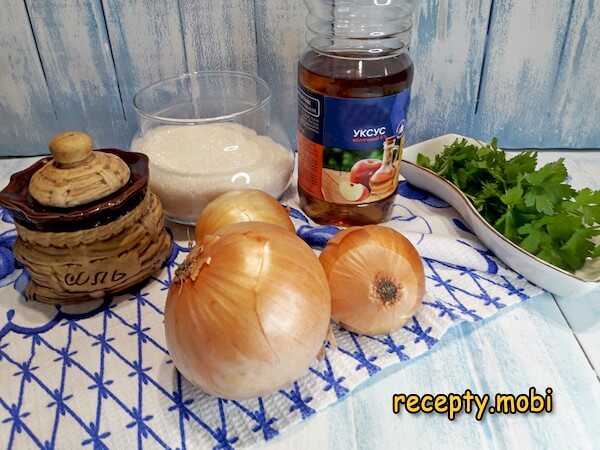
I prepare the ingredients. Apple vinegar substitutes: any FRUIT vinegar (grape, raspberry) or rice vinegar — keep concentration at 6% for proper acidity balance. Avoid: white distilled vinegar (too aggressive, pure-acid taste), balsamic (too sweet, wrong character), wine vinegar (too aromatic, masks onion). Onion choice: white onion (classic, sharp) or red onion (sweeter, prettier colour) both work well. Yellow onion is the budget standard.
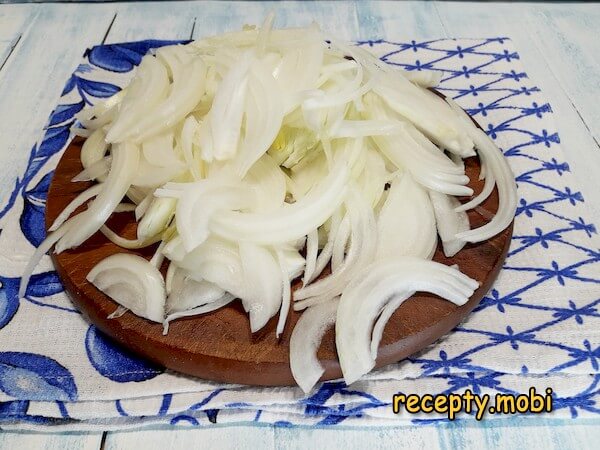
Cut the onion in half (root to tip). Slice each half into thin strips (3-4 mm thickness). Thinner strips marinate faster but lose texture; thicker strips stay too crunchy. The 3-4 mm sweet spot balances marinade absorption with textural integrity.
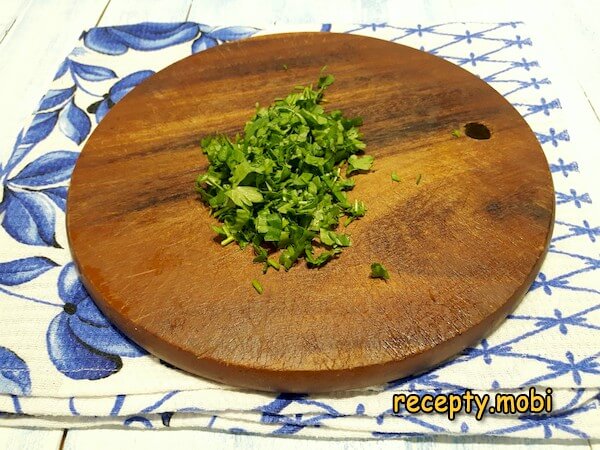
Finely chop the herbs (parsley and/or dill). Use leaves only — discard tough stems.
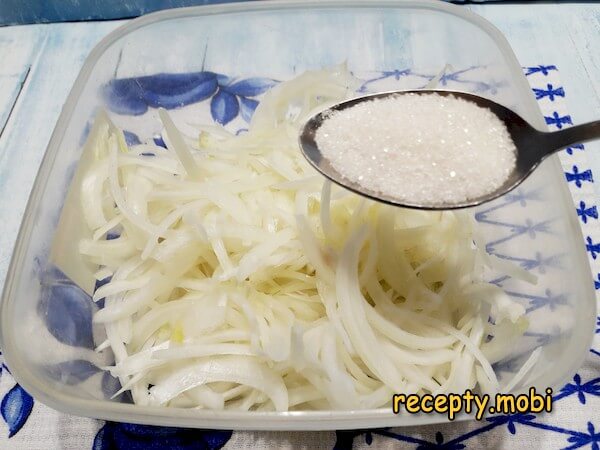
Place onion strips in a container with a tightly-sealing lid. Add the sugar.
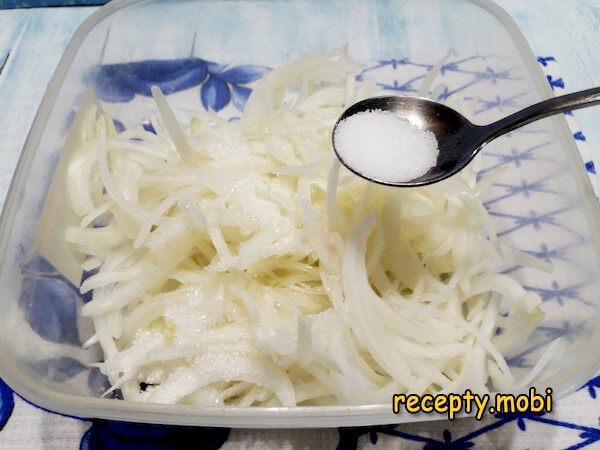
Add the salt.
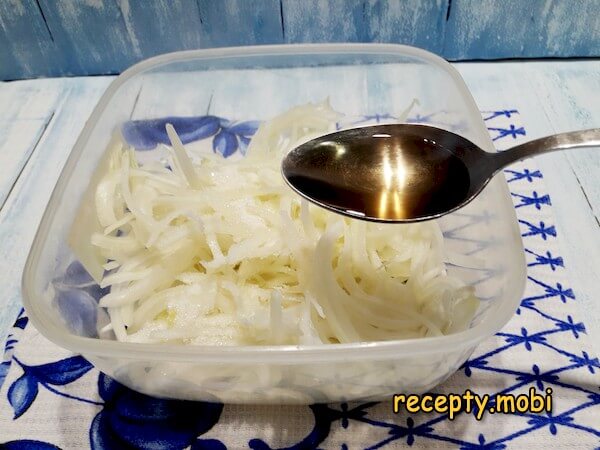
Pour in the apple vinegar.
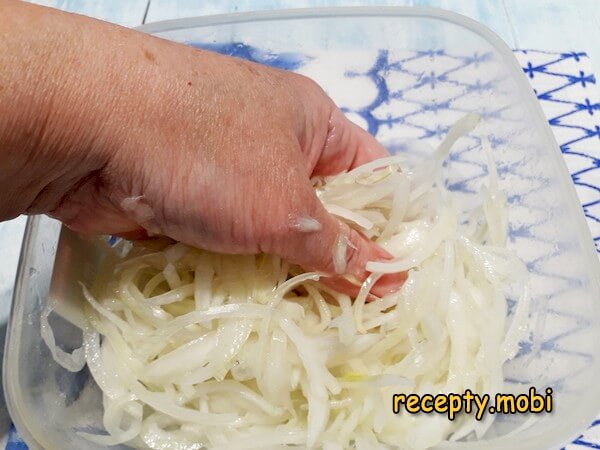
Mix everything thoroughly and KNEAD with hands ("squish" the onion strips firmly between fingers). The mechanical kneading bruises the cell walls of the onion, releasing juice and accelerating the marination process. This is the technique's key step — without it, the dry marinade doesn't penetrate properly.
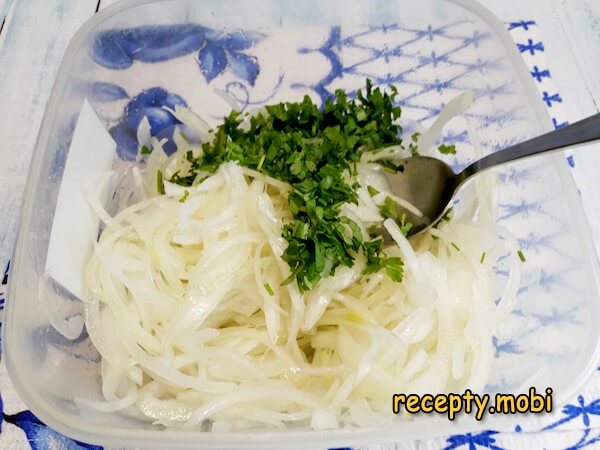
Add the chopped fresh herbs to the kneaded onion.
Mix to distribute herbs evenly. Cover with the tight lid. Let stand at room temperature 15-20 minutes — the onion already released visible juice during kneading; the rest period allows full marination penetration.
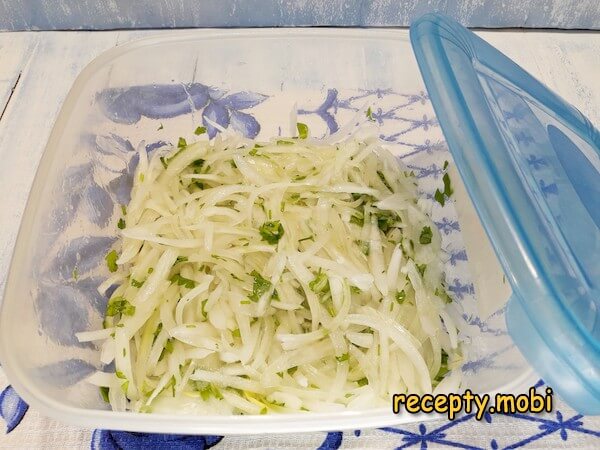
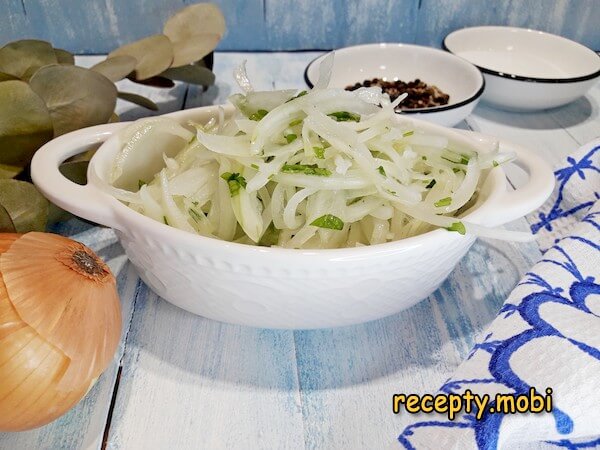
The marinated onion for shashlik is ready.The marinated onion is portable — ideal for picnic transport. In a sealed container, it holds peak quality (firm crunch + bright flavour) for up to 6 hours. Beyond 6 hours, the onion strips soften noticeably and the flavour becomes more aggressively sour. For best results: prepare just before leaving for the cookout. Serve sprinkled directly on grilled shashlik, or alongside in a separate bowl for diners to add to taste.


Tips
- 1
THE DRY-MARINADE METHOD IS TEXTURE PRESERVATION. The "no water added" technique (the recipe's defining feature) preserves onion crunch dramatically better than wet-marinade versions. Wet marinades dilute the onion's juices and produce limp soft texture. Dry marinades use only the onion's own juices (released through the kneading) plus the small amount of vinegar, producing concentrated flavour with intact crunch. Same principle applies to "salt-cured" raw vegetables in many cuisines — keep moisture inside, don't add external water.
- 2
THE KNEAD-AND-SQUEEZE STEP IS NON-NEGOTIABLE. Step 7's hand-kneading isn't optional — it's the mechanical action that ruptures the onion cell walls, releasing juices and creating proper marinade penetration. Without kneading: onion strips remain coated in marinade externally but unmarinated internally — produces mismatched flavour profile. With kneading: marinade penetrates throughout, every strip evenly flavoured. Don't be gentle — actively squeeze and crush the strips for 30-60 seconds. For another marinated vegetable companion to grilled meats, see Marinated Bell Peppers with Garlic.
- 3
THE 20-MINUTE TIMING IS PRECISION. Step 9's 15-20 minutes isn't approximate. Less than 15 minutes: marinade hasn't fully penetrated, raw onion bite still detectable (unpleasant for sensitive eaters). More than 25-30 minutes: structural integrity starts breaking down (onion becomes soft, loses crunch). The 20-minute window is the sweet spot. For larger batches: scale ingredients proportionally, but don't extend marination time. Quality is time-sensitive, not quantity-sensitive.
- 4
THE TIMING-RELATIVE-TO-MEAT MATTERS. Best practice: prepare the marinated onion 20-30 minutes BEFORE the meat finishes grilling. This ensures both components are at peak quality when serving. Common mistake: prepare onion early in the day, leave for hours = soggy unappealing onion. Equally common: prepare onion at meat-serving time = unmarinated raw-onion bite. The 20-minute lead time before meat-readiness is the precise window. For another vegetable preparation pairing well with grilled meat, try Appetizer of Marinated Eggplants with Bell Peppers and Onions.
FAQ
Why marinated onion specifically with shashlik? +
The pairing is culinary geometry. Shashlik (grilled marinated meat) is rich, fatty, smoky, intensely flavoured. The marinated onion provides exact opposite qualities: crisp texture (vs tender meat), bright acid (vs rich fat), fresh herbs (vs smoky char), light bite (vs hearty chew). The contrasting elements amplify each other on the palate, producing a more complete eating experience than either component alone. Plain raw onion lacks the acid component (too aggressive); cooked onion lacks the textural contrast. The marinated form is the precise sweet spot. Same principle applies to British "pickled onions" with cheese, Mexican "cebolla encurtida" with carnitas, etc.
Can I make this ahead and refrigerate? +
Partially yes. The 6-hour quality window applies at room temperature; refrigeration extends it slightly to 12-18 hours, but never to "next-day" quality. Refrigerated marinated onion: still edible at 24 hours but noticeably softer and more aggressive in acidity. For best results: prepare same-day as serving. If overnight prep is required: increase the salt slightly (helps preserve crunch), reduce vinegar slightly (prevents over-souring during long marination), use red onion (holds texture better than yellow). The same-day fresh preparation is genuinely worth the small effort.
What other vegetables can I marinate this way? +
Most crisp raw vegetables work with this dry-marinade technique. Best alternatives: thinly-sliced cucumber (refreshing, bright), thinly-sliced cabbage (Russian-style cabbage salad), shredded carrot (Korean-style without the spice), thinly-sliced radish (sharp clean bite), thinly-sliced fennel (anise-onion crossover). For each: maintain the 250 g vegetable + 2 tbsp vinegar + 1 tbsp sugar + 1 tsp salt ratio; adjust herbs to suit (dill with cucumber; parsley with cabbage; cilantro with carrot). The technique is universally applicable to crisp vegetables.
What if I find the result too sour? +
Two adjustments work. First (preventive): reduce vinegar by 25% (1.5 tbsp instead of 2 tbsp), increase sugar by 25% (1.25 tbsp instead of 1 tbsp). Second (corrective, after preparation): rinse the marinated onion briefly under cold water, drain well — removes excess surface acid while preserving the absorbed flavour. The recipe ratios are calibrated for typical Russian taste preferences (moderate sour-sweet balance); Western palates often prefer milder versions. Feel free to adjust to your taste — the underlying technique is forgiving. Document your preferred ratios for repeatability.
- Comment
or post as a guest
Be the first to comment.