Frying: Principles, Rules, and Techniques
Frying is one of the most popular cooking techniques, where food is cooked in hot fat at 150-200°C (300-400°F). What sets it apart from other methods is the appetizing golden crust that forms on the surface, giving food a distinctive flavor and aroma. I'll cover all the main frying styles: pan-frying with minimal oil, deep-frying in plenty of oil, grilling or dry-frying on a hot pan, stir-frying in a wok, and high vs. medium heat — each style has its own rules and ideal foods. I'll also explain how to choose the right oil for different temperatures (smoke point matters!), why patting food dry before frying is essential and how to avoid the most common mistakes. A practical guide for cooks at every level.
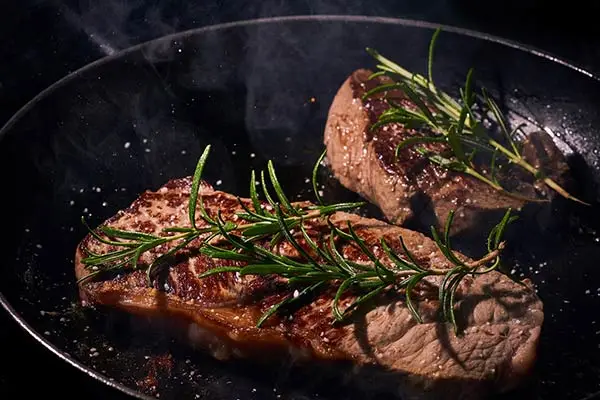
Frying is one of the most popular methods for cooking food, involving the thermal processing of products with the mandatory addition of oil and never using water or any other liquid. During frying, under the influence of high temperatures and the various transformations they cause, a golden crust forms on the food that gives it an appetising appearance and "locks" all the juices inside.
Types of frying
Several types of frying are distinguished, differing from each other by the amount of oil used:
- Searing and browning. Searing is an auxiliary process; products are usually seared before subsequent stewing. It is done over high heat in a small amount of oil until a golden crust forms. If the products continue cooking in the oil after searing, this means browning is taking place. Browning usually takes only a short time, during which specialists advise not leaving the stove so as not to burn the food. You can brown fish, vegetables, pastry and minced meat. The pieces need turning during the process so that they brown evenly.
- Sweating (passerovka). Sweating is an auxiliary process that uses a greater amount of oil than browning, so that the chopped products are, in effect, "stewed" in it over low heat. It is usually done in small saucepans or sauté pans, without covering with a lid and stirring periodically.
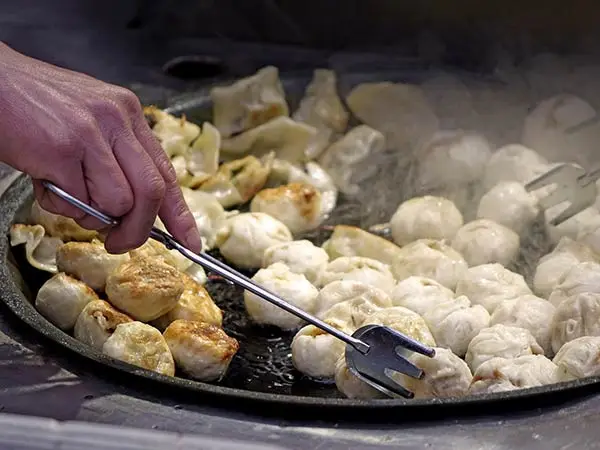
- Shallow deep-frying (pryazhenie). This is a universal variety of frying involving cooking the product in a deep layer of oil one to two centimetres thick. The product lies at the bottom of the dish. At first a crust forms on it, through which the oil then continues to penetrate, so that browning and sweating happen at the same time. You can cook meat, fish, minced-meat products, pies and dumplings this way.
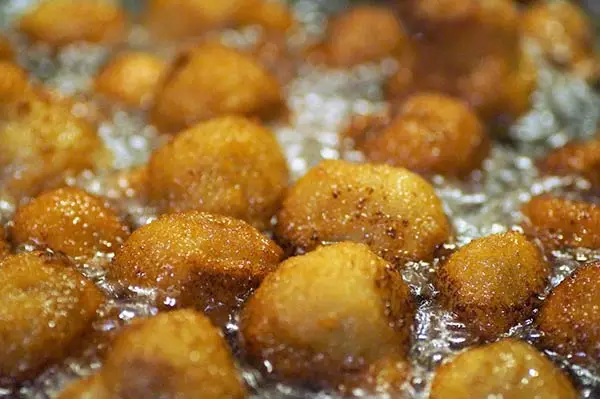
- Deep frying. Deep frying is similar in idea to shallow deep-frying, but in this case the product does not lie at the bottom of the dish; instead it floats, fully immersed in the oil. Deep-frying fat refers to melted and superheated pork fat placed in a deep fryer in a volume of at least one litre. Deep frying takes a remarkably short time — from a few seconds to two minutes. In a deep fryer one cooks fish in batter, fruit in batter, puff pastries, angel wings (hvorost), doughnuts and the famous French fries.
- Frying in oil vapours. Frying in oil vapours is the rarest variety of frying, since it is quite labour-intensive. This method is used to cook meat: whole poultry carcasses or individual parts of an animal carcass, for example a leg or thigh. The cook needs special cookware called a "latka", an oval cast-iron dish. If such cookware is not available, a deep, heavy frying pan can be used. The dish is placed in the oven, oil is poured into it and the meat is put in, then basted every five to ten minutes with the oil that drips to the bottom of the latka or pan. As a result, an oily "cloud" is created in the oven, heated to a temperature of about three hundred degrees.
Principles and essence of frying
The main principle of frying is the use of some kind of oil, which serves as a sort of layer between the food and the hot cookware. Some home cooks, not closely familiar with culinary art, mistakenly take the process of scorching food without any oil for frying. However, it is worth remembering that there is no frying without the addition of oil.
Frying requires suitable cookware and a heat source close at hand. The frying process begins with overheating the oil — a most important culinary technique that consists of heating the oil. Overheated oil does not give off fumes, does not smoke, does not burn and stays clear throughout the whole process. What is more, it is precisely in hot oil that a crust forms instantly, preventing the juices from leaking out.
For frying you can use sunflower, corn or mustard oils. Under no circumstances should flaxseed oil be subjected to heat treatment, as it forms trans fats that are very harmful to health. Butter should not be overheated, since it burns quickly and starts to smoke. Special culinary fats and animal fats contain practically no proteins, so they tolerate the overheating procedure well. Products are placed only into overheated oil.
During frying, temperature is of great importance. Three temperature points deserve attention, and reaching them can be determined visually. The first point is the boiling point of water, that is, one hundred degrees Celsius. Water is present in any product, and during cooking it begins to be released. If the oil has heated above one hundred degrees, then when the product is placed in the pan the water it contains evaporates instantly. If, however, the oil has not reached the boiling point of water, then after the product is placed in it the water is released and the process of stewing follows. The next significant point is the temperature of the Maillard reaction, at which the golden crust forms. The values of this temperature range from one hundred and forty to one hundred and sixty degrees Celsius. The third important temperature point is the smoke point of the oil. After this point is reached, the oil begins to smoke, which indicates a change in its chemical composition and the formation of carcinogens. Such oil must not be used. Bear in mind that after the products are immersed in it the oil cools down, and the colder the products, the more the temperature drops. Try to take the products out of the fridge in advance, but not long enough for them to warm up to room temperature.
Suitable cookware
The most suitable cookware for frying is metal — cast iron, copper or aluminium. Metal cookware conducts heat well and allows the oil to boil. On the whole, a good frying pan should meet the following requirements: it should have a thick bottom so that heat is distributed evenly; it should have a comfortable handle that does not overheat; and where possible it should have a large surface area so that more food can be fried at once.
Use Teflon-coated cookware with care. When heated strongly, such cookware begins to release toxic substances that get into the food. If you are going to fry a steak, the cooking of which requires high temperatures, do not use a Teflon-coated frying pan.
How to fry potatoes?
Fried potatoes are a favourite treat for many, yet cooking them properly is not so simple. How can you do it so that the potatoes turn out tasty and crispy? Cut the potatoes into medium-sized pieces, soak them in cold water, then dry them. This is necessary in order to get rid of the starch. Place the potatoes in overheated oil and fry them until done without a lid, stirring occasionally. You must not stir too often, or the potatoes will turn into "mush". Add salt and spices at the very end of cooking.
How to fry meat?
Use refined vegetable oil — it does not affect the taste of the dish. When frying meat, do not forget that it should be placed only into overheated oil. As a result, the golden crust that forms will reliably "lock" all the juices inside, and the meat will turn out tender and juicy. It is recommended to salt meat at the end of the process — this advice is also connected with preserving the juices. The thing is that salt promotes the release of juices, so that in the end they all come out and evaporate, which makes the meat dry.
Tough meat and meat from old animals are better marinated so that they come out soft. Softness is also achieved with the help of a mallet, with which the meat is beaten in order to break down the fibres. For frying any kind of meat it is advised to use thick-walled pans, which heat up evenly. Offal such as liver, kidneys and hearts is fried on a hot pan for a short time. If you fry them for a long time, they become tough and lose their flavour. You can check the readiness of meat with a toothpick: pierce the piece and pay attention to the colour of the juice; if it is light, then the dish is ready.
How to fry fish?
Fish is salted fifteen minutes before frying, both outside and inside. The oil is overheated, after which the fish, rolled in breading, is placed in the pan. Throughout the whole cooking process you keep an eye on the level of vegetable oil so as not to let the fish burn. The fish is turned only once, in order to avoid it falling apart and to allow a golden crust to form.
How to fry vegetables and mushrooms?
After washing, the excess water, which would turn the frying process into stewing, must drain off the vegetables. Tip them into a colander or place them on a paper towel. Vegetables and mushrooms are placed in a hot pan. Mushrooms are best fried in portions, because a lot of water is usually released from them. Mushrooms that are subjected to heat treatment for a long time become "rubbery", so they must not be over-fried. Mushrooms and vegetables are salted at the very end.
Secrets and tips
- It is recommended to use not just one oil, but a mixture of several oils and fats. The following are excellent combinations: sunflower oil and pork lard; sunflower oil and lamb fat; mustard oil and beef fat. Such mixtures burn less and acquire a pleasant aroma after the overheating procedure.
- You can improve the taste and aroma of the oil by adding various spices to it at the overheating stage, for example onion, garlic, anise or fennel. These ingredients cleanse the oil and remove the specific odours characteristic of some of its varieties. After a few minutes the spices need to be taken out of the oil so that they do not burn and spoil the taste.
- Do not be in a hurry to put food into cold oil. It is in that case that it begins to give off fumes.
- During cooking it is highly inadvisable to add more oil. You should try to calculate in advance the amount of fat that will be needed for cooking. If you are going to cook several dishes, pour in at once as much oil as will be needed to cook them all.
- Oil must not be used twice. After frying, the cookware must be thoroughly cleaned of oily residues. The thing is that oil heated even once oxidises very quickly in the air.
- Frying time can be reduced by using a coating (breading), which involves rolling food in loose or liquid substances. Thanks to this procedure a kind of shell is created that keeps all the juice inside the product. As a coating, the following are used: flour, semolina, breadcrumbs, icing sugar, egg, syrup, mayonnaise, sour cream. How does the coating process work? Pour, for example, flour onto a flat plate or board. Roll the product in the flour until it is covered with it on all sides, and leave it on the table for about five minutes. If during this time the coating gets wet, the procedure is repeated. In the case of a liquid coating, the product is dipped into it for three minutes, after which it is taken out and dried slightly.
- Spices are added not at the very beginning of frying, but later, otherwise they will simply burn and give the dish a bitter taste.
- The frying process turns into stewing once you cover the cookware with a lid. Condensation forms on it and drips down.