How Long to Boil Chicken: Whole, for Broth, Soup and Salad
A whole 3-4 lb (1.4-1.8 kg) broiler chicken takes about 60-75 minutes at a gentle simmer. Smaller cuts need different times, listed below. Check 165°F (74°C) in the breast, inner thigh and inner wing; colour and clear juices cannot confirm safety.
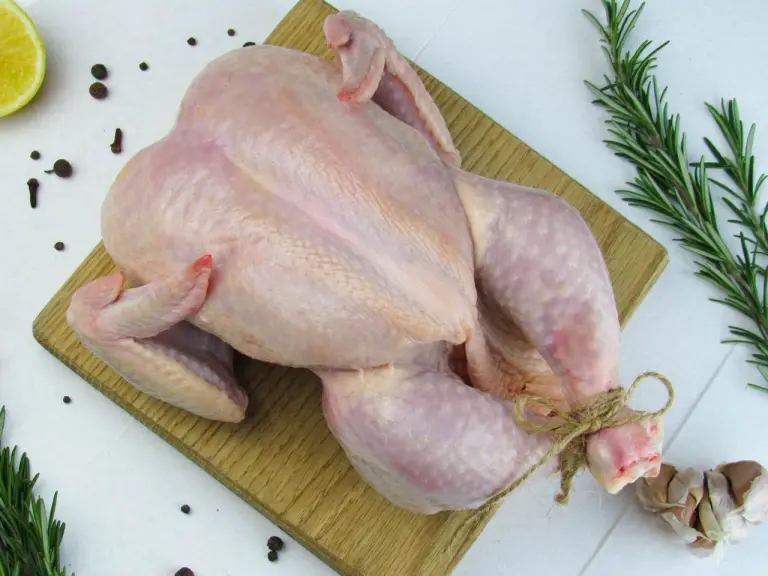
How long to boil chicken: time chart
For a young whole broiler-fryer weighing 3-4 lb (about 1.4-1.8 kg), allow 60-75 minutes at a gentle simmer. This is a planning range, not a promise that every bird is cooked at a particular minute. Bring the liquid up to a boil, reduce the heat and count the simmering time from that point.
| Chicken and weight | Planning time or check |
|---|---|
| Small whole broiler, under 3 lb (1.4 kg) | Can cook sooner than the next row; begin checking earlier rather than using a fixed time per pound |
| Whole broiler-fryer, 3-4 lb (1.4-1.8 kg) | About 60-75 minutes |
| Large whole roasting chicken, 5-7 lb (2.3-3.2 kg) | About 1 hour 45 minutes to 2 hours; not a timetable for an old stewing hen |
| Mature stewing hen | Allow roughly 1.5-3 hours for tenderness, sometimes longer; age and size matter |
| Older rooster | May need roughly 2.5-4 hours to soften; a young rooster is different |
| Half or quarter chicken | Depends on the size of the pieces; check several thick areas rather than halving the whole-bird time |
| Leg quarters | Large quarters can need longer than small leg portions; check the thick meat, away from bone |
| Bone-in thighs, 4-8 oz (115-225 g) More about thighs | About 40-50 minutes |
| Drumsticks, about 4 oz (115 g) | About 40-50 minutes |
| Wings or wingettes, 2-3 oz (55-85 g) | About 35-45 minutes |
| Bone-in breast half, 6-8 oz (170-225 g) How to boil breast | About 35-45 minutes |
| Boneless breast half, about 4 oz (115 g) How long to boil fillet | About 25-30 minutes in the reference simmering chart; thickness and method can change this |
| Backs, carcass and soup pieces for broth | Often simmered for 1-1.5 hours for flavour; edible meat still needs its own temperature check |
| Frozen chicken | The ranges above assume thawed meat; see the thawing section before choosing a method |
The common-cut ranges above follow a USDA reference simmering chart; the longer times for older birds are rough tenderness guides. Do not mix these with roasting, grilling or a poaching method that finishes with the heat off. Pan size, starting temperature, thickness and altitude affect cooking. Start checking early enough to avoid overcooking, but keep cooking if the thermometer shows a cold spot.
How many minutes per pound? There is no single reliable multiplier for a whole chicken, bone-in pieces and boneless breasts. Use the matching cut and weight as a starting point, then measure doneness. A broiler is a young meat chicken; it does not mean a bird must be broiled rather than simmered.
How to boil a whole chicken: step by step
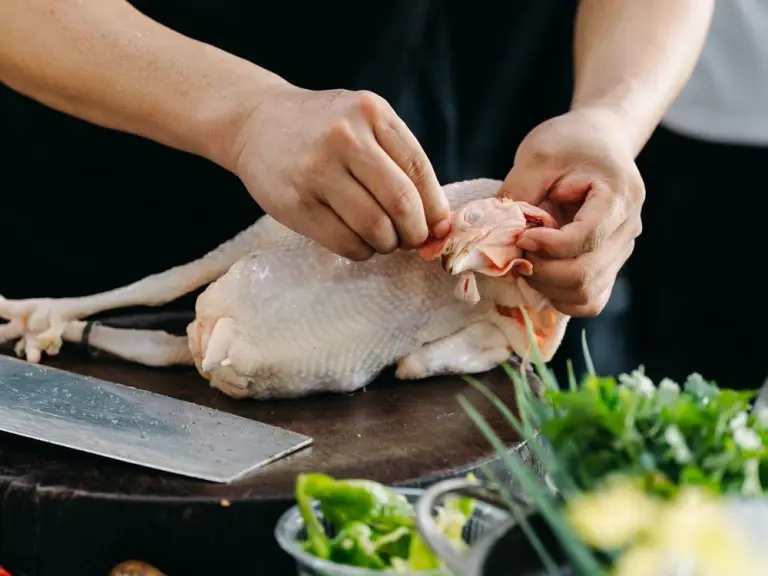
1. Prepare the bird
Thaw a frozen chicken in the fridge in advance, allowing about 24 hours per 4-5 lb (1.8-2.3 kg) and extra time if needed for the cavity to thaw fully. Do not rinse raw poultry under the tap. Splashes spread Campylobacter and Salmonella over the sink and worktop, so the UK Food Standards Agency (FSA) and the USDA advise against washing it: bacteria on the surface are killed by cooking.
- Pat the bird dry with kitchen paper, check it and pluck out any remaining feathers.
- Cut off the parson's nose (the tail with the preen gland) and large pieces of fat: the broth will be clearer and free of off-flavours.
- If the bird does not fit in the pot, cut it in half lengthways along the breastbone and backbone.
- Remove any bag of giblets before cooking. The neck can go into the broth; hearts and cleaned gizzards have their own texture and cooking needs. Liver has a stronger flavour and can be cooked separately. Check giblets with a thermometer too, rather than assuming a brief boil is enough.
- After handling raw chicken, wash your hands, board and knife in hot soapy water.
2. Choose the pot and water
- Choose a pot that holds the bird comfortably, with enough room for covering water and a gap below the rim. A 5-6 litre pot may suit a small bird, but the shape and fill level matter more than a fixed water volume.
- The water should cover the chicken by 2-3 cm (about 1 inch), otherwise the top cooks less evenly.
- For broth, start the chicken in cold water: the flavour gradually passes into the broth.
- For this whole-bird method, a cold-water start is convenient and avoids lowering a heavy bird into boiling liquid. Other poaching recipes use hot liquid; follow one complete method rather than switching between its times and this chart. A gentle simmer and stopping when cooked help preserve the meat's texture.
3. Bring to the boil and skim
Heat over medium heat and skim off the grey foam with a slotted spoon before the water boils: the protein rises in flakes and is easy to remove. If you miss this moment, the foam breaks into tiny particles and the broth turns cloudy.
4. Turn down the heat
- Once boiling, set the lowest heat at which the surface barely trembles.
- Leave the lid ajar by 1-2 cm.
- Do not stir: stirring lifts sediment from the bottom.
5. Add salt, vegetables and spices
- Salt lightly at the start if desired, then taste and adjust the finished broth after it reduces. There is no need to treat a fixed teaspoon-per-litre measure or late salting as a safety rule.
- For the flavour used here, add onion, carrot and parsley or celery root during the final 30-40 minutes. Add them earlier if following a different stock recipe. Charring the cut side of an onion is an optional way to deepen the colour.
- Add bay leaves and peppercorns during the last 10-15 minutes if you prefer a lighter spice flavour, then strain them out.
6. Check doneness and lift out the chicken
Use a food thermometer to check at least 165°F (74°C) in the thickest breast and the innermost thigh and wing, without touching bone. If any reading is lower, continue simmering and recheck. Clear juices and a loose leg are not safe substitutes for a thermometer. Lift the cooked bird out carefully; for soup, remove bones before returning the meat. For salad, follow the prompt cooling guidance below rather than leaving the whole pot to go cold.
How long to boil chicken for broth
Broth takes longer than the meat: flavour and gelatine from the bones pass into the water gradually. For a rich broth use 2-2.5 litres of water per 1 kg of chicken.
- Whole broiler: 1-1.5 hours.
- Farm hen: 2-3 hours.
- Rooster: 3-4 hours.
- Soup set, backs, carcass: 1-1.5 hours.
- Leg quarters and wings: 50-60 minutes.
For both broth and meat, remove the broiler once temperature checks show it is cooked, rather than automatically leaving it in for the longest stock time. When cool enough to handle safely, take off the meat and return the bones to the simmering pot for a further 30-40 minutes if you want more extraction. Keep serving and cooling times in mind.
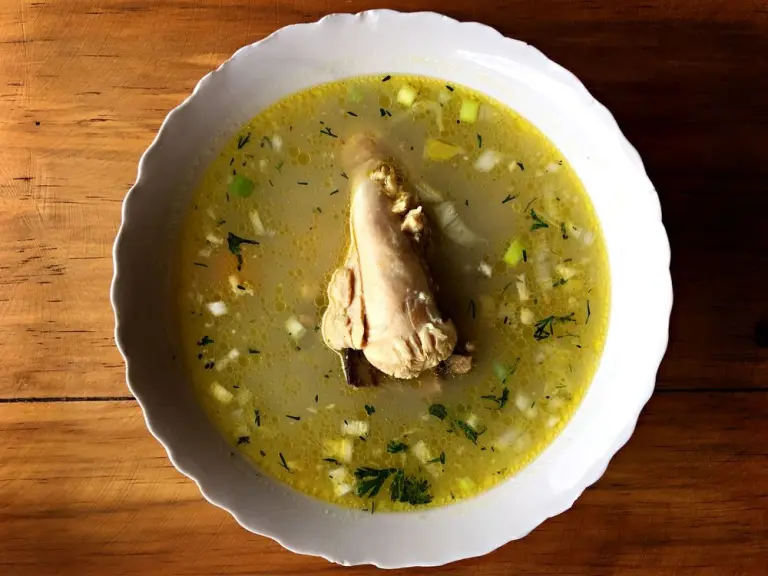
How to make clear broth
- Start the chicken in cold water and heat it gradually.
- Skim the foam before the boil, not after.
- Keep a gentle simmer and the lid ajar.
- Cut off the parson's nose and excess fat, add the vegetables whole.
- For a less fatty broth, remove skin and visible fat if desired. Skim the finished broth, or chill it promptly and lift off the set fat later. This is a flavour and fat-content choice, not a special safety treatment for children or a prescribed diet.
- Strain the finished broth through a sieve lined with 2-3 layers of muslin.
A cloudy broth can be rescued with an egg-white raft. For every 1.5-2 litres of broth, whisk 1 egg white with 2 tablespoons of cold water, pour it into the strained broth cooled to 50-60 °C (120-140 °F), stir once and bring slowly to the boil: the egg white sets into flakes and traps the cloudiness. After 5-10 minutes on low heat, strain the broth again.
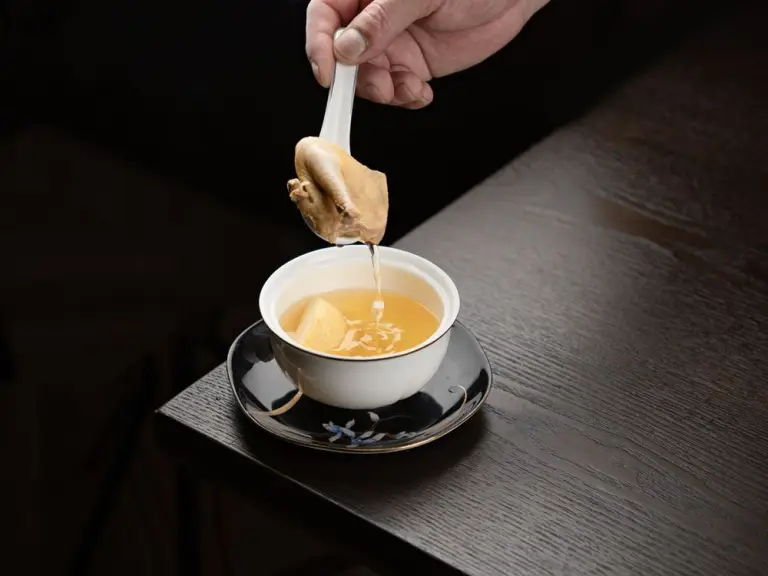
How long to boil chicken for soup
For soup, the chicken is cooked before the other ingredients go in: meat first, then vegetables and grains according to their own times.
- For a whole 3-4 lb broiler, plan on about 60-75 minutes; pieces vary by cut and size as shown in the table. Confirm they are cooked with a thermometer before serving.
- A mature stewing hen may need roughly 1.5-3 hours or longer to become tender. A young farm-raised chicken is not automatically an old hen.
- For 3 litres of soup, take 500-700 g of chicken on the bone: half a bird, 2 leg quarters or a soup set.
- Add potatoes 15-20 minutes before the end, grains and noodles according to the packet, herbs at the very end.
- Lift out the cooked chicken, remove bones and return the meat to the soup near the end. If using refrigerated cooked chicken, reheat it thoroughly to 165°F (74°C); five minutes is not a universal reheating time.
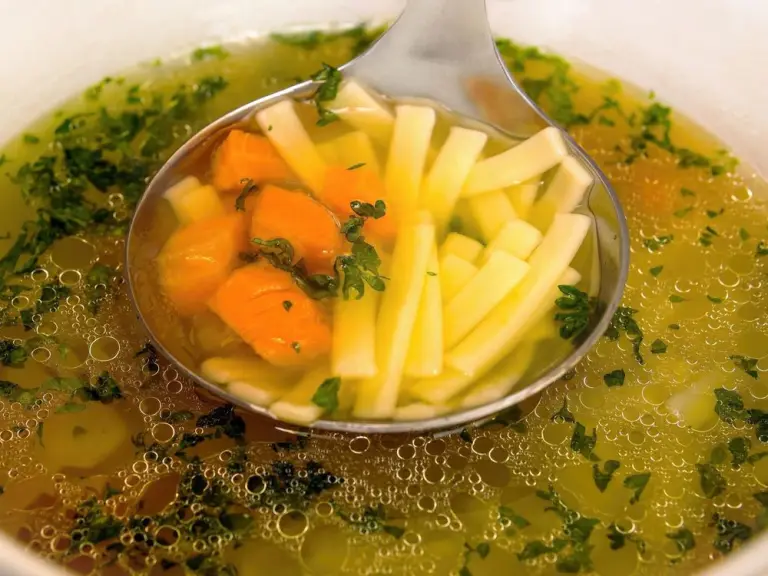
Chicken broth makes a good base for chicken soup with frozen vegetables, pea soup with chicken, pickle soup with barley and sorrel soup with egg.
How to boil chicken for salad so the meat stays juicy
- Use the whole-bird method above, or follow a separate recipe for breasts. Do not apply a whole-chicken timetable to a small boneless piece.
- Keep the liquid at a gentle simmer. A rolling boil is unnecessary and can damage the texture.
- For a 3-4 lb whole broiler, allow about 60-75 minutes as a starting point. For a breast half, use its cut and size in the chart and begin temperature checks in good time.
- Season to suit the salad. Late salting is optional, not a guarantee of juiciness.
- Once safely cooked, remove the meat from the hot pot and portion it in shallow containers for prompt cooling. Refrigerate within 2 hours, or within 1 hour in heat above 90°F (32°C).
- Shred when safe to handle or chill promptly before slicing. Keep cooked chicken separate from raw-poultry equipment and juices.
This meat suits salads such as "Chicken Under the Influence", Men's Tears, chicken with Chinese cabbage and corn and chicken with pineapple and walnuts.
Farm hen and rooster: why they take longer
"Farm chicken" describes where or how a bird was raised, not a fixed age. A young broiler can be farm-raised. A mature laying hen sold as a "stewing hen", "boiling fowl" or "soup chicken" has more developed connective tissue and can need much longer to soften.
- For a mature hen, plan roughly 1.5-3 hours at a gentle simmer and allow extra time if it is still firm.
- An older rooster can need roughly 2.5-4 hours. A younger bird may cook much sooner, so ask the seller what you have.
- These are tenderness ranges, not safe-temperature guarantees. Check a whole bird in the breast, inner thigh and inner wing.
- A leg that loosens easily can indicate tenderness, but does not confirm safety by itself.
- For aspic or a richer stock, follow the full recipe's longer extraction method. It is not necessary to cook a young broiler for several hours just because it is intended for soup.
Frozen chicken: boil straight away or thaw first
The table above is for thawed chicken. Thawing a whole bird first makes the timetable easier to use and lets you remove the giblet bag before cooking.
- In the fridge: allow about 24 hours for each 4-5 lb (1.8-2.3 kg), with extra time if necessary. Keep the bird in a container that catches drips and check that the cavity is thawed.
- In cold water: use a leakproof bag, keep the chicken submerged and change the water every 30 minutes. Cook immediately after thawing. The size and shape of the pack affect the time.
- Do not thaw on the counter. The outside can warm while the centre is still frozen.
- Cooking from frozen: USDA guidance allows oven or stovetop cooking, with roughly 50% more time, but that is not a guarantee for any particular bird. Check all required internal locations; do not leave a trapped giblet bag in place.
- Slow cooker: thaw poultry before putting it in. A slow-cook programme is not interchangeable with a pressure cooker; use the appliance's instructions for its selected mode.
How long to boil chicken in a multicooker or pressure cooker
In a non-pressure multicooker
A programme called "Soup" or "Stew" can operate differently between models. If the appliance maintains an ordinary simmer, use the relevant cut and weight in the stove chart as a planning reference, but follow the manual and check the meat's actual temperature. Do not rely on a fixed bowl size to decide whether a whole bird will fit safely.
- Use thawed chicken for a slow-cook setting.
- Stay within the fill limit for the selected programme, including liquid and ingredients.
- Never open a sealed pressure programme simply to skim foam. Non-pressure simmering and pressure cooking are different methods.
In a pressure cooker
Choose a tested recipe for your model, the bird's weight and whether the chicken is whole or cut up. Pressure level, liquid requirement and release instructions matter; a generic "25-30 minutes" does not describe every cooker.
- Use the manual's minimum liquid and the correct maximum fill level. Foaming stock needs particular care.
- Count heat-up and pressure release as well as the set cooking time when planning the meal.
- Release pressure only as instructed for that recipe and appliance. Never force open the lid or assume a fixed 10-15 minutes is always enough.
- After opening safely, check at least 165°F (74°C) in all the required locations. Continue cooking if any reading is too low, and allow more time for tenderness when using an older bird.
How to tell when chicken is done
- Use a food thermometer. A whole chicken needs at least 165°F (74°C) in the thickest breast and the innermost thigh and wing. Avoid touching bone with the probe.
- Check more than one spot. For cut pieces, measure the thickest part of several large pieces. A warm reading in one small piece does not prove every piece is done.
- Do not use clear juices as a safety test. Meat colour, texture and a leg that pulls away easily cannot reliably tell you whether harmful bacteria have been destroyed.
- Separate safety from texture. An older hen may be safely heated but still need more simmering to soften. A young breast can dry out if cooked for the same duration as an old stewing bird.
Pink colour near a bone can remain after cooking, and pale-looking chicken can still be undercooked. Without a thermometer, there is no equally reliable visual substitute. Keep cooking to the required temperature rather than choosing between contradictory colour cues.
Common mistakes
- Rinsing raw chicken under the tap. Splashes carry bacteria around the kitchen. If drying is needed, use disposable kitchen paper, discard it immediately and wash your hands.
- Boiling on high heat. The broth turns cloudy and the meat tough. Keep a gentle simmer.
- Ignoring the recipe's vegetable timing. Long simmering can make vegetables break down. Add them later for distinct pieces, or follow a stock recipe that deliberately cooks aromatics for longer.
- Using thawed-chicken times for a frozen bird. Heating takes longer. Follow the frozen-cooking guidance, remove packaging and giblets as appropriate, and verify every required temperature location.
- Leaving cooked meat in for the entire stock-making time. Remove it when temperature checks show it is done; continue simmering the bones separately if desired. Do not use a fixed removal time regardless of the bird's size.
- Leaving the pot to cool on the hob overnight. The broth stays in the danger zone for too long and bacteria multiply. Cool it within 2 hours and refrigerate.
How to store boiled chicken and broth
- Cool promptly. Portion meat and broth into shallow containers. Do not leave a large pot on the hob overnight or wait until it becomes completely cold.
- Refrigerate within 2 hours of cooking, or within 1 hour if the surrounding temperature is above 90°F (32°C). Keep the fridge at 40°F (4°C) or below.
- Use within 3-4 days under USDA guidance, or follow a stricter local recommendation. For a shorter household plan, eat within 2 days or freeze promptly. Storage in broth does not extend the limit.
- Reheat thoroughly. Bring broth to a rolling boil and heat cooked chicken to 165°F (74°C). Reheat only the amount you need rather than repeatedly warming the entire batch.
- Freeze in labelled portions. For soups and stews, 2-3 months is a quality guide; continuously frozen food at 0°F (-18°C) or below can remain safe longer if it was safe before freezing. Thaw in the fridge.
What to make with boiled chicken and broth
- Chicken soup with champignons on ready-made broth.
- Green borscht with sorrel on chicken broth.
- Julienne with chicken and mushrooms: boiled meat in a creamy sauce.
- Poured pie with chicken.
- Bride salad with chicken and processed cheese.
- Aspic from pork legs and chicken.
- More ideas in "What to Cook with Chicken".
More on individual cuts and giblets: how long to cook chicken thighs, how to boil chicken breast, how to boil chicken fillet and how to boil chicken hearts. For other poultry, see how long to boil turkey.
Video: clear chicken broth
A chef shows how to make clear chicken broth (video in Russian).
❓ Frequently asked questions
How long to boil chicken after the water boils?
For a whole young broiler weighing 3-4 lb (1.4-1.8 kg), allow about 60-75 minutes at a gentle simmer. Smaller cuts and older birds differ. Use the table as a planning guide and confirm the required temperature with a food thermometer.
How long to boil a farm hen?
A mature stewing hen may need roughly 1.5-3 hours or longer for tenderness. Farm-raised does not automatically mean old: a young farm broiler can cook much sooner. Check safety by temperature, not by a loose leg or the clock alone.
How long to boil chicken for broth?
Broiler stock is often simmered for 1-1.5 hours; older stewing birds may need longer. If you want juicy meat as well as stock, remove the safely cooked meat and continue with the bones separately. The best flavour-extraction time is not necessarily the best meat-cooking time.
How long to boil chicken for soup?
Start with the chicken, using its cut and weight as a guide, then add vegetables and noodles for their own cooking times. A whole 3-4 lb broiler commonly takes 60-75 minutes at a simmer. Check temperature before serving, including any reheated cooked meat.
Should I pour off the first water?
Not for safety. Skimming foam is usually enough for this broth. Changing the first water is a flavour or appearance choice, not a way to make poultry safe or a special requirement for children's food. Cook the meat properly and cool leftovers promptly.
When should I salt chicken while boiling?
Season lightly at the start if desired and adjust after the broth reduces. Late salting is optional, not a safety rule or a guarantee of juicy meat. Choose the amount to suit the dish rather than automatically adding a teaspoon for every litre.
Why did my broth turn cloudy?
A rolling boil, stirred-up sediment or dispersed foam can cloud broth. Skim gently and strain it for a clearer result. An egg-white clarification method is described above, but clarity is an appearance preference, not proof that broth is safe.
Can I boil chicken from frozen?
Stovetop cooking from frozen can take roughly 50% longer, but the actual time varies. A whole bird is easier to manage after fridge thawing, especially if it contains a giblet bag. Do not put frozen chicken straight into a slow cooker; follow the instructions for the exact appliance mode.
How long to boil chicken for aspic?
Aspic needs a recipe designed for connective tissue and setting, not just the shortest time to cook the meat. Bird age, bones and added pork parts change the process. Follow the method in aspic from pork legs and chicken and the guide to how long to boil kholodets, checking safety and cooling promptly. Do not assume every chicken broth will set without gelatine.
How long does boiled chicken keep in the fridge?
USDA guidance allows 3-4 days at 40°F (4°C) or below after prompt cooling. You can use a shorter 2-day household limit or freeze portions sooner. Keeping the meat in broth does not extend its storage life.