avg —
How to Boil Soft-Boiled Eggs – The Easiest Methods

Instructions
I take the eggs out of the fridge in advance, at least 30 minutes before cooking – they should be at room temperature, 18–22 °C. This is critically important: cold eggs crack from the thermal shock when lowered into hot water, and the white leaks out into the water. Warm eggs cook without any trouble and do not crack.
I prick the shell at the blunt, wide end with a pin or needle – that is exactly where the air pocket is. The pinprick releases the air as the egg heats and prevents the shell from bursting. Without pricking, 30–40% of eggs crack during cooking. Prick carefully, without touching the white – otherwise it will start to leak out through the hole.
I put the prepared eggs into a small saucepan and cover them with cold water so that it fully covers the eggs by 1–2 cm. Cold water gives a gradual, even heat-up – the eggs cook evenly. Hot water shocks them at once and cracks the shell.
I put the saucepan over medium heat and bring it to the boil over 5–7 minutes. Do not use high heat – a rapid boil also encourages the shell to crack. Any foam can be skimmed off with a slotted spoon if it appears (this is white that has seeped through micro-cracks).
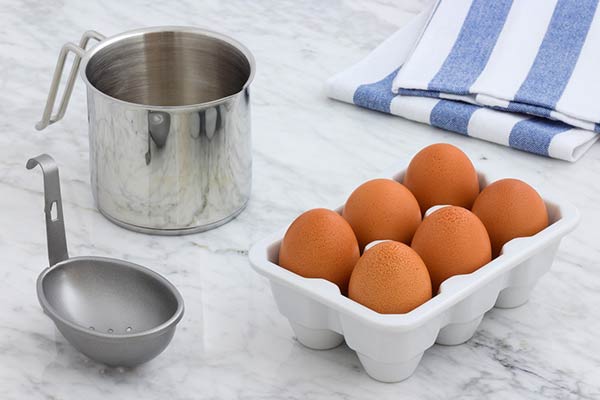
As soon as the time is up I transfer the eggs with a slotted spoon into a bowl of iced cold water for 30–60 seconds – the sharp change in temperature instantly stops the cooking and keeps the yolk from carrying on. Without this step the eggs will keep cooking from the residual heat, and the yolk will become firmer.
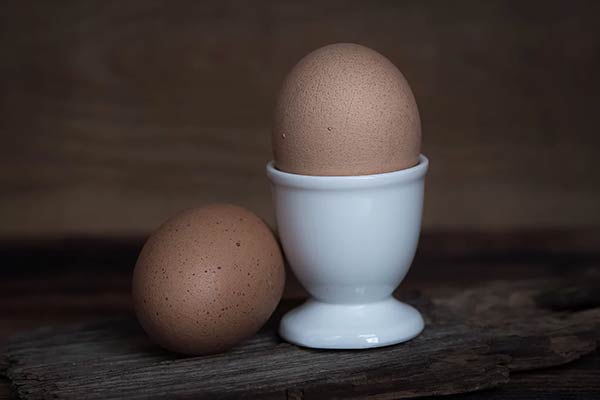
The soft-boiled eggs are ready! I serve them in a special egg cup with toast made from white or brown bread, a knob of butter and a pinch of coarse salt. Cut the top off the egg with a knife and eat it with a teaspoon, dipping thin strips of toast into the yolk – the classic English way to serve breakfast.


Tips
- 1
Eggs at room temperature will not crack during cooking – plan your breakfast in advance, or hold the eggs under warm water for 5 minutes.
- 2
Do not cook over high heat – a vigorous boil knocks the shell against the sides of the pan. Medium heat gives the most consistent result.
- 3
Fresh eggs are harder to peel after boiling – use eggs that are about a week old for easy peeling. I use a similar principle for stuffed eggs.
- 4
Serve with toasted bread, butter, caviar or soy sauce – soft-boiled eggs go beautifully with a range of flavours.
FAQ
Can you boil eggs straight from the fridge? +
Technically you can, but the risk of cracking is much higher – about 50% of cold eggs crack during cooking. If you are really in a hurry and time is short, add 1 minute to the standard cooking time – cold eggs take longer to heat through inside. Also be sure to prick the shell at the blunt end with a pin, as this lowers the risk of bursting. The best way: hold the eggs under warm water for 5 minutes – a quick “warm-up” brings them to roughly “room temperature”.
Why did my egg crack while boiling? +
The main causes: heat that is too high (a vigorous boil knocks the eggs against the bottom), the shell not pricked at the blunt end (the air tears the membrane as it heats), eggs put into hot water (thermal shock), or eggs that were cold from the fridge (also thermal shock). A thin or damaged shell can also be to blame – check the eggs against the light before cooking. If an egg cracks while boiling, add a tablespoon of salt or vinegar to the water – this “seals” the white and keeps it from leaking out.
How do you check eggs are fresh before boiling? +
A traditional method: lower a raw egg into a glass of cold water. A fresh egg lies flat on the bottom (3–5 days), a relatively fresh one stands at an angle (1–2 weeks), and a stale one floats to the surface (2–3 weeks or more – not fit to eat). This works because over time the air pocket inside the egg grows as moisture evaporates through the shell. A fresh egg also has a firm white and a rounded, domed yolk when cracked open. An old egg spreads out in a “puddle”.
What is best to serve with soft-boiled eggs? +
The classic English way: with toast made from white or brown bread cut into “soldiers” (long strips), a knob of butter and coarse sea salt. For a more modern serving: with avocado, lightly salted salmon, red or black caviar, or a slice of prosciutto. They also work well at breakfast with feta cheese, olives and spinach leaves – a Greek breakfast. Soft-boiled eggs are a versatile protein that goes with almost any side dish or starter.
- Comment
or post as a guest
Be the first to comment.