avg —
How Long to Boil Beef for Salad and Broth: Times by Cut

Instructions
Trim off membranes and large sinews. There is no need to rinse raw meat under the tap: splashes spread bacteria around the kitchen, so just pat it dry with kitchen paper. Lean boneless beef is best for salads: it cooks faster and slices neatly.
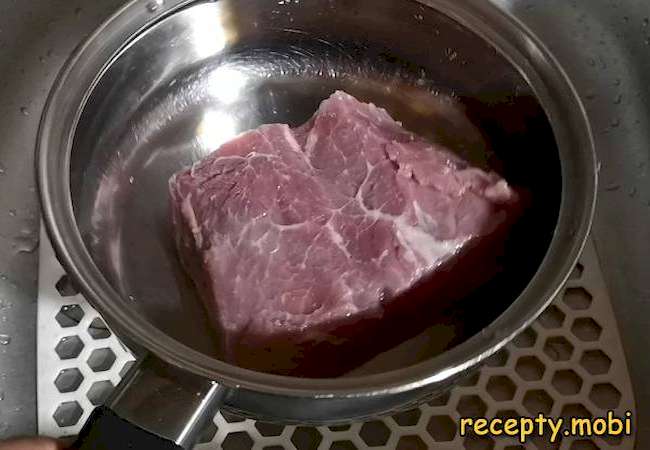
Put the meat in a pot and cover it with hot water by a few centimetres, about 1-1.5 litres per kilogram. This is how boiled meat is made in Russian catering: less flavour goes into the broth. Cover and bring to the boil.
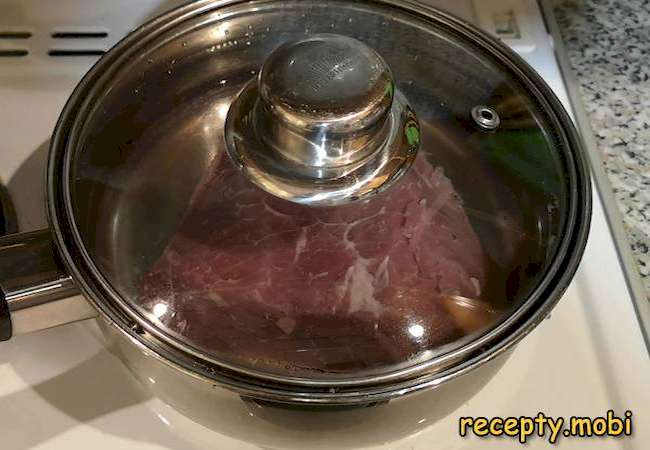
Once it boils, turn the heat down so the water barely trembles and skim off the foam: it is coagulated protein and makes the broth cloudy.
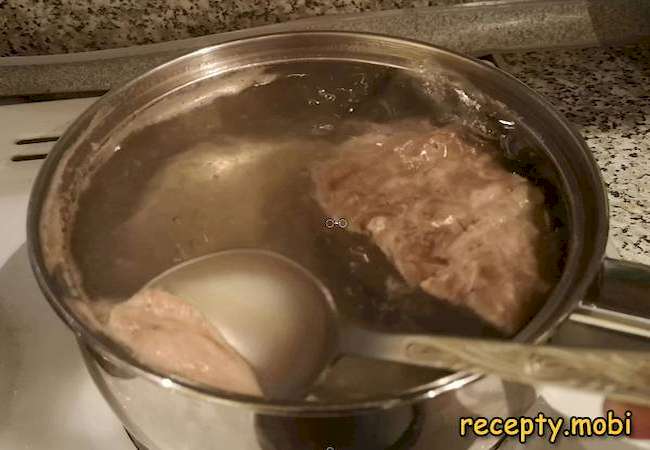
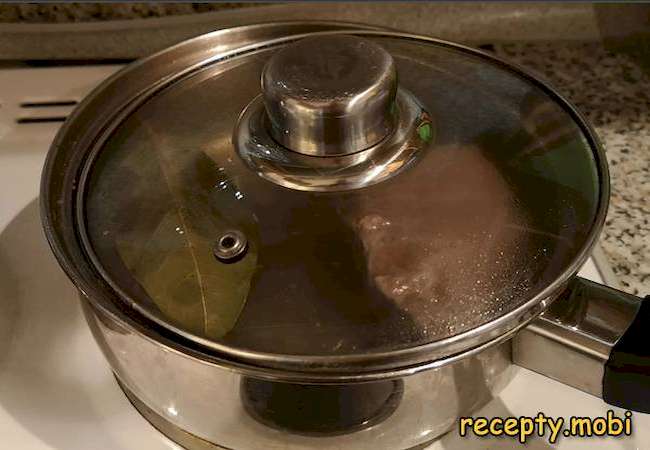
Add the allspice, black pepper and salt. You can salt now or 15-20 minutes before the end, as catering recipes do: there is no evidence that early salt makes beef tough. Cover.
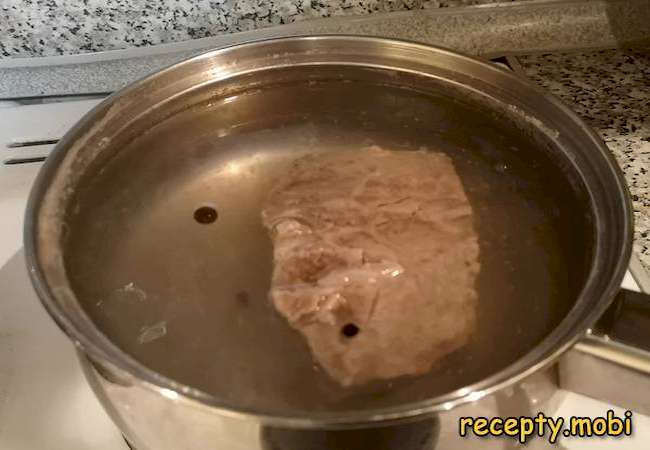
Simmer a 300 g piece for 1-1.5 hours. Add the bay leaf whenever you like: the longer it simmers, the stronger the aroma, and it does not turn bitter.
Test with a fork or knife: it should go in easily, the juices should run clear and the cut should be evenly grey. If the fork meets resistance, simmer for another 15 minutes and test again.
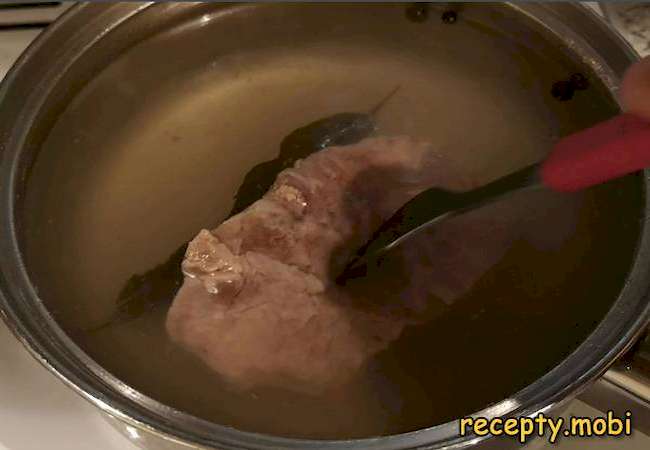
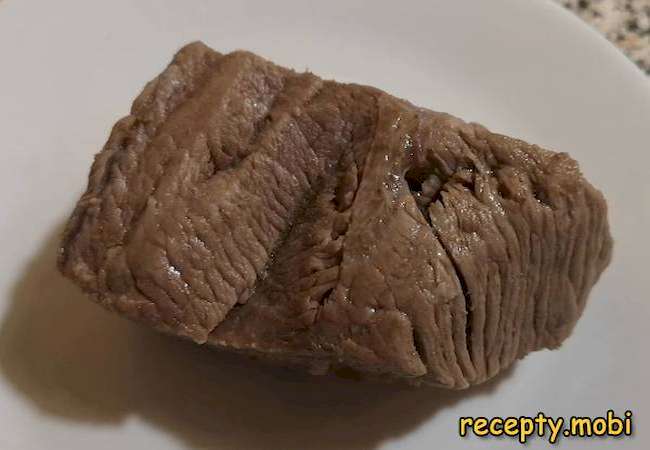
For a salad, leave the meat in the broth for 15-20 minutes so the surface does not dry out, then lift it out, cool it and slice across the grain. Refrigerate the meat and broth within 2 hours of cooking.


Tips
- 1
Cook the meat in one piece and slice it afterwards: pre-cut meat loses more juice and flavour to the broth.
- 2
Keep the heat as low as possible: a hard boil makes the meat shrink and turn stringy, and the broth goes cloudy.
- 3
Timing depends on the thickness and toughness of the cut, not just its weight. The chart below is a guide; a fork test is the most reliable check.
- 4
For salads, slice the meat across the grain so the pieces are more tender. Boiled beef works well in Men's Whim salad, Prince salad and Glutton salad.
Beef Boiling Times Chart
Time is counted from the boil, on low heat. The Soviet catering recipe collection gives no boiling time for meat at all: doneness is checked with a skewer. The figures below come from catering technical cards and tested recipes.
| What you boil | Time after the boil |
|---|---|
| Lean beef for salad 300-500 g piece | 1-1.5 h |
| Lean piece 1-1.5 kg, up to 8 cm thick | 2-2.5 h |
| Large piece about 2 kg | 2.5-3 h |
| Chunks 3-4 cm for soup and goulash | 1-1.5 h |
| Brisket whole piece | 2.5-3 h |
| Shank on the bone 4 cm pieces | 2.5-3 h |
| Bone broth bones in cold water | 3.5-4 h |
| Veal 0.5-1 kg piece | 1-1.5 h |
| Frozen beef not thawed | 1.5 times longer |
Beef is safe at 63 °C (145 °F) in the centre, but tough cuts only turn tender after long heating: the collagen in connective tissue shrinks at 55-63 °C and only turns into gelatine with prolonged cooking. That is why beef simmers for hours. Boiled beef loses about 38% of its weight: 500 g raw gives about 310 g cooked.
Beef for Salad: How to Keep It Tender
- Choose lean cuts without large sinews: shoulder (chuck), outside and side pieces of the round, or brisket. These are the cuts the catering collection recommends for boiling.
- Put the meat into hot water and keep it at a gentle simmer, never a hard boil.
- Test with a fork rather than the clock: meat from an older animal takes longer.
- Leave the meat in the broth for 15-20 minutes, then cool it and slice across the grain into cubes or strips.
- A 300-500 g piece is enough for meat salads; Olivier salad with meat can be made with beef too.
How Long to Boil Beef for Broth and Soup
- Cover the bones with cold water and simmer gently for 3.5-4 hours, skimming foam and fat. Longer cooking does not help: the catering collection notes it only worsens the taste and aroma.
- If you want meat in the broth too, add 1.5-2 kg pieces 2-3 hours before the end: the meat tastes better and the broth stays clearer.
- Add salt, root vegetables and charred onion and carrot 30-40 minutes before the end.
- For soup, take the meat out, cut it and return it to the pot when the other ingredients are nearly done.
- Beef feet and shank also go into kholodets, and tongue times are in how long to boil beef tongue.
Beef in a Pressure Cooker or Multicooker
- Electric pressure cooker, high pressure: a large lean piece or brisket takes about 20 minutes per 450 g (1 lb), about 45 minutes per kilogram. Shank in 4 cm pieces takes 25-30 minutes.
- 1.5 cm cubes are done in 15-25 minutes under pressure, depending on the model.
- Let the pressure release naturally for 10-15 minutes so the meat does not dry out and the broth does not spurt from the valve.
- Multicooker without pressure, "Soup" or "Stew" mode: about the same as on the stove, 1.5-2.5 hours depending on size. Check with a fork.
How to Store Boiled Beef
Cool the meat and broth and refrigerate them within 2 hours: large batches of warm meat and gravy held at 4-60 °C cause Clostridium perfringens outbreaks. Keep boiled beef in a closed container for 2-3 days: the US FDA allows 3-4 days, Food Standards Scotland advises eating leftovers within 2 days, and Russian catering rules allow boiled meat 24 hours. Keep broth for 1-2 days and bring it to the boil before eating. In the freezer, beef keeps for 2-3 months.
Video

FAQ
How long do you boil beef for salad? +
A 300-500 g lean piece takes 1-1.5 hours after the boil on low heat, a 1-1.5 kg piece 2-2.5 hours. Check with a fork: it should go in easily and the juices should run clear.
How long do you boil beef chunks? +
3-4 cm chunks take 1-1.5 hours. The cut matters: brisket and shank take longer than lean meat.
How long do you boil beef for broth? +
Bone broth takes 3.5-4 hours, starting from cold water. Meat for the broth goes in 2-3 hours before the end.
How long do you cook beef in a pressure cooker? +
About 20 minutes per 450 g (1 lb) at high pressure, about 45 minutes per kilogram. 1.5 cm cubes take 15-25 minutes. Then let the pressure release naturally.
How long do you boil veal? +
A 0.5-1 kg piece of veal takes 1-1.5 hours: young meat is more tender and cooks faster than beef.
Should beef go into cold or hot water? +
For boiled meat, the catering collection uses hot water; for broth, bones start in cold water. In cold water the foam gathers into large clumps that are easy to skim, so the broth is clearer.
When should you salt beef while boiling? +
Catering recipes add salt 15-20 minutes before the end, but earlier is fine too. There is no evidence that early salt makes beef tough.
Which cut of beef is best for salad? +
Lean meat without large sinews: shoulder, outside or side pieces of the round, or brisket. For a salad the meat needs to slice neatly into cubes or strips.
Why did the beef turn out tough? +
Most often it was undercooked: connective tissue needs time to soften. Other causes are a hard boil and slicing with the grain. Return the meat to the broth and simmer gently, checking with a fork every 15 minutes.
Why is the broth cloudy? +
Because of a hard boil and foam that was not skimmed in time. Keep the heat as low as possible, skim before and right after the boil and strain the finished broth through muslin. A cloudy broth can be cleared with whisked egg white: stir it into the hot broth, bring to the boil and strain.
How long does boiled beef keep? +
In a closed container in the fridge for 2-3 days, broth for 1-2 days. In the freezer for 2-3 months. Refrigerate the meat within 2 hours of cooking.
- Comment
or post as a guest
Be the first to comment.