avg —
How to properly cook couscous – the simplest methods

Instructions
I tip the dry couscous into a heat-resistant bowl or a deep dish with a tight-fitting lid. The dish should be roomy enough – the grain swells to 2–2.5 times its volume as it steeps. Glass or ceramic is preferable to plastic, as it holds the heat better during steeping.
I add salt to taste straight to the dry grain and stir thoroughly with a spoon so it is evenly distributed. The salt must be in the grain before the boiling water goes in – once it has steeped you cannot stir it, or you will disturb the process and the grain will be unevenly salted.
I bring the water to a rolling boil in a kettle or pan – you need genuinely fierce boiling water at 100 °C. If the water has not quite boiled, the couscous will swell poorly and stay slightly hard. The ratio of water to grain is 1.5:1, the standard for a fluffy texture.
I quickly pour the fiercely boiling water over the couscous without letting it cool – the success of the steeping depends on this. A thin trickle of water will not do – pour it evenly over the whole surface of the grain so that all of it makes contact with the boiling water at once and begins to swell at the same time.
I stir gently for 5–7 seconds with a spoon so the grain spreads evenly through the water, then cover tightly with the lid. A snug-fitting lid is critical – any gap will let the steam out and the couscous will not steep all the way through. You can use cling film or a towel over the lid for a better seal.
I leave it under the lid for 5–10 minutes, completely without stirring and without lifting the lid. In that time the couscous fully absorbs all the water and swells in volume. Lifting the lid lets the steam out and interrupts the steeping – you absolutely must not do this.
After 10 minutes I add the butter and gently loosen the grain with a fork, lifting from the bottom upwards in a “fluffing” motion. A fork, not a spoon, is essential: a spoon presses the couscous into a gluey lump, while a fork keeps it fluffy with the grains separate.
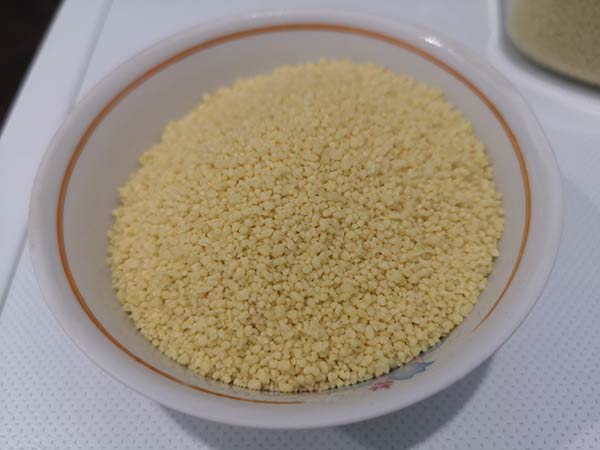
The fluffy couscous is ready! I serve it as a side dish with roasted meat, lamb, chicken, or baked fish. In the Middle East couscous is served with a stewed vegetable ragout and lamb – a classic of Moroccan cuisine. It is also excellent for cold tabbouleh salads.

Tips
- 1
Couscous is not boiled on the stove – it is only steeped with fiercely boiling water under a tight lid. Any boiling will ruin the grain.
- 2
A ratio of 1:1.5 (1 cup of grain to 1.5 cups of water) gives a perfectly fluffy side dish. More water means a gluey mass.
- 3
Use meat or vegetable broth instead of water for a richer aroma. I make bulgur as a side dish on a similar principle.
- 4
Choose couscous made from hard (durum) wheat varieties – it does not turn to mush and gives the proper texture of separate grains.
What to make with couscous
- Purée soup: add steeped couscous to a vegetable soup with processed cheese and fresh herbs;
- Tabbouleh salad: mix it with chopped parsley, tomatoes, cucumbers, olive oil, and lemon juice;
- Cottage cheese pancakes with couscous: replace part of the flour with steeped couscous for an interesting texture;
- Meat ragout: serve steeped couscous as a bed under stewed lamb with vegetables.
FAQ
What is couscous and what is it made from? +
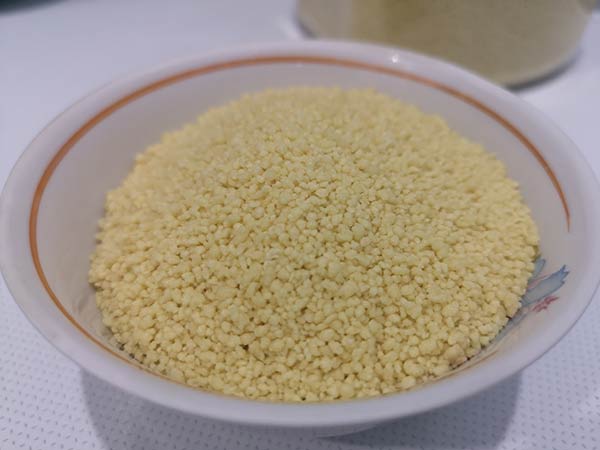
Couscous is a traditional Moroccan dish – granules of semolina rolled in wheat flour and steam-treated. In essence it is not a grain in the classic sense but a product made from wheat flour, similar to a very fine pasta. It comes in large (moghrabieh, the size of peas), medium (Israeli, like grains of rice), and small (the classic Moroccan) varieties. Mediterranean cuisine uses couscous as the base for many dishes.
Can couscous be boiled like an ordinary grain? +
It is not recommended – boiled on the stove it sticks together into a gluey mass and loses its signature fluffy texture of separate grains. The traditional Moroccan method uses the steam from cooking a tagine (a meat ragout): the couscous is placed in a special steaming basket over a pot of broth. At home it is enough to steep it in boiling water under a lid – the result is practically identical to genuine Moroccan couscous. The stovetop boiling method is absolutely unsuitable.
How long does cooked steeped couscous keep? +
In the refrigerator in a tightly sealed container – up to 3 days without loss of quality. On the second day it becomes less aromatic, but remains edible. Before serving, reheat it in a pan with a couple of spoonfuls of broth, or in the microwave for 1–2 minutes – to “revive” the grain. It can be used cold in salads. I do not advise freezing it – the texture deteriorates after thawing. Cook it in portions, exactly enough for one serving.
What is couscous best served with? +
The classic of Moroccan cuisine is with stewed lamb, a vegetable ragout with chickpeas and carrots, or spiced chicken. Mediterranean versions go with roasted vegetables (aubergine, courgette, pepper), chicken skewers, or prawns in garlic butter. For a tabbouleh salad – with parsley, mint, tomatoes, and olive oil. An excellent serving is with lamb in pomegranate sauce and yoghurt with coriander. It is a versatile side dish for almost any Middle Eastern or Mediterranean meal.
- Comment
or post as a guest
Be the first to comment.