What to Use Instead of Gelatine: Agar-Agar, Pectin and Other Options That Work
The easiest way to replace gelatine is with agar-agar: it is a plant-based thickener made from seaweed, and it is the strongest of the lot. You need 2-3 times less agar than gelatine, roughly 1 g of agar in place of 3-4 g of gelatine. Jelly set with agar firms up even at room temperature, you just have to bring the mixture to the boil and simmer it for 1-2 minutes. For fruit jellies and jams pectin works better, for puddings and kissels use cornflour, and for aspic a rich stock made from trotters, ears and cartilage is often enough, as it sets on its own. Below are the exact ratios and the right use for each substitute.
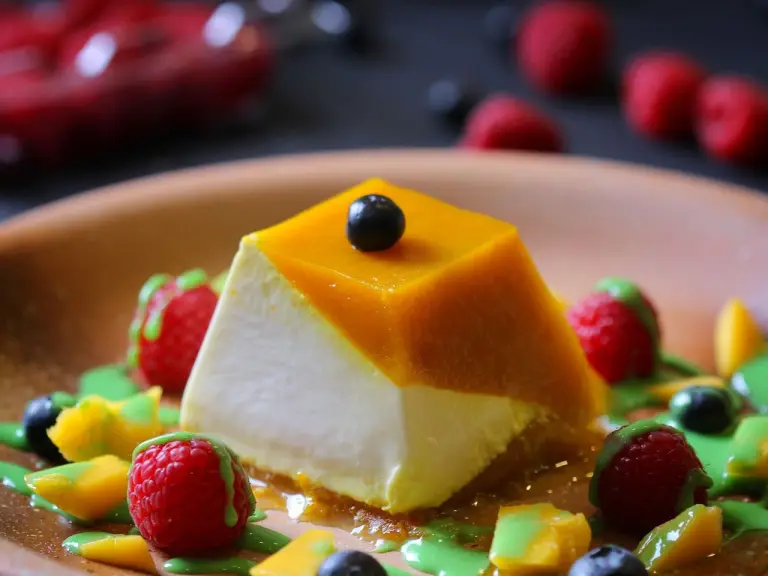
Gelatine Substitutes: Ratios and Uses
| Substitute | Amount vs gelatine | What it is for |
|---|---|---|
| Agar-agar | 3-4 times less by weight (1 g agar in place of 3-4 g gelatine) | Jelly, cakes, marshmallows, jelly sweets, vegetarian desserts |
| Pectin | As per the packet, usually 5-10 g per 1 kg of fruit | Fruit jellies, jams, confitures, fillings |
| Starch (cornflour, potato starch) | 2-3 tsp per 250 ml of liquid | Puddings, kissels, creams, sauces (no bounce) |
| Jam sugar, setting mix | 1 sachet per 1 kg of fruit (as per the packet) | Preserves, jam, quick confiture |
| Chia seeds, flax | 1-2 tbsp per 200 ml of liquid | Vegan puddings, smoothies, breakfasts |
| Carrageenan, gums | 0.5-1 g per 250 ml of liquid | Dairy and plant-based desserts, homemade jelly |
| Gelling stock | No additives, thanks to trotters, ears and cartilage | Aspic, brawn, jellied fish and meat |
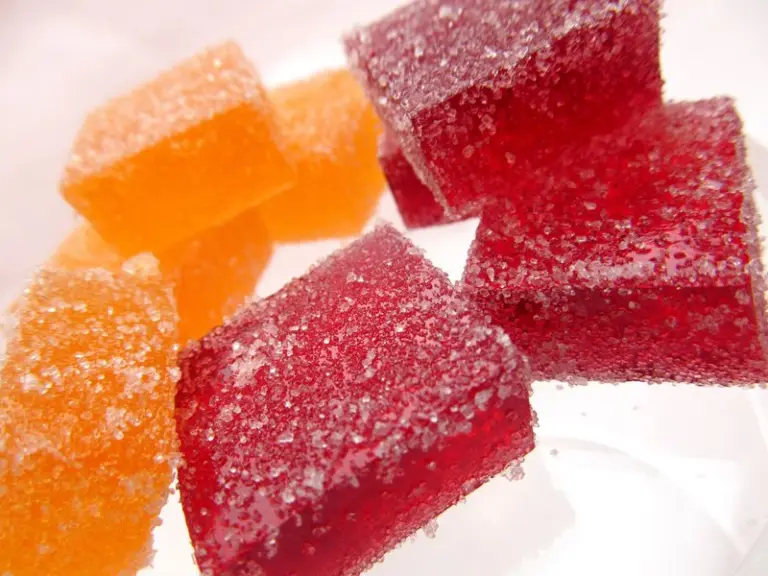
What to Use Instead of Gelatine: 7 Options That Work, With Ratios
1. Agar-agar
A concentrated gelling agent made from seaweed that sets even at room temperature. It is denser than gelatine, so you use noticeably less of it by weight.
- Ratio: 1 g agar per 100 ml liquid for a firm jelly, roughly 3-4 times less than gelatine by weight
- Good to know: the mixture must be brought to the boil and simmered for 1-2 minutes, otherwise the agar will not set
- Best for: marshmallows, fruit jelly sweets and bird's milk soufflé, suitable for vegans and fasting
Recipe: Agar-agar fruit jelly recipe.
2. Pectin
A plant-based thickener made from apples and citrus that only works alongside sugar and acid. Without them the mixture sets poorly.
- Ratio: 5-10 g pectin per 1 kg fruit, check the exact dose for your type of pectin on the packet
- Good to know: sugar and acid, such as lemon juice, are essential, otherwise the gelling will not happen
- Best for: jams, conserves, fruit jellies and fillings
3. Cornflour and potato starch
The most affordable option, but it does not give a springy jelly, only thickens the liquid to a kissel. It suits anything that needs a soft, gooey texture.
- Ratio: 2-3 teaspoons starch per 250 ml liquid
- Good to know: first mix with cold water, then pour into the hot base and heat until thickened
- Best for: kissels, custards, sauces and pie fillings
4. Gelfix and Konfiturka
Ready-made pectin-based mixes for quick jam. The dose is already worked out by the maker, so it is hard to go wrong.
- Ratio: 1 sachet per 1 kg fruit, but check the instructions on your particular packet
- Good to know: add it in with the sugar following the method on the packet and boil for a couple of minutes
- Best for: quick jam, conserve and confiture in a single batch
5. Chia and flax seeds
When soaked they release a thick gel and thicken the mixture without any cooking. The texture comes out gloopy, with tiny seeds running through it.
- Ratio: 1-2 tablespoons chia per 200 ml liquid
- Good to know: leave to swell for 20-30 minutes, or better still overnight in the fridge
- Best for: vegan puddings, smoothie bowls and hearty breakfasts
6. Carrageenan and gums
Gelling additives from seaweed and plants that work in very small doses. Carrageenan is especially good with milk and cream.
- Ratio: 0.5-1 g per 250 ml liquid
- Good to know: carrageenan gives a delicate milk-based jelly, while gums (xanthan, guar) tend to thicken rather than set
- Best for: milk jellies, panna cotta, ice cream and stabilising creams
Recipe: Panna cotta recipe.
7. A setting stock for aspic
This is not an additive but a method in itself: long simmering of collagen-rich cuts gives a natural set, so gelatine is not needed at all. Instead of a ratio, go by your selection of meat cuts and the cooking time.
- Guide selection: pork and beef trotters, ears, tails, cartilage and shin
- Good to know: simmer it long and gently, 4-6 hours, without a rolling boil
- Best for: holodets, aspic and brawn, which set thanks to collagen
Recipe: Slow cooker holodets recipe.
Tips and tricks
- Always bring agar to the boil and cook it for 1-2 minutes, only then will it set properly.
- Mix agar and starch into cold liquid to avoid lumps, and only then add them to the hot base.
- Remember the difference: agar and pectin give a springy jelly, while starch, chia and flax only thicken.
- For acidic juices and berries increase the agar dose a little, as acid weakens the set.
- If your agar jelly sets badly, melt it down over heat and pour it back into the mould.
- Test the set on a small spoon in the freezer: in 1-2 minutes it will be clear whether the mixture will hold.
Common mistakes
- Using as much agar as gelatine. This makes the jelly too hard and rubbery.
- Not boiling the agar, just adding hot water. Without boiling, the mixture will not set.
- Trying to make a springy jelly with starch. Starch only thickens and gives a kissel, not a jelly.
- Adding pectin without sugar and acid, then being surprised the jam will not thicken.
- Pouring agar over fresh pineapple, kiwi or papaya without heating them. Their enzymes stop the set, so the fruit needs to be cooked first.
How to Convert Gelatine to Agar and Pectin
The easiest thing to remember is the main rule of thumb: you need 3-4 times less agar than gelatine by weight. If a recipe calls for 12 g of gelatine, use roughly 3-4 g of agar. For a firm jelly aim for 1 g of agar per 100 ml of liquid, for a delicate jelly 0.5-0.8 g is enough. Pectin is usually added as per the packet, most often 5-10 g per 1 kg of fruit along with the sugar. Always do a test: drop a little of the mixture onto a cold plate and see how it sets, then add more thickener if needed.
Fasting and Vegan Gelatine Substitutes
Gelatine is of animal origin, so during fasting and on a vegan menu it is replaced with plant-based alternatives. The most reliable options are agar-agar and pectin: they are fully plant-based and give a proper jelly. For soft puddings and breakfasts chia seeds and ground flax work well, thickening the liquid without any cooking. Carrageenan and gums are plant-based too and work well in dairy and plant-based desserts. With these swaps you can make fasting-friendly jelly, jelly sweets, marshmallows and fruit fillings without any animal products.
What to use instead of gelatine in specific dishes: a dish-by-dish cheat sheet
There is no one-size-fits-all substitute: each dish calls for its own gelling agent and its own ratio. Below is a quick guide to what to reach for and what to expect from the texture.
Fruit jelly: agar, 4-8 g per 1 litre of liquid (about 1 g per 100 ml for a firm jelly you can slice). The catch: it holds its shape even in the warmth, but comes out firmer and more matte, less wobbly than a gelatine set.
Meat aspic and jellied dishes: a naturally setting stock from trotters, ears and hocks, with no additives. If the stock is weak, add agar at 3-4 g per 1 litre. The catch: with agar the cut is firmer and slightly cloudier, but it will set even in the heat.
No-bake cheesecake: agar at 1 g per 100 ml of the liquid part. The catch: the cut comes out firm and sliceable rather than creamy and soft; for a softer set use the minimum of agar, or carrageenan.
Mousse cake: carrageenan or a small dose of agar (0.5-1 g per 250 ml), with NH pectin to stabilise the fillings. The catch: too much agar tears the airy foam and makes the mousse rubbery, and ordinary jam pectin is no good for mousses.
Panna cotta: agar at about 4 g per 1 litre of cream, brought to the boil. The catch: agar makes panna cotta firmer and less wobbly; for a creamy texture use the minimum of agar or add a little carrageenan.
Zefir, pastila, bird's milk sweets and soufflé: agar only, 7-10 g per standard batch (about 450-500 g of purée), with the syrup boiled down to 107-110°C. The catch: agar sets quickly and holds the whipped foam, while gelatine and pectin do not give that kind of stability; pastila can also be made with apple purée.
Firm fruit jelly sweets and pâte de fruits: yellow pectin or agar. The catch: agar gives a firm, self-standing sweet, while yellow pectin gives the more elastic set typical of a classic pâte.
Jam and confiture: pectin with sugar and acid (5-15 g per 1 kg depending on the sugar) or chia seeds for a sugar-free version. The catch: without sugar and acid, pectin simply will not work.
Yoghurt, curd cheese and soured cream creams: agar at 1 g per 100 ml, or carrageenan. The catch: agar sets at as low as 40°C, so the boiled agar is stirred into a warm base and mixed in quickly, otherwise you get lumps.
Types of pectin and why jam does not thicken
Unlike agar and gelatine, pectin does not set on its own: it needs both sugar and acid at the same time. That is exactly why jam made from low-acid fruit, or a preserve with little sugar, often stays runny no matter how long you cook it. If the fruit is low in acid, you add lemon juice or citric acid.
The types of pectin differ by purpose. Apple and citrus pectin are all-rounders for jams and preserves. Yellow pectin is not troubled by long cooking and does not melt again once set, so it is used for firm fruit jelly sweets and pâte de fruits. NH pectin is thermoreversible, dissolving and setting again and again, which is why it goes into mirror glaze and mousse cake fillings. Certain brands (FX and the like) are designed for dairy desserts.
The dose depends on how much sugar there is: the more sugar, the less pectin you need. As a guide: about 5 g per 1 kg of mixture with 500 g of sugar, and up to 12-15 g per 1 kg if there is little sugar. To stop the pectin clumping, mix it in advance with some of the sugar (roughly 1 part pectin to 2-5 parts sugar) and sprinkle it in a stream into the almost boiling mixture while stirring, then cook for 1-2 minutes.
Agar for zefir, pastila and bird's milk sweets
In airy desserts such as zefir, pastila, bird's milk sweets and soufflé, gelatine is replaced specifically with agar, and that is no accident. Agar sets quickly, at as low as 35-40°C, so it instantly fixes the whipped foam and it does not collapse. Gelatine sets more slowly and does not give such a stable structure, while pectin without sugar and acid will not work at all.
The proportions are approximate: 7-10 g of agar per standard batch (about 450-500 g of fruit purée plus egg white). The agar is first soaked, then dissolved in syrup and boiled down to 107-110°C so that the finished mass holds its shape well. Classic pastila can also be made with apple purée that is high in its own pectin, in which case no shop-bought gelling agent is needed at all.
An important point on technique: agar is added to hot syrup, and you start whipping the mass while it is still warm, otherwise it will set too soon right there in the bowl. The step-by-step proportions are easy to follow in a separate recipe for agar-based zefir.
Natural setting without shop-bought gelling agents
You can set a dessert or a jellied dish with no agar, pectin or gelatine at all, provided you use ingredients that are naturally high in their own pectin or collagen.
For sweet dishes, a reduced purée of apples, quinces, gooseberries or redcurrants works well: these fruits are rich in natural pectin, so jam, firm fruit jelly sweets and pastila made from them thicken on their own. Citrus peel with its white pith is also rich in pectin, and its decoction is sometimes added to preserves for body.
For meat aspic, brawn and jellied dishes, the collagen comes from the right cuts: pork and beef trotters, ears, hocks, tails and skin. With long cooking (5-6 hours over a low heat) the collagen passes into the stock, and it sets without a single gram of gelatine. If the cuts were lean and the stock came out weak, you strengthen it with a little gelatine or agar.
How the substitute affects taste and texture
The substitutes give noticeably different results, and it is worth taking that into account in advance, before you start cooking.
Agar: no taste or smell, but the gel is firm, springy and slightly brittle, self-standing rather than wobbly, and it clouds clear jellies a little.
Gelatine: neutral in taste, giving an elastic, soft, wobbly texture and a clear shine, but it melts in the warmth.
Starch: makes the mass opaque and coating, and with too much you get a starchy aftertaste; it is good for kissels, creams and fillings, but not for a clean sliceable jelly.
Pectin: gives a soft, fruity texture, but requires sugar and acid.
Chia and flax seeds: form a gel-like mass with visible seeds, neutral in taste, suited to puddings, smoothies and sugar-free jams.
Carrageenan: works more gently than agar and is especially good in dairy desserts.
Carrageenan, xanthan and gums: how they differ
These thickeners are often lumped together, even though they behave differently and should not be confused.
Carrageenan is made from red seaweed. It sets dairy desserts particularly well because it works in the presence of calcium and potassium, so it is used for panna cotta, blancmange and milk jelly.
Xanthan gum (xanthan) is first and foremost a stabiliser and thickener: it does not give a firm sliceable gel, but it binds moisture, stabilises foam and prevents separation, working in very small doses, fractions of a gram.
Guar gum and locust bean gum thicken a product, including when cold, and work well in combination with carrageenan and xanthan, reinforcing one another. They are handy in sauces, ice cream and drinks rather than for moulded jelly.
Cooking video
More substitution guides: sour cream and kefir. More in culinary tips →
See also
❓ Frequently asked questions
What can I use instead of gelatine in jelly?
Agar-agar is best: use 3-4 times less than gelatine, bring the liquid to the boil and simmer for 1-2 minutes. The jelly will set even at room temperature. Pectin also works for fruit jelly.
What can I use instead of gelatine in a cake or cheesecake?
For mousses, soufflés and layers use agar-agar, as it holds its shape in the warmth. Use around 1 g of agar per 100 ml of liquid for a firm layer and 0.5-0.8 g for a delicate one. Pectin is handy for fruit fillings.
What can I use instead of gelatine in aspic?
Often nothing at all: cook a rich stock from trotters, ears, cartilage and shin, and it will set on its own thanks to the collagen. Cook it for 4-6 hours over a low heat. If you want to speed things up, add a little agar.
Which vegetarian and vegan gelatine substitute should I choose?
The plant-based options are agar-agar and pectin for a proper jelly, plus chia and flax seeds for puddings. Carrageenan suits dairy and plant-based desserts. None of them contain any animal products.
Agar instead of gelatine: what are the ratios?
You use 2-3 times less agar by weight, 1 g of agar replaces roughly 3-4 g of gelatine. For a firm jelly that is around 1 g of agar per 100 ml of liquid. Always boil the mixture for 1-2 minutes.
What can I use instead of gelatine in jelly sweets?
The classic choice is agar-agar for springy jelly sweets or pectin for fruit ones. Agar gives a firm, slightly brittle texture, while pectin gives a softer, more chewy one. Both options are plant-based.
Can I replace gelatine with starch?
Only where you do not need bounce: in puddings, kissels, creams and sauces. Starch thickens, but it will not make a jelly hold its shape. Use 2-3 teaspoons per 250 ml of liquid.
What can I use instead of gelatine if I have no agar?
For fruit dishes use pectin, jam sugar or a setting mix. For puddings starch or chia seeds will do. For aspic a rich stock from gelling cuts is enough.
Does agar jelly set at room temperature?
Yes, and that is its big advantage: agar sets as it cools to room temperature and does not melt in the warmth. Gelatine jelly, by contrast, needs the fridge. That is why agar is handy for cakes and the hot season.
How do I swap leaf gelatine for powdered and vice versa?
Leaf and powdered gelatine are interchangeable by weight, one to one. Leaf gelatine is first soaked in cold water and squeezed out, while powdered is covered with water and left to swell. Convert to agar and pectin separately, using their own ratios.
What can I use instead of gelatine in panna cotta?
Agar-agar is the best choice: about 4 g per 1 litre of cream, with the mixture brought to the boil and poured into moulds. Bear in mind that agar makes panna cotta firmer and less wobbly than the classic gelatine version. For a creamier texture use the minimum of agar or add a little carrageenan, which is especially good for dairy desserts.
Which is better, agar-agar or pectin, and what is the difference between them?
They are different tools for different jobs. Agar sets on its own as it cools, needs no sugar, and suits jellies, zefir, soufflé and jellied dishes. Pectin works only together with sugar and acid, and is meant for jams, preserves, firm fruit jelly sweets and fruit fillings. For a clear, firm jelly choose agar, and for a thick preserve reach for pectin.
What can I use instead of gelatine in a mousse or a mousse cake?
In mousses, gelatine is replaced with carrageenan or a very small dose of agar, about 0.5-1 g per 250 ml, while NH pectin is used to stabilise the fillings. Ordinary jam pectin is no good for airy mousses. It is important not to overdo the agar: too much makes the mousse rubbery and tears the delicate foam.
What can I use instead of gelatine in zefir and bird's milk sweets?
Only agar-agar, about 7-10 g per standard batch (around 450-500 g of purée plus egg white). Agar sets quickly and holds the whipped foam reliably, whereas gelatine or pectin will not give such a stable structure. The syrup with agar is boiled down to 107-110°C, otherwise the dessert will hold its shape poorly.
How does agar differ from gelatine in taste and texture?
In taste both are practically neutral, but the texture is noticeably different. Gelatine gives a soft, elastic, wobbly jelly that melts in the warmth. Agar sets firmer: the gel comes out springy, slightly brittle and self-standing, but it holds its shape at room temperature and in the heat. Clear jellies made with agar are usually a touch cloudier than those made with gelatine.
Is gelatine a vegan, or at least a vegetarian, product?
No. Gelatine is made from animal collagen, that is, from the bones, skin and cartilage of pigs and cattle, so it is unsuitable for both vegans and vegetarians. For the same reason, ordinary gelatine without special certification is not considered halal or kosher. The plant-based alternative is agar-agar from seaweed, along with pectin and starch.
Why did my agar jelly fail to set, or turn out rubbery?
Most often the agar simply was not boiled: it dissolves and starts to work only at 95-100°C, so the mixture must be brought to the boil and cooked for anywhere from 30 seconds to 2 minutes. If the jelly came out too firm and rubbery, you used too much agar, so reduce the dose next time. Lumps and uneven setting most often happen when dry agar is tipped into liquid without first being mixed with sugar.
Why does jelly with kiwi, pineapple or papaya fail to set?
Fresh kiwi, pineapple and papaya contain enzymes (actinidin, bromelain, papain) that break down the gelatine protein, so a gelatine jelly with these fruits will not set. Just cook the fruit for 2-3 minutes and the enzymes are destroyed, after which the gelatine works normally. These enzymes have no effect on agar and pectin, since those are not proteins, so with them you can add fresh pineapple or kiwi without cooking it first.
Can you freeze jelly or agar-based desserts?
It is best not to freeze agar jelly: after thawing the gel separates, weeps water and turns grainy. Agar does, however, hold its shape beautifully at room temperature and even in the heat, which makes it handy for cakes, deliveries and summer desserts that would simply melt in the warmth with gelatine. Finished agar jelly keeps in the fridge for 2-3 days, while dry agar in a sealed pack is good for a year or longer.
Is agar-agar harmful, does it have a laxative effect or any contraindications?
In culinary amounts, a few grams per portion, agar is safe and even beneficial: it is a soluble fibre from seaweed that gently aids digestion. In large doses it does indeed have a mild laxative effect and can cause bloating, so it is taken with plenty of water. Agar has no serious contraindications; it is worth using with caution only if you are prone to diarrhoea.