What to use instead of vinegar: 12 swaps and ratios
The easiest swap for vinegar is lemon juice: use 2 tbsp of juice in place of 1 tbsp of 9% vinegar. For winter preserves, reach for citric acid (1/4 tsp dissolved in 1 tbsp of water replaces a tablespoon of vinegar); for salads and marinades, apple or wine vinegar works in a 1:1 ratio, along with lime juice, pomegranate juice and brine, while in baking the acid is covered by kefir or whey. The key is to recalculate the strength of your substitute and to avoid unstable options for preserving.

What to use instead of vinegar: ratios and best uses
| Substitute | Ratio (for 1 tbsp of 9% vinegar) | Best for | Note |
|---|---|---|---|
| Lemon juice | 2 tbsp | salads, dough, activating baking soda | weaker than vinegar, fresh tang |
| Citric acid | 1/4 tsp + 1 tbsp water | preserving, winter preserves | dissolve in water only |
| Apple cider vinegar | 1 tbsp (1:1) | salads, meat and chicken marinades | fruity aroma, slightly clouds brine |
| Wine vinegar (6%) | 1.5 tbsp | salads, sauces, fish, onion | milder than table vinegar |
| Balsamic | 2 tsp | dressings, grilled vegetables | dark and sweet, adds colour |
| Lime juice | 2 tbsp | Asian dishes, seafood | brighter aroma than lemon |
| Dry white wine | 3 tbsp | hot sauces, braising | needs to reduce for 2-3 minutes |
| Cucumber or cabbage brine | 2-3 tbsp | borscht, solyanka, vinaigrette | adds salt, so reduce it in the dish |
| Pomegranate juice or narsharab | 2 tbsp juice / 1 tbsp narsharab | kebabs, dolma, meat sauces | sweet-sour, adds colour |
| Kefir or whey | 50-70 ml (activates baking soda) | fritters, pancakes, baking | replaces both the acid and part of the liquid |
12 ideas for what to use instead of vinegar in different dishes
1. Lemon juice: the most versatile swap
This is the first thing to reach for instead of vinegar in salads, dough and most sauces. Fresh juice gives a clean citrus tang without the sharp smell of vinegar. The one thing to keep in mind: lemon juice is roughly 1.5-2 times weaker than table vinegar, so you need more of it.
- Ratio: 1 tbsp of 9% vinegar equals 2 tbsp of fresh lemon juice (juice has about 5-6% acid against 9%)
- For a salad dressing: 1 tsp of juice per 3 tbsp of vegetable oil
- To activate baking soda in dough: 1/2 tsp of juice per 1/2 tsp of baking soda
- Not suitable for long-term preserving: the acidity is unstable and jars can ferment
- Always strain out pips and pulp
Recipe: Greek tzatziki sauce.
2. Citric acid: for jars and preserves
This is the most reliable vinegar swap for preserving specifically, when safety and a clear brine matter. The powder has no smell, does not cloud the marinade and is easy to measure out. The crystals must always be dissolved in water rather than tipped into the jar dry.
- 1 tsp of crystals weighs roughly 5-6 g
- Instead of 100 ml of 9% vinegar: dissolve 1 tsp of citric acid in 100 ml of water
- For a marinade: 1 scant tsp (about 4 g) per 1 litre of water gives a mild acidity
- Ideal where you need a clear brine: pattypan squash, gherkins, mushrooms
- Do not tip dry crystals straight into the jar: they will not dissolve evenly
Recipe: Mushroom marinade per litre of water for winter.
3. Apple cider vinegar: a mild 1:1 swap for table vinegar
If you have no ordinary table vinegar to hand, apple cider vinegar replaces it with almost no recalculation. It is milder in taste and adds a light fruity note that is especially good in marinades for meat and poultry. Check the strength on the label: most often it is the same 5-6%.
- A 1:1 ratio if both vinegars are the same strength: 1 tbsp for 1 tbsp
- If the apple cider vinegar is 6% and the recipe calls for 9%: add a third more, around 1.5 tbsp
- Works brilliantly in a marinade for pork and chicken
- Do not use it for white marinades and preserves where clarity matters: it slightly clouds the brine
4. Wine vinegar: for salads, sauces and onion
White and red wine vinegar are milder than table vinegar and more aromatic, which is why they are loved in Mediterranean cooking. They are excellent for dressings, pickled onion and fish. The usual strength is 6%, which is worth bearing in mind when recalculating.
- Strength 6%: use 1.5 tbsp in place of 1 tbsp of 9% vinegar
- White wine vinegar: in dressings, with fish and vegetables
- Red wine vinegar: with meat, with grilled vegetables, in sauces
- Great for quickly pickling onion for salads and appetisers
Recipe: Pickled onion for salads and appetisers.
5. Balsamic vinegar: for dressings and grilled vegetables
Balsamic replaces vinegar where sweetness and a rich colour are welcome. It is thick, dark and noticeably sweeter than ordinary vinegar, so you use less. It is no good for preserving and pale dishes, but it transforms salads and roasted vegetables.
- Use less: 2 tsp of balsamic in place of 1 tbsp of table vinegar
- A quick dressing: mix with olive oil in a 1:3 ratio
- Suits salads with tomatoes, grilled vegetables and strawberries
- Not for preserving or anywhere you cannot change the colour of the dish
6. Lime juice: a bright swap for Asian cooking
Lime works the same way as lemon, but its aroma is brighter and has a hint of bitterness. It is the ideal vinegar swap in Thai and Vietnamese dishes, in marinades for seafood and chicken. Because of its intensity, start with a smaller amount.
- Same ratio as lemon: 2 tbsp of juice in place of 1 tbsp of 9% vinegar
- Ideal in Asian salads and with prawns
- The aroma is stronger than lemon, so taste and adjust the salt to suit
- Not suitable for winter preserves
7. Dry white wine: for hot sauces and braising
Wine replaces vinegar in hot dishes that call for a delicate acidity and aroma. As it heats, the alcohol evaporates while the tang and flavour remain. This is a classic trick for creamy sauces, fish and braised meat.
- 3 tbsp of wine in place of 1 tbsp of vinegar, be sure to reduce for 2-3 minutes over the heat
- Mild acidity: suits fish, chicken and creamy sauces
- Does not replace vinegar in cold salads and marinades with no heat treatment
- Dry red wine suits red meat and dark sauces
Recipe: Classic fish in marinade.
8. Cucumber and cabbage brine: for soups and salads
Brine is a ready-made sour dressing that already contains salt and spices. It is an excellent vinegar swap in borscht, solyanka and vinaigrette, giving the dish its characteristic tang. Simply reduce the amount of salt in the recipe.
- 2-3 tbsp of brine in place of 1 tbsp of vinegar, and reduce the salt in the dish
- Sauerkraut brine lends acidity to borscht and solyanka
- Cucumber brine is good in vinaigrette and salads in place of a vinegar dressing
- Bear in mind that brine is cloudy and salty: not for clear marinades
Recipe: Borscht with pickled beetroot and sauerkraut.
9. Pomegranate juice and narsharab: for meat and Caucasian dishes
Pomegranate gives a sweet-sour profile that suits meat perfectly. Narsharab is a reduced pomegranate sauce, concentrated and rich. Both options are good for kebabs, dolma and sauces, but they colour the dish, so they are not used in pale marinades.
- 2 tbsp of natural pomegranate juice or 1 tbsp of narsharab in place of 1 tbsp of vinegar
- The sweet-sour taste is ideal for kebabs, dolma and meat sauces
- Narsharab is thicker and more concentrated: taste and add a little at a time
- It does not lighten but colours: not for white marinades
Recipe: Dolma in vine leaves.
10. Kefir, soured milk and whey: in baking
In dough, vinegar is often needed only to activate the baking soda. Fermented dairy products handle this themselves: their own acid reacts with the soda and makes the dough fluffy. As a bonus, the vinegary aftertaste disappears and a softness appears.
- Fermented dairy activates the soda by itself: 200 ml of kefir per 1/2 tsp of baking soda
- Replace part of the liquid in the dough: instead of water and vinegar, pour in kefir or whey
- For fritters and pancakes it gives fluffiness without a vinegary aftertaste
- Mix the baking soda with the flour in advance so the reaction happens in the dough
11. Baking powder: when vinegar is only there for the soda
When a recipe has only baking soda plus vinegar to activate it, it is easier to use ready-made baking powder. It already contains both the alkali and the acid in the right ratio, so there is no need to activate anything separately. This is the simplest route for cupcakes and biscuits.
- 1 tsp of baking soda activated with vinegar equals roughly 2 tsp of ready-made baking powder
- Do not activate the soda separately: simply mix the baking powder with the flour
- Works in cupcakes, fritters, biscuits and sponge cakes
- Does not give the dish a sour taste
12. Sorrel and sour berries: natural tang for soups
Sometimes the acidity in a dish comes not from vinegar but from sour ingredients. Sorrel makes green borscht sour without any vinegar, while berry fruit drink works wonderfully in meat marinades. It is a natural and gentle way to add a tang.
- A handful of fresh sorrel lends acidity to green borscht in place of vinegar
- Cranberry or lingonberry fruit drink: 3-4 tbsp in a meat marinade
- Sour apples replace part of the acid when fermenting cabbage
- Add the acid from berries and herbs at the end of cooking to preserve the flavour
Recipe: Green borscht with chicken, sorrel and egg.
Tips and tricks
- Add the acid gradually and taste as you go: substitutes can be weaker or stronger than vinegar, and it is easier to add more than to take it away
- For winter preserving, choose only citric acid or trusted vinegar: the safety of your preserve depends directly on this
- Strain lemon juice and lime juice free of pips and pulp, otherwise a bitterness will appear
- Consider the colour: pomegranate, balsamic and red wine tint the dish, so for pale marinades use citric acid or white vinegar
- Brine contains salt, and wine contains alcohol and sugar: adjust the other ingredients in the recipe
- In hot dishes, add the acid closer to the end of cooking so the taste and aroma do not evaporate
- Keep a sachet of citric acid at home: it is compact and replaces a whole bottle of vinegar
- Add the acid to baking soda dough last, right before baking, so the reaction happens in the oven
Common mistakes
- Replacing vinegar with lemon juice in preserving: the acidity is unpredictable and the risk of spoilage and botulism rises
- Tipping dry citric acid straight into the jar: the crystals will not dissolve evenly and one spot will be over-acidic
- Using balsamic, red wine or pomegranate in a white marinade: the brine and dish turn dark
- Swapping vinegar for juice one to one without recalculating the strength: lemon juice is 1.5-2 times weaker than 9% vinegar
- Boiling lemon juice or wine for a long time: the acid and aroma partly break down, so add them at the end
- Using aromatic apple cider or wine vinegar where a neutral taste is needed: the foreign note will overpower the dish
How to recalculate the ratio: the strength of vinegar and its substitutes
The main mistake when swapping vinegar is to ignore its strength. In the shops you most often find three options: table 9%, table or wine 6%, and vinegar essence 70%. In terms of acid strength, lemon juice roughly corresponds to a 5-6% solution, meaning it is almost twice as weak as the usual 9% vinegar.
- 9% to 6%: in place of 1 tbsp of the nine percent, use 1.5 tbsp of the six percent.
- 9% to lemon juice: in place of 1 tbsp of vinegar you need 2 tbsp of juice.
- 9% to citric acid: 1 tbsp of vinegar is replaced by roughly 1/4 tsp of crystals dissolved in 1 tbsp of water.
- 70% essence to 9%: 1 part essence plus 7 parts water gives the usual table vinegar.
The logic is simple: the stronger the acid, the less of it you need. So always check the percentage on the label and adjust the volume of the substitute, rather than mechanically taking it one to one.
Replacing vinegar in preserving: the key points on safety
Winter preserves are one case where the acid is responsible not only for the taste but also for safety. A sufficient level of acidity stops bacteria from developing, so here you cannot improvise with unstable substitutes such as fresh lemon juice: the concentration of acid in it is inconsistent.
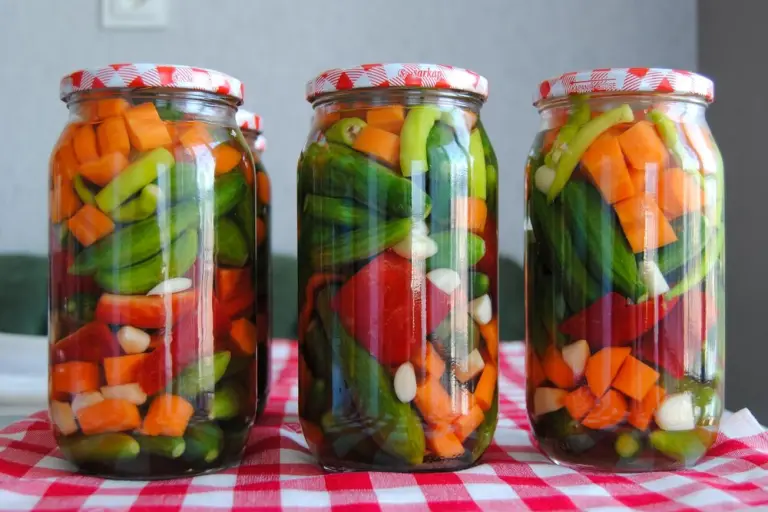
- The most reliable vinegar swap in jars is citric acid: about 1 scant tsp (4 g) per 1 litre of marinade.
- Always dissolve the crystals in water in advance rather than tipping them into the jar dry.
- Do not reduce the acid arbitrarily for the sake of taste: keep to the ratios of a trusted recipe.
- For a clear brine, citric acid is better than vinegar: it does not cloud or add a smell.
If you are making pickled gherkins or crunchy pattypan squash, stick to the acid dosage in the recipe: it is precisely this that guarantees the jars will not bulge.
Who should avoid vinegar and what to use instead
Not everyone likes vinegar and it cannot always be eaten. With gastritis and high acidity, ulcers, heartburn and in children's food, the sharp acid of vinegar is best removed or softened. Fortunately, almost every dish has a more delicate alternative.
- For a sensitive stomach: instead of vinegar, a small amount of lemon juice or fermented dairy products in dough.
- In children's dishes: for a tang, use berry fruit drink, sour apples or a little lemon juice.
- For a mild-tasting salad: a dressing of oil with lemon or yoghurt is tolerated more easily than a vinegar one.
With chronic digestive conditions, the amount of any acid in the diet is worth discussing with a doctor. For a healthy person, a moderate amount of vinegar or its substitutes is safe.
❓ Frequently asked questions
What can I use instead of vinegar in dough to activate baking soda?
The easiest is lemon juice: 1/2 tsp of juice per 1/2 tsp of baking soda. Better still, use kefir or whey, which activate the soda themselves (200 ml per 1/2 tsp of baking soda). And if the recipe has only baking soda plus vinegar, replace it all with ready-made baking powder: 2 tsp in place of 1 tsp of baking soda.
What can I use instead of 9% vinegar if I only have apple cider vinegar?
Apple cider vinegar is most often 5-6%, so in place of 1 tbsp of the nine percent use around 1.5 tbsp of the apple cider one. It is milder and gives a light fruity aroma, works well in salads and meat marinades, but slightly clouds a pale brine.
Can I replace vinegar with citric acid in a marinade?
Yes, this is one of the best swaps, especially for preserves. In place of 1 tbsp of 9% vinegar, take 1/4 tsp of citric acid dissolved in 1 tbsp of water. For a marinade per 1 litre of water, 1 scant teaspoon of crystals is enough. Dissolve the acid in advance rather than tipping it in dry.
What can I use instead of vinegar in winter preserving?
Only a reliable acid with a consistent concentration: citric acid (about 4 g per 1 litre of marinade) or trusted vinegar. Fresh lemon juice is not suitable for long-term preserves: its acidity is unstable and the jars can ferment.
How much lemon juice do I need in place of 1 tbsp of vinegar?
About 2 tbsp of fresh lemon juice, because it is 1.5-2 times weaker than 9% vinegar. Add it gradually and taste: the exact amount depends on the acidity of the particular lemon.
What can I use instead of vinegar in borscht?
Acidity is given to borscht by sauerkraut brine or cucumber brine (2-3 tbsp), lemon juice, as well as pickled or fermented beetroot. Reduce the salt in that case, since the brine is already salty.
What can I use instead of vinegar for kebabs?
For a meat marinade, fermented dairy products (kefir), lemon juice, pomegranate juice or narsharab work better than vinegar. In place of 1 tbsp of vinegar, take 2 tbsp of pomegranate juice or 1 tbsp of narsharab: the meat will become tender and the flavour deeper.
Can I skip activating the baking soda and not add vinegar at all?
Yes, if the dough contains sour components: kefir, soured milk, soured cream, lemon juice, sour berries or fruit. They react with the soda themselves. Alternatively, replace the pairing of soda and vinegar with ready-made baking powder.
What can I use instead of rice vinegar for sushi and rolls?
Mix 2 tbsp of apple cider or white wine vinegar with 1 tsp of sugar and a pinch of salt, and warm slightly until dissolved. As a milder option, lemon juice with sugar will do. This way you recreate the characteristic sweet-sour dressing for the rice.
Does lemon juice spoil the taste of a dish compared with vinegar?
No, more often the opposite: the juice gives a fresh citrus tang without the sharp smell of vinegar. Just remember that it is weaker, so you need more of it, and strain out the pips so that no bitterness appears.