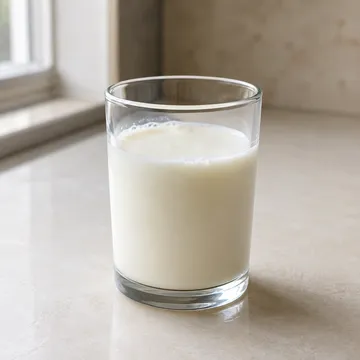
FOOD REFERENCE
Kefir calories: 1%, 2.5% and 3.2% fat per 100 g
The selected Prostokvashino plain kefir products provide 37 kcal at 1% fat, 51 kcal at 2.5% and 57 kcal at 3.2% per 100 g. These are specific manufacturer records for plain kefir.
Calculate your serving
For a 100 g serving
Free, no sign-up. Transfer this food and weight without deleting other ingredients.
Calories and macros per 100 g
All values are for the edible portion in the stated food state.
| Food | Calories, kcal | Protein, g | Fat, g | Carbohydrate, g | Fibre, g |
|---|---|---|---|---|---|
| Plain kefir 2.5%, Prostokvashino | 51 | 3 | 2.5 | 4 | not available |
| Plain kefir 1%, Prostokvashino | 37 | 3 | 1 | 4 | not available |
| Plain kefir 3.2%, Prostokvashino | 57 | 3 | 3.2 | 4 | not available |
Calories in common servings
These are reference edible weights. Weigh your own food for a more precise result.
| Serving | Weight | State | Kcal | Protein | Fat | Carbs |
|---|---|---|---|---|---|---|
| Weighed serving of 2.5% kefir | 200 g | Plain kefir 2.5%, Prostokvashino | 102 | 6 g | 5 g | 8 g |
| 250 g serving of 2.5% kefir | 250 g | Plain kefir 2.5%, Prostokvashino | 127.5 | 7.5 g | 6.25 g | 10 g |
| 200 g serving of 1% kefir | 200 g | Plain kefir 1%, Prostokvashino | 74 | 6 g | 2 g | 8 g |
| 200 g serving of 3.2% kefir | 200 g | Plain kefir 3.2%, Prostokvashino | 114 | 6 g | 6.4 g | 8 g |
What affects the calorie value
These three selected products list the same protein and carbohydrate values but different fat amounts. This is not a rule for every brand: check the macros and calories on your bottle.
Fruit-flavoured kefir drinks, sweetened cocktails and plain kefir are not the same reference food. Sugar and other additions require their own label or a recipe calculation.
Values here are per 100 g, not per 100 ml. Glass markings measure volume, while scales measure mass. Do not automatically equate the two, especially for a large bottle.
The manufacturer data used does not list vitamin and mineral amounts. Missing values are not replaced with zero.
How to calculate more accurately
Tare the scales with the empty glass, pour in the kefir and enter the drink weight. For a whole pack, use its labelled net mass if that quantity is given in grams.
Select the fat level before transferring it to the calculator. For a smoothie, add fruit and other ingredients separately; for pancakes, also include flour, eggs and oil.
Calories are taken from the manufacturer pages. Small differences from a 4/9/4 calculation using rounded macros can result from rounding. Do not replace the label energy value with that reconstruction.
Common questions
How many calories are in a glass of kefir?
At a weight of 200 g, the selected 1% kefir gives 74 kcal, 2.5% gives 102 kcal and 3.2% gives 114 kcal. These are weight-based calculations, not universal glass sizes.
Can I enter 200 ml as 200 g?
No, the calculator expects grams. Weigh the drink or use separate manufacturer values per 100 ml if those are provided.
How do I calculate a whole 930 g bottle?
Select the matching product and enter 930. The 2.5% kefir example gives 474.3 kcal. Count only the amount you actually drink.
Do these values apply to homemade kefir?
Not automatically. The milk and preparation may differ from the commercial product. This table shows specific labelled examples.
Data source and accuracy
Images are AI-generated illustrations of the food, not photographs of a particular brand.
Source: official Prostokvashino product pages, checked on 5 September 2026. These are identified products, not averages across brands. Quantitative vitamin, mineral and fibre values are not published on the pages used.
Serving calculation: value per 100 g × serving weight / 100. Calories come from the stated source, not from rounded macros.
For packaged foods, prefer the label. Calculate cooked dishes from their ingredients and actual yield. This reference does not prescribe medical diets.
Original sources
- Простоквашино / Prostokvashino: Кефир 2,5%, 930 г / Plain kefir 2.5%, 930 g
- Простоквашино / Prostokvashino: Кефир 1%, 930 г / Plain kefir 1%, 930 g
- Простоквашино / Prostokvashino: Кефир 3,2%, 930 г / Plain kefir 3.2%, 930 g