FOOD REFERENCE
Oatmeal calories: cooked with water and dry oats
The selected USDA records give 71 kcal per 100 g for plain oatmeal cooked with water, without salt, and 379 kcal for dry oats. Choose the food state that matches when you weighed it.
Calculate your serving
For a 100 g serving
Free, no sign-up. Transfer this food and weight without deleting other ingredients.
Calories and macros per 100 g
All values are for the edible portion in the stated food state.
| Food | Calories, kcal | Protein, g | Fat, g | Carbohydrate, g | Fibre, g |
|---|---|---|---|---|---|
| Cooked in water, no salt or additions | 71 | 2.54 | 1.52 | 12 | 1.7 |
| Dry oats, not fortified | 379 | 13.15 | 6.52 | 67.7 | 10.1 |
Calories in common servings
These are reference edible weights. Weigh your own food for a more precise result.
| Serving | Weight | State | Kcal | Protein | Fat | Carbs |
|---|---|---|---|---|---|---|
| Dry oats before cooking | 40 g | Dry oats, not fortified | 151.6 | 5.26 g | 2.61 g | 27.08 g |
| Weighed dry-oat serving | 50 g | Dry oats, not fortified | 189.5 | 6.58 g | 3.26 g | 33.85 g |
| Cooked oatmeal serving | 150 g | Cooked in water, no salt or additions | 106.5 | 3.81 g | 2.28 g | 18 g |
| Weighed bowl of cooked oatmeal | 200 g | Cooked in water, no salt or additions | 142 | 5.08 g | 3.04 g | 24 g |
What affects the calorie value
Oats absorb water during cooking. Their weight increases without calories being added by the water. A runny porridge therefore contains less dry matter per 100 g than a thick one. The 71 kcal figure describes a specific reference preparation, not every homemade bowl.
Instant sachets with sugar, cream or dried fruit have a different composition. Use their own label even if they are called oatmeal. The dry record here is for regular or quick, unfortified oats without additions.
For oatmeal with milk, banana or butter, calculate the ingredients. Do not simply add a glass of milk to the calories of 100 g cooked oatmeal: first establish the complete ingredients and cooked weight.
Vitamins and minerals per 100 g
Values come from the same USDA records. They show the amount in the food, not a percentage of an individual daily requirement.
| Nutrient | Cooked in water, no salt or additions | Dry oats, not fortified |
|---|---|---|
| Magnesium, mg | 27 | 138 |
| Phosphorus, mg | 77 | 410 |
| Iron, mg | 0.9 | 4.25 |
| Vitamin B1, mg | 0.08 | 0.46 |
| Manganese, mg | 0.58 | 3.63 |
| Selenium, µg | 5.4 | 28.9 |
How to calculate more accurately
Choose the dry record if you weighed dry oats. If you are weighing porridge on the plate without knowing its starting proportions, the cooked record gives a reference estimate.
Worked example: 40 g of these dry oats contains 151.6 kcal. If cooking with water alone produces 200 g of porridge, that is 75.8 kcal per 100 g. This is a calculation example, not a fixed yield for 40 g of oats.
For your own batch, enter the oats and all additions in the recipe analyzer, then set the cooked yield. This accounts for serving size without mixing dry and cooked weights.
Common questions
How many calories are in 200 g of oatmeal cooked with water?
For the selected plain cooked record, 142 kcal. Your porridge may have a different consistency; dry ingredients and actual yield give a closer estimate.
Why are dry oats much higher in calories than cooked oatmeal?
The comparison uses equal 100 g weights, but added water makes up much of the cooked weight. The starting oats have not lost their calories simply by absorbing water.
How many calories are in oatmeal made with milk?
There is no single value: milk fat level and amount, oat weight, sugar and cooked yield all matter. Calculate your recipe from its ingredients.
Can this table be used for rolled oats?
As a reference for plain regular or quick oats. Use the package label for a specific brand, fortified oats or sweetened mixtures.
Data source and accuracy
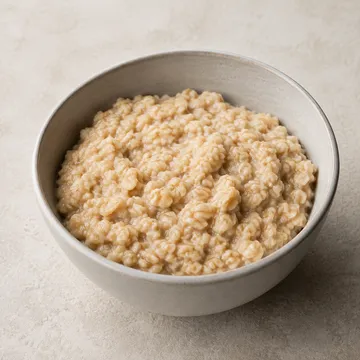
Images are AI-generated illustrations of the food, not photographs of a particular brand.
Source: USDA FoodData Central, SR Legacy, April 2018 release. Values checked against the source dataset on 5 September 2026. These are reference records, not an analysis of your serving.
Serving calculation: value per 100 g × serving weight / 100. Calories come from the stated source, not from rounded macros. USDA total carbohydrate includes fibre. Do not add fibre again.
For packaged foods, prefer the label. Calculate cooked dishes from their ingredients and actual yield. This reference does not prescribe medical diets.
Original sources
- USDA FDC 173905: Cereals, oats, regular and quick, unenriched, cooked with water (includes boiling and microwaving), without salt
- USDA FDC 173904: Cereals, oats, regular and quick, not fortified, dry