avg —
Skoblyanka

Instructions
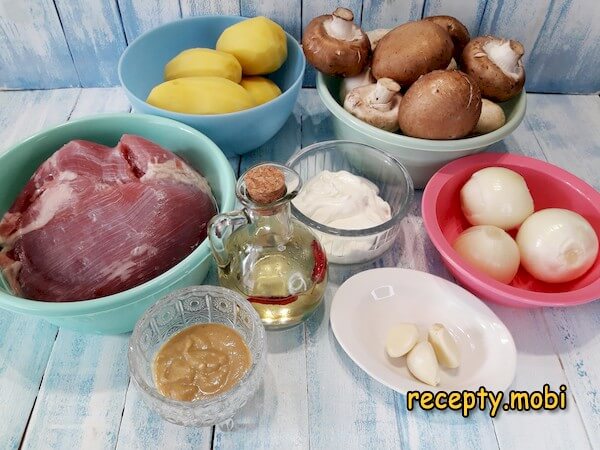
I prepare the ingredients for skoblyanka. You can use any meat, even a mix of different kinds. The main thing is that it should be slightly frozen, but not too much, so that slicing thin slivers comes out perfectly. I take the meat, mushrooms and potatoes in roughly equal proportions. If you use forest mushrooms instead of champignons, as was done in the old days, the dish turns out truly authentic.
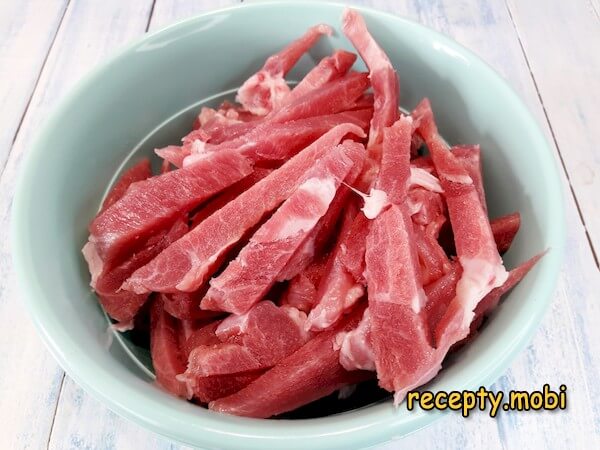
I cut the slightly frozen meat first into thin slices and then into long strips about 1 cm wide – exactly the "scraped" format that gave the dish its name.
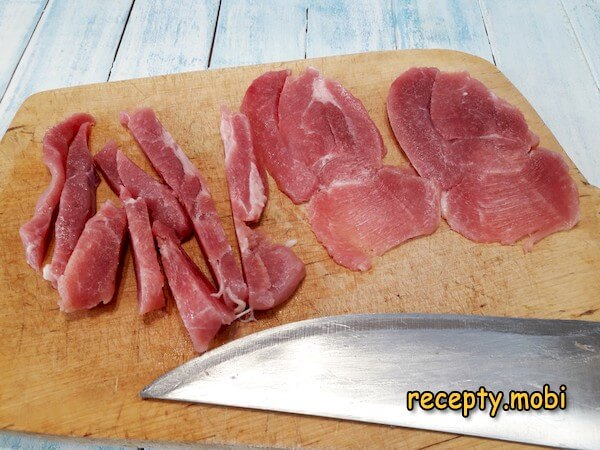
I put the cut meat into a bowl and set it aside for now – the meat needs to "wait" for its turn.
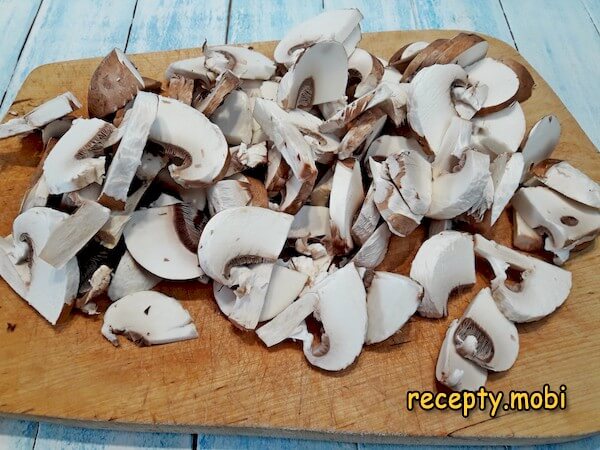
I slice the mushrooms into thin plates, about 3–4 mm thick, so that they fry quickly and keep their texture.
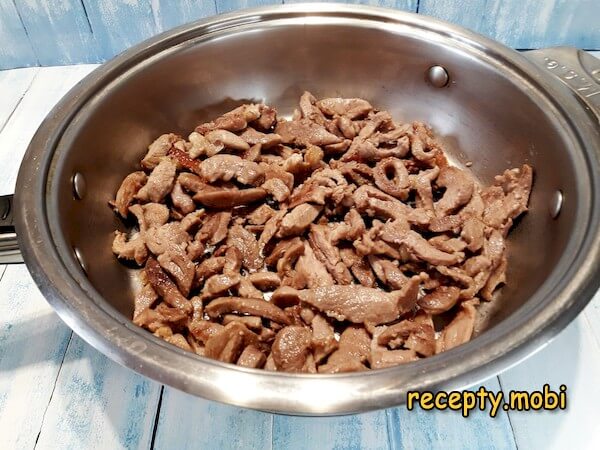
In a small amount of oil over high heat, I fry the meat, stirring it constantly, until a golden crust forms. I add pepper. I salt only at the very end, otherwise the meat will release a lot of moisture and stew rather than fry – this is the secret of dry-frying versus stewing.
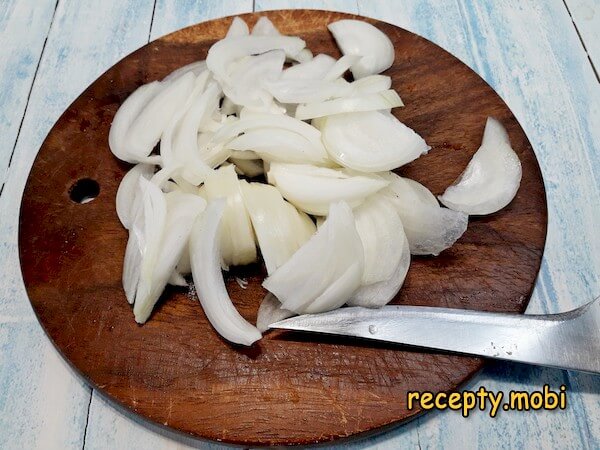
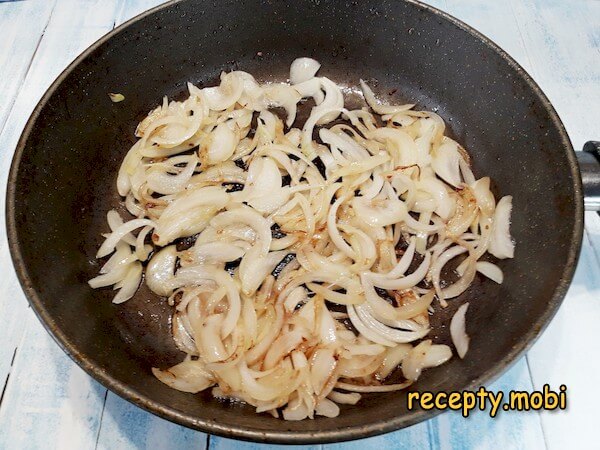
I prepare the onion in half-rings – thin, but not "see-through", so that the onion texture can still be felt in the finished dish.
I fry it until the first signs of golden colour appear – not until brown, so that the onion does not turn bitter.
Now I can add all the mushrooms to the skillet at once. At first the volume will look very large, even making it hard to stir – but that is "normal", the mushrooms will shrink quickly.
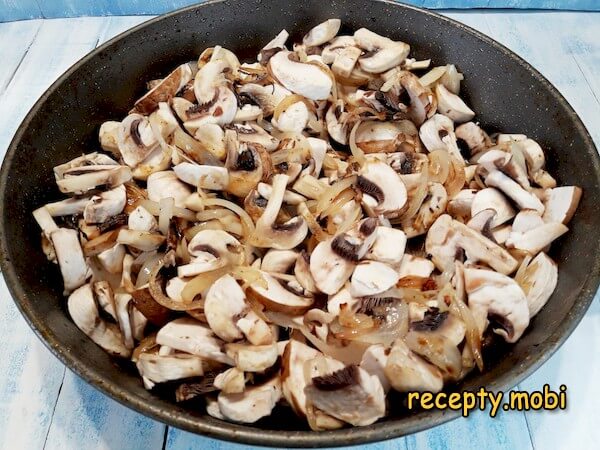
After 5–7 minutes the champignons will shrink considerably in size, releasing their moisture. I salt them and fry them together with the onion until golden for a few more minutes – the mushrooms should "boil off" their water and turn slightly golden.
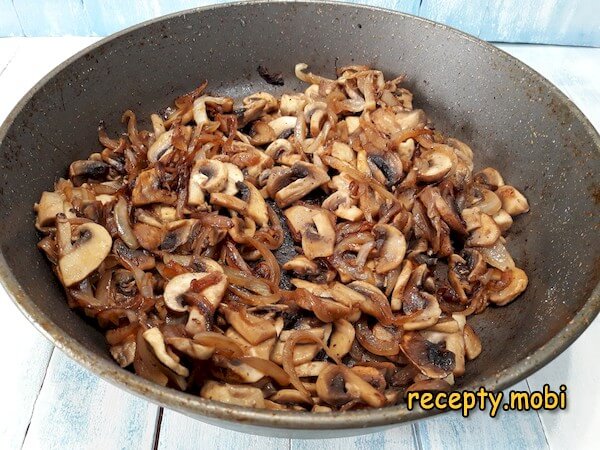
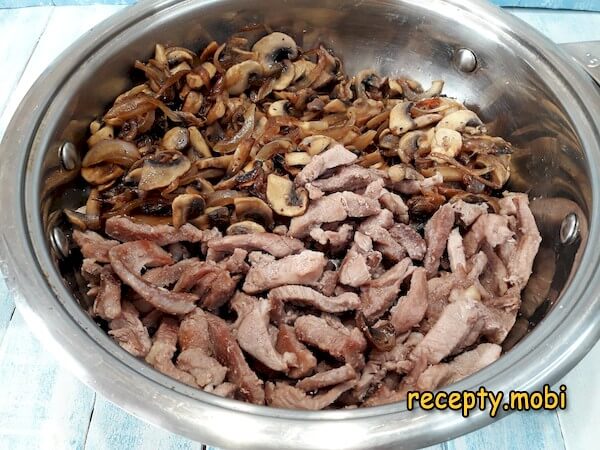
I transfer the mushrooms into the skillet with the meat – the two fried "halves" now come together.
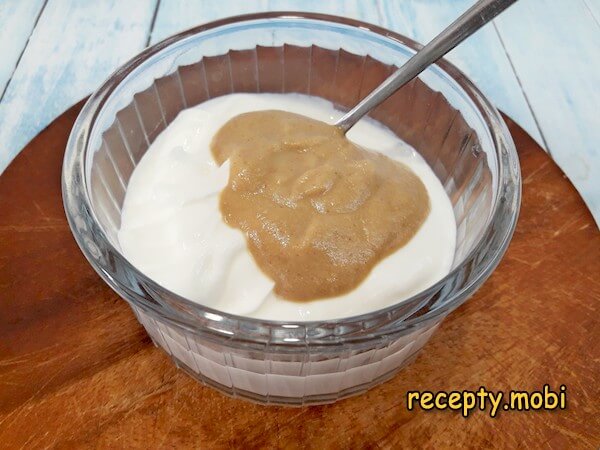
For the sauce, I add mustard to the sour cream – it is the mustard that gives the "sharp" accent, without which skoblyanka would be "bland".
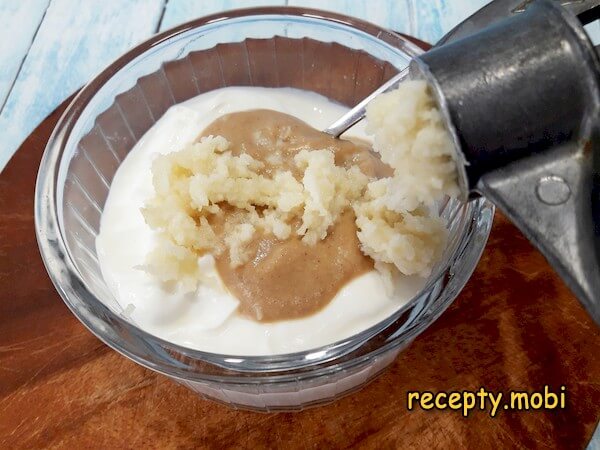
Into the same bowl I press the garlic through a press – fresh garlic gives the sauce its characteristic "Russian" aroma.
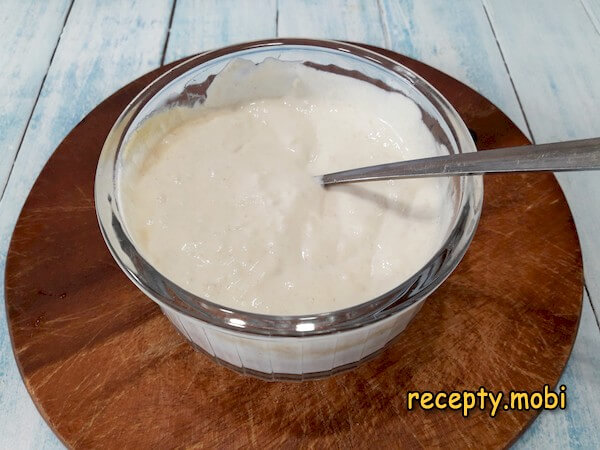
I mix everything well – the sauce should become smooth, with the garlic and mustard evenly distributed.
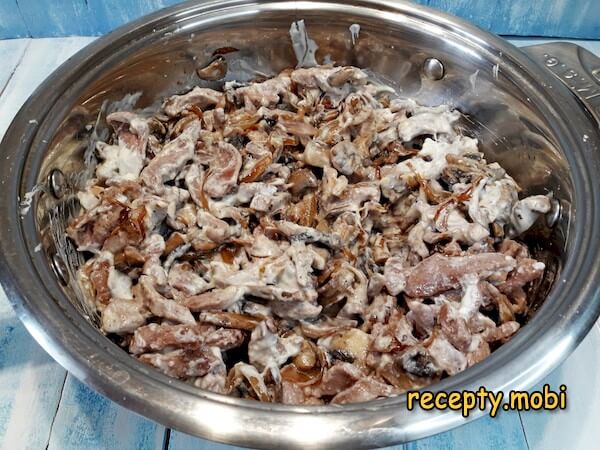
I pour the sauce into the skillet with the mushrooms and meat, stir, and warm it on the stove for about 3–4 minutes – the sauce should "embrace" all the ingredients, but not boil down.
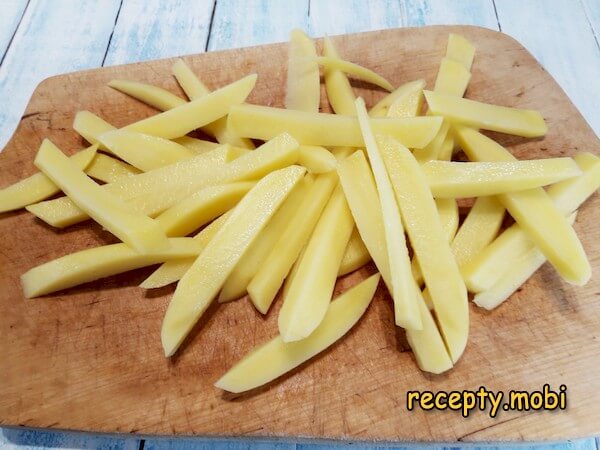
I cut the potatoes into long sticks – roughly 8×8×40 mm, like for chips, so that they fry to a golden crust.
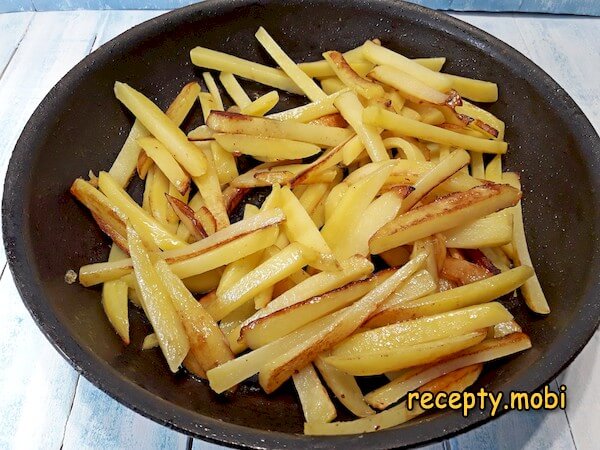
I fry them in oil, turning them carefully, until soft and golden-crusted. At the end I sprinkle them with salt – the potatoes in skoblyanka are a flavour "layer" of their own.
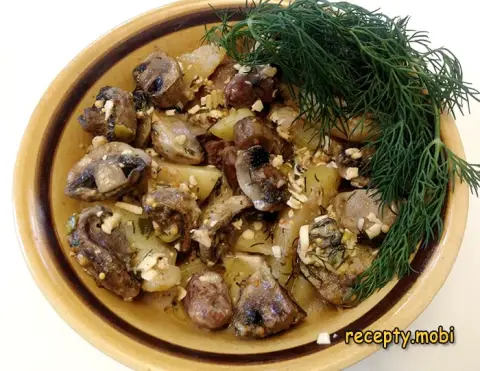
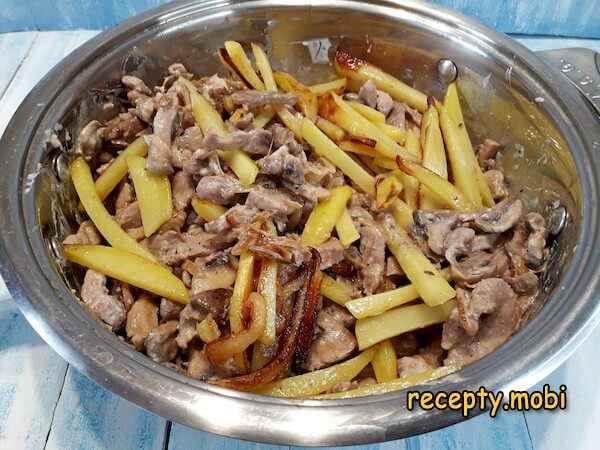
I combine the contents of both skillets, keep everything over the heat for another 5 minutes – and the dish is ready.


Tips
- 1
SLIGHTLY FROZEN MEAT is the secret of the original "scraped" format. Fully frozen meat is awkward to slice (the knife slips), while fully thawed meat gives thick, stringy pieces. The ideal is meat chilled to a "firm" state (roughly -2 to -5°C, about 30–40 minutes in the freezer before slicing). With a sharp knife you get thin slices 2–3 mm thick, which are then cut into 1 cm strips. This is exactly what allows instant frying over high heat without releasing juices.
- 2
FRYING WITHOUT SALT is the secret against stewing. Salt draws water out of the meat. If you salt the meat before or during frying, it will "leak" its juices and the skillet will turn into a pot – the meat will stew rather than fry. There will be no crust. For skoblyanka this is critically important: fry over maximum heat, without salt, until a golden crust forms. The salt goes in at the very end, once the crust has set.
- 3
FRYING THE INGREDIENTS SEPARATELY is the secret of a complex flavour. All the ingredients are fried in turn, in different skillets or in sequence: first the meat, then the onion, then the mushrooms (with the onion), and separately the potatoes. Only at the very end are they all combined. This is not the cook being "lazy" but the right approach – each product gets its own "golden crust" rather than turning into one common mass. If you throw everything in at once, the meat will leak, the mushrooms will boil off their water into a cold skillet, and you will end up with a "stew".
- 4
SOUR CREAM + MUSTARD + GARLIC is the secret of the Russian sauce. Plain sour cream gives a "diet" sauce with no character. Mustard (Russian hot mustard, not Dijon) provides the sharp accent. Fresh garlic through a press is the aromatic "soul". A ratio of 6:1:1.5 (120 g sour cream / 20 g mustard / 3 cloves) is the optimum. You can add a pinch of dried dill for a "country" aroma. The sauce is made "cold" and then warmed through, not boiled, so that the sour cream does not curdle.
FAQ
What is the best meat for skoblyanka? +
The classic set is ideal. Turkey thigh (our choice) is lean, juicy and neutral in flavour. Alternatives: chicken fillet or thigh (a "lighter" version), pork (tenderloin or neck – the "fatty", authentic option), beef tenderloin (the premium choice), venison or elk (for "forest" authenticity, as in the old days). Duck also works well – with its fattiness and characteristic flavour. Not the best choice are lamb (too distinctive in flavour) and chicken breast (a little dry). The main thing is meat without sinews and tendons.
Can I replace champignons with other mushrooms? +
Yes, ideally with forest ones. Porcini (the king of mushrooms, they add authenticity), orange-cap boletus (firm texture), chanterelles (a characteristic "forest" aroma), butter mushrooms (juicy, but they need extra cleaning to remove the slimy film). Among cultivated ones – oyster mushrooms (firmer than champignons), king oyster mushrooms (dense and "royal"), shiitake (an Eastern accent). Dried forest mushrooms can be used after soaking for 2–3 hours, then sliced. Frozen ones should be thawed in a colander and then fried, though they release more water.
Can I bake skoblyanka in the oven instead of using a skillet? +
Yes, this is a "modern" variation. All the ingredients are fried in turn in a skillet (meat, onion with mushrooms, potatoes), then combined with the sauce, placed in a ceramic dish and baked for 15–20 minutes at 180°C – this gives a "baked skoblyanka with a crust". You can sprinkle grated cheese on top (a hard cheese such as Parmesan) – then you get a "Russian-French" version with a golden baked cap. For a "rustic" presentation, bake it in individual clay pots for 5–7 minutes.
What to serve with skoblyanka? +
The Russian classic is with a handful of fresh herbs (dill, parsley, green onion) on the plate, lightly salted cucumbers or sauerkraut, dark "Borodinsky" bread, and homemade horseradish or mustard. For drinks: cranberry or lingonberry fruit drink (the authentic choice), bread kvass, black tea from a samovar, wheat beer. For a celebration – ice-cold vodka to wash it down. For salads: vegetable "Vinaigrette", a simple salad of tomatoes with green onion, cucumbers with sour cream. For a "lean" accompaniment – soured apples, soaked lingonberries.
- Comment
or post as a guest
Be the first to comment.