
avg —
Crispy pickled cucumbers for winter in liter jars

Instructions
Wash the cucumbers thoroughly under running water, using a soft sponge to remove dirt from the bumps. Soak them in cold water for 2-4 hours: this restores lost moisture and ensures a crunchy texture. Trim 3-5 mm off both ends, this is where bitterness and nitrates accumulate. Sort the cucumbers by size: fruits of the same size will pickle evenly.
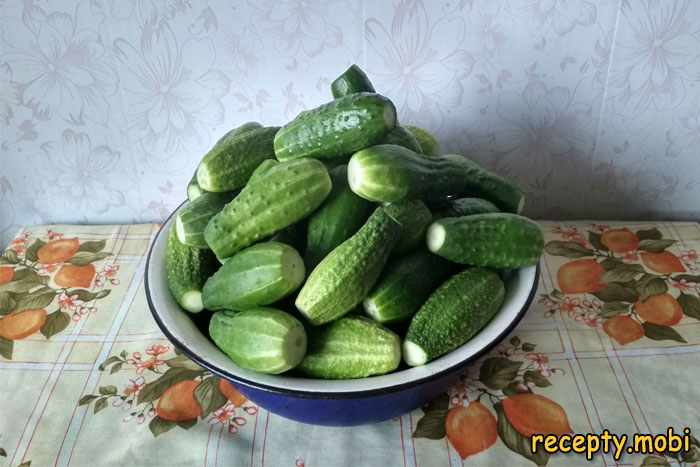
Be sure to sterilize the jars for 10-15 minutes.
In the prepared jars, place on the bottom (calculated for a liter jar): a dill umbrella, a bay leaf, 2-3 black currant and cherry leaves, 1-2 garlic cloves, 2-3 allspice peas, 6-8 mustard seeds. Tightly pack the cucumbers into the jar.
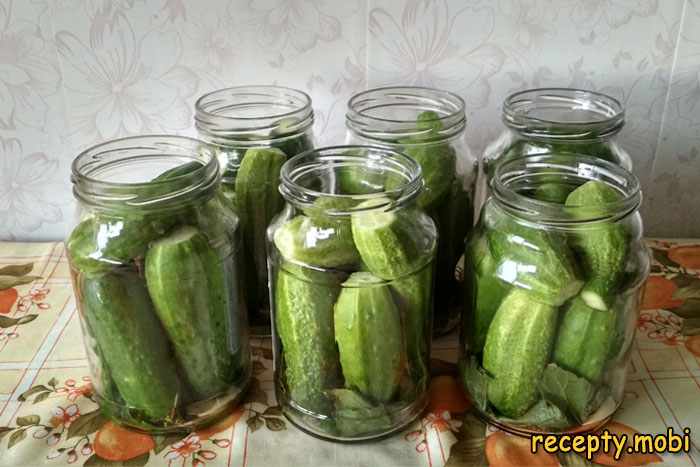
Pour boiling water into the jars. Cover with lids, but do not screw them on yet. Let sit for 15-20 minutes.
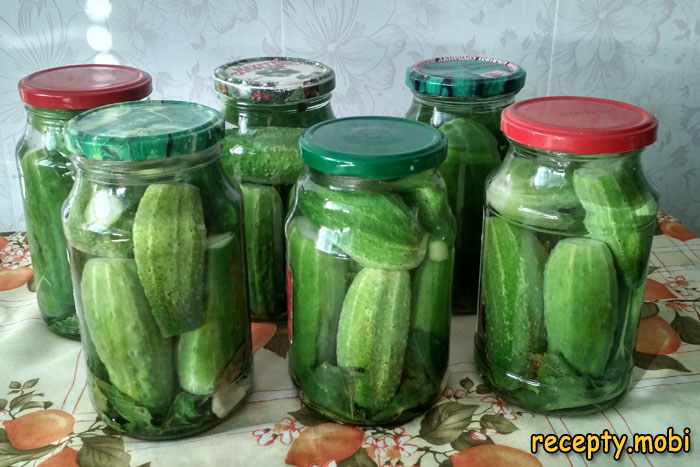
Drain the water and count how many liters you have.
Bring the brine to a boil over high heat. Add the ingredients, calculated per 1 liter of brine: 1 tablespoon of salt, half a cup of sugar. As soon as the water boils, pour in 250 ml of 9% table vinegar, it is important to add the vinegar after boiling, to preserve its preserving properties. Boil the marinade for 2-3 minutes.
Immediately pour the boiling marinade into the jars with cucumbers, right to the top, no air bubbles should remain. Cover with lids and place the jars in a pot of hot water for sterilization. The water should reach the shoulders of the jars. Sterilize for 15 minutes from the moment the water boils, this guarantees long storage without bulging lids.
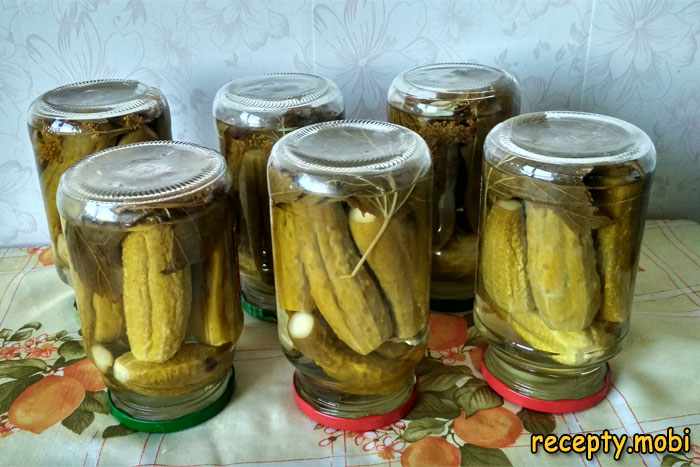
Carefully lift the jars out of the boiling water with special tongs. Immediately screw the lids on tightly with screw-top lids or a sealing machine. Turn the jars upside down: if no marinade leaks out, the seal is airtight. Wrap them in a warm blanket and leave to cool for 12-24 hours, slow cooling completes the sterilization process.


Tips
- 1
Add an oak or horseradish leaf to the bottom of the jar, the tannins will give the cucumbers extra crunch.
- 2
For spicy cucumbers, add a ring of chilli pepper to each jar.
- 3
Use only freshly picked cucumbers: those that have sat for more than 24 hours lose their crunch.
Comparison of Preserving Methods
Five working methods for different needs and storage conditions. Proportions are given per 1 liter of water or marinade. For methods without sterilization, acid is the only barrier against botulism, so do not reduce the vinegar or citric acid.
| Method | Salt per 1 l | Acid per 1 l | Sugar per 1 l | Sterilization | Shelf life and storage | Feature |
|---|---|---|---|---|---|---|
| Classic with sterilization | 2 tbsp (~50 g) | vinegar 9%, 100-120 ml | 2-3 tbsp | Yes | Up to 12 months, cool pantry | Most reliable: acid and heat back each other up |
| With citric acid | 2 tbsp (~50 g) | citric acid 1 tsp (5-6 g) | 2 tbsp | No (triple pour) | Up to 12 months, cool | No vinegar smell, mild taste |
| Triple pour without sterilization | 2 tbsp (~50 g) | vinegar 9%, 100 ml (50 ml per jar) | 2 tbsp | No (boiling water pours) | Up to 12 months, cool | Fast, no sterilizer needed |
| Cold salting (fermented) | 70 g (large up to 8-9%) | none, lactic acid works | none | No | 6-8 months, only cold 0-4 °C | Live barrel flavour, hard water adds crunch |
| With vodka | 2 tbsp (~50 g) | equivalent of 100 ml vinegar 9% plus vodka ~1 tbsp | 1 tbsp | No (vodka and boiling pour) | Up to 12 months, no cellar needed | Clear brine, firm cucumbers |
Preserving Variations
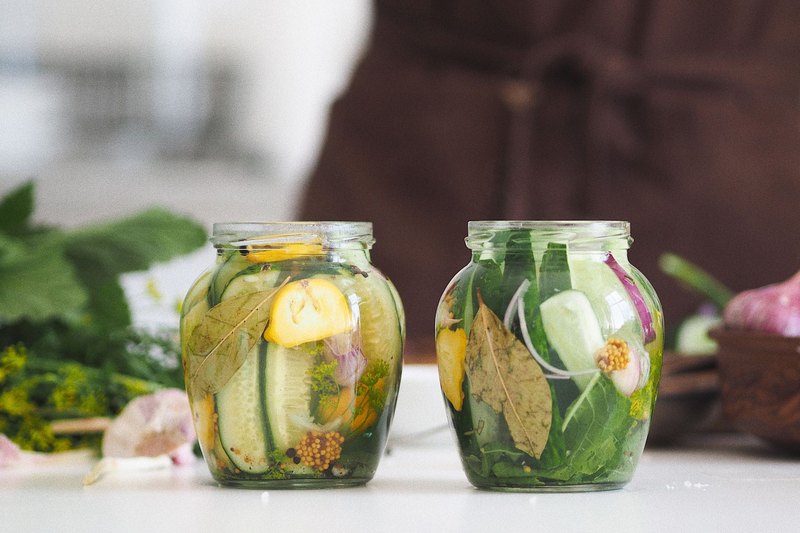
Variation 1. Classic with sterilization
Best for: those who want the most reliable jar and storage in an ordinary apartment.
Ingredients (per liter jar):
- cucumbers, ~600 g;
- water, 500 ml;
- salt, 1 tbsp;
- sugar, 1.5 tbsp;
- vinegar 9%, 2 tbsp;
- garlic, 2 cloves; a dill umbrella, a horseradish leaf, 2-3 currant or cherry leaves, peppercorns.
- Soak the cucumbers in cold water for 4-8 hours, trim both ends.
- Sterilize the jars and lids: over steam for 10-15 minutes or in the oven at 120 °C.
- Place the spices on the bottom, then pack the cucumbers tightly and vertically.
- Boil the marinade from water, salt and sugar, pour over the cucumbers, let stand 10 minutes.
- Drain the marinade back into the pot, bring to a boil again.
- Pour the vinegar into the jar, fill with boiling marinade to the top, seal.
- Turn upside down, wrap until cooled for 8-12 hours.
Storage and safety: up to 12 months in a cool dark pantry. The double barrier (acid plus heat) makes this method the safest.
Variation 2. With citric acid, no vinegar smell
Best for: those who dislike the smell of vinegar but want to seal jars for warm storage.
Ingredients (per 1 l of marinade):
- water, 1 l;
- salt, 2 tbsp;
- sugar, 2 tbsp;
- citric acid, 1 tsp (5-6 g);
- garlic, dill, a horseradish leaf, currant leaves.
- Soak the cucumbers 4-8 hours, trim the ends, pack into sterile jars with spices.
- First pour: boiling water for 10-15 minutes, drain.
- Second pour: fresh boiling water for 10 minutes, drain.
- Boil the marinade from water, salt and sugar, add citric acid 1 tsp per 1 l at the end.
- Third pour with boiling marinade to the top, seal, turn over, wrap for 8-12 hours.
Storage and safety: up to 12 months in a cool place. Acid is the only preservative, so do not reduce the citric acid below 1 tsp per 1 l.
Variation 3. Triple pour without sterilization
Best for: when you need it fast and without a sterilizer pot, but with apartment storage.
Ingredients (per liter jar):
- cucumbers, ~600 g;
- salt at 2 tbsp per 1 l;
- sugar 2 tbsp per 1 l;
- vinegar 9%, 50 ml per jar (that is 100 ml per 1 l of marinade);
- spices: dill, garlic, a horseradish leaf, currant leaves.
- Soak the cucumbers 4-8 hours, trim the ends.
- First pour with boiling water for 10-15 minutes, drain.
- Second pour with boiling water for 5-15 minutes, drain.
- Boil the marinade with salt and sugar.
- Pour vinegar 9%, 50 ml into the jar, fill with boiling marinade, seal at once.
- Turn over, wrap for 8-12 hours, the residual heat pasteurizes further.
Storage and safety: up to 12 months in a cool place. There is no sterilization, so keep the acid strictly at 50 ml of vinegar 9% per liter jar.
Variation 4. Cold salting (fermented, no vinegar)
Best for: fans of the sour barrel flavour who have a refrigerator or a cold cellar.
Ingredients (per 1 l of water):
- cold water, 1 l;
- coarse non-iodized salt, 70 g;
- horseradish leaf and root, dill umbrellas, garlic, oak and currant leaves.
- Soak the cucumbers in cold water 4-8 hours, the ends may be left uncut.
- Pack with spices into the jar, horseradish leaves on top.
- Dissolve 70 g of salt in 1 l of cold water (large cucumbers 8-9%, medium 7-8%, small 6-7%).
- Fill completely with the cold brine, cover but do not seal airtight at this stage.
- Leave for 2-3 days at room temperature to ferment, cloudiness and bubbles will appear, this is normal.
- Move to the cold at 0-4 °C, where fermentation slows down.
Storage and safety: only in the cold, up to 6-8 months. There is no vinegar, so warmth and airtight sealing are not allowed: salt and live lactic acid do the work. Hard water gives a firmer crunch.
Variation 5. With vodka, for storage without a cellar
Best for: those without a cold cellar who still want a lasting crunch and clear brine.
Ingredients (per liter jar):
- cucumbers, ~600 g;
- salt, 1 tbsp;
- sugar, 0.5 tbsp;
- vinegar essence 70%, 0.5 tbsp;
- vodka, 1 tbsp;
- garlic, dill, a horseradish leaf, oak or currant leaves.
- Soak the cucumbers in cold water 6-24 hours, trim the ends.
- Pack with spices into sterile jars.
- Pour boiling water for 10-15 minutes, drain, repeat if desired.
- Boil the marinade from water, salt and sugar.
- Pour vodka 1 tbsp and essence 70% 0.5 tbsp into the jar.
- Fill with boiling marinade to the top, seal at once, turn over, wrap.
Storage and safety: up to 12 months, no cellar needed. The barriers are acid (equivalent of 100 ml vinegar 9% per 1 l), vodka as an antiseptic and the boiling pour. Do not reduce the acid.
What Makes Cucumbers Crunchy
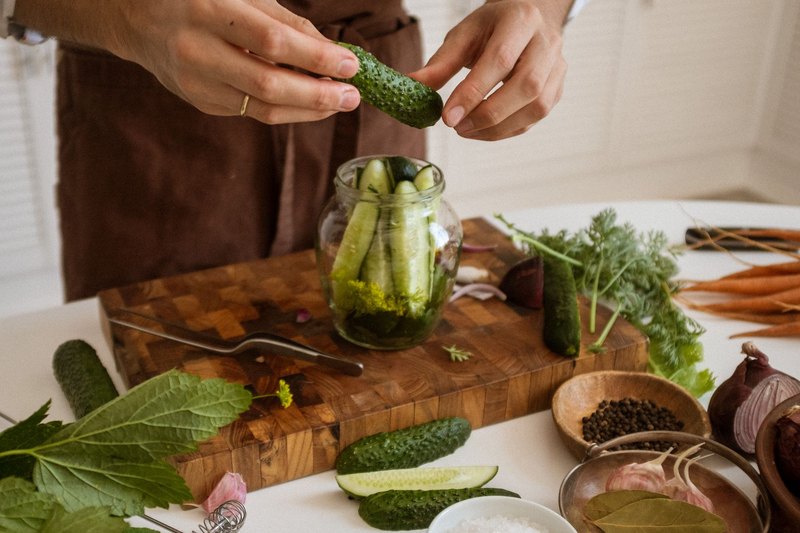
The crunch comes from tannins in oak, cherry and black currant leaves and in horseradish root and leaves: they strengthen the cell walls and skin, while horseradish and oak also suppress mould. The other half of the success is preparation: soaking in cold water for 4-8 hours saturates the cucumbers with moisture, fills the inner voids, and the fruit does not shrivel during storage, while ends trimmed on both sides speed up even salting. Water matters too: hard water, with calcium and magnesium salts, makes cucumbers noticeably firmer than soft water. Freshness is important: take firm young pickling-variety cucumbers up to 10-12 cm and salt them on the day of harvest. Use only coarse non-iodized salt, iodine softens the fruit. And do not overheat: extra repeated pours of fierce boiling water cook the cucumber and kill the crunch.
Safety and Storage
Why acid is essential: cucumbers, like zucchini, patty pan squash and eggplant, have almost no acid of their own. In an airtight jar without oxygen, Clostridium botulinum spores germinate and produce a deadly toxin without changing the taste, colour or smell, so a spoiled jar cannot be told apart by eye. Spore growth is stopped only by an acidic environment with a pH below 4.5. Therefore, for methods without sterilization, keep at least 100 ml of vinegar 9% or 1 tsp of citric acid per 1 l of marinade (about 2% vinegar) and do not cut the acid, the salt or the heating time.
Alternative barriers: spore growth is also suppressed by a high concentration of salt (more than 8%). Cold salting relies on this: plenty of salt plus mandatory cold storage, without sealing in the warmth.
Shelf life and lids: acidic sealed jars with sterilization or pours keep up to 12 months in a cool dark place. Fermented ones (cold salting) only in the refrigerator or cellar at 0-4 °C, 6-8 months. Use whole lids without rust or dents, seal tightly. After cooling, check that the lid is not bulging. Treat a bulging lid, cloudiness with bubbles in pickled jars, or an off smell as signs of spoilage and do not eat. As a safeguard, health authorities recommend boiling home preserves for 15-20 minutes before eating: the botulinum toxin is destroyed by this.
What Went Wrong: Common Problems and Fixes
The brine turns cloudy. In fermented cucumbers this is normal lactic fermentation. In pickled ones, cloudiness with bubbles and bulging is spoilage: poorly washed jars, trapped air, iodized salt. Fix: do not worry about fermented ones, but do not eat a cloudy bulging pickled jar, use non-iodized salt, wash and sterilize the containers thoroughly.
Lids bulge, jars explode. Cause: not enough acid or salt, weak sterilization, trapped air, a loose seal. Fix: do not reduce the vinegar and salt, sterilize, check the seal, do not eat bulging jars.
Cucumbers are soft, not crunchy. Cause: old or limp fruit, no soaking, extra pours of fierce boiling water, few tannins, iodized salt. Fix: fresh firm cucumbers, soaking 4-8 hours, horseradish, oak and currant leaves, coarse non-iodized salt, do not over-pour with boiling water.
Hollow inside. Cause: overgrown cucumbers, a delay between harvest and salting, fermentation that is too warm and vigorous. Fix: young cucumbers up to 10-12 cm, salting on the day of harvest, soaking, do not overheat during fermentation.
Cucumbers taste bitter. Cause: cucurbitacin built up from growth stress (heat, under-watering), the stem ends not trimmed. Fix: trim both ends, soak, taste the end before salting, choose pickling varieties.
White film on top of fermented jars. Cause: film yeast when air gets in. Fix: a horseradish leaf on top, a weight so the cucumbers stay under the brine, skim off the film, keep in the cold.
FAQ
Why soak cucumbers before salting? +
Cold water over 4-8 hours fills the inner voids and saturates the fruit with moisture, so it does not shrivel and stays crunchy.
Which salt should I use? +
Only coarse rock salt, non-iodized. Iodine softens the cucumbers and clouds the brine.
Can I replace vinegar with citric acid? +
Yes, about 1 tsp (5-6 g) of citric acid per 1 l gives acidity close to 100 ml of vinegar 9%. In a method without sterilization, do not reduce the acid.
How much vinegar is safe? +
For methods without sterilization, at least 100 ml of vinegar 9% per 1 l of marinade (about 2% vinegar), this brings the pH below 4.5.
Do I have to sterilize the jars? +
No, if there is enough acid and you use the pouring method with wrapping (pasteurization by residual heat). Cold salting needs no sterilization, but must be stored strictly in the cold.
How do I know a jar has spoiled? +
A bulging lid, cloudiness with bubbles in pickled jars, an off smell. Do not taste anything doubtful, as a safeguard home preserves are boiled for 15-20 minutes before eating.
Why trim the ends of cucumbers? +
It speeds up and evens out the salting and helps the bitterness leave the stem end.
Why add vodka? +
It acts as an antiseptic, lets the jars be stored without a cellar, the cucumbers turn out firmer and the brine stays clear.
Which leaves give crunch? +
Oak, cherry, black currant and horseradish: their tannins strengthen the skin, and horseradish and oak also protect against mould.
Can fermented cucumbers be stored at room temperature? +
No. After 2-3 days of fermenting at room temperature, the jars are moved to the cold at 0-4 °C, otherwise they over-sour and soften.
- Comment
or post as a guest
Be the first to comment.