avg —
Pickles from cucumbers for winter

Instructions
I prepare the ingredients. The cucumbers should be firm and bumpy. They need to be washed thoroughly – it is precisely the "bumpy" varieties that give the finished pickles their characteristic "crunch".
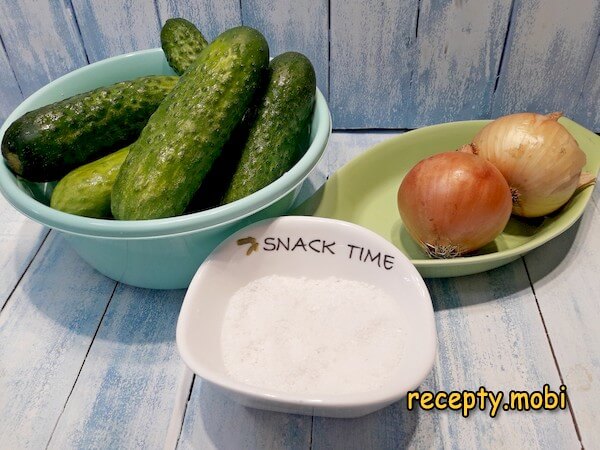
I get out all the components for the marinade. Turmeric will give the slices a beautiful tint and a special flavour, but you should not add more than the recipe states, as an unpleasant bitterness may appear – the "secret" of dosing this Eastern spice.

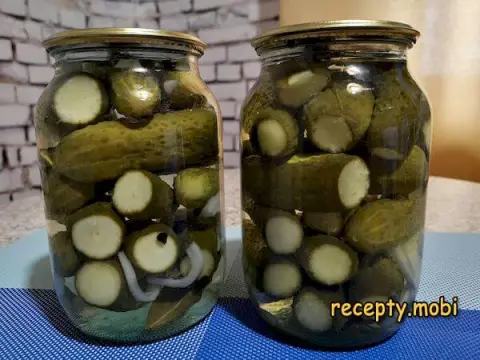
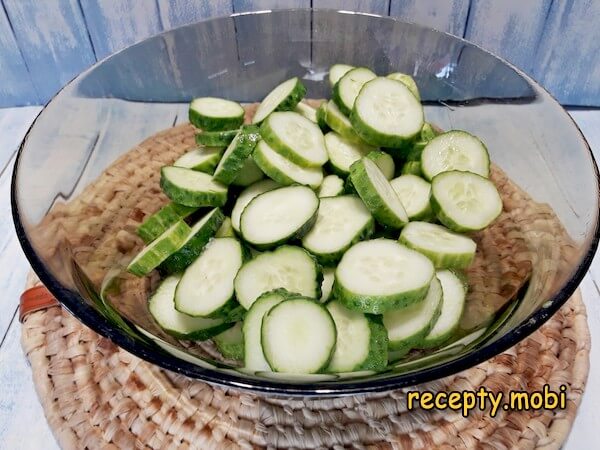
I remove the ends of the cucumbers and then slice them into rounds 0.5 cm thick – this is exactly the thickness that is best for burgers.
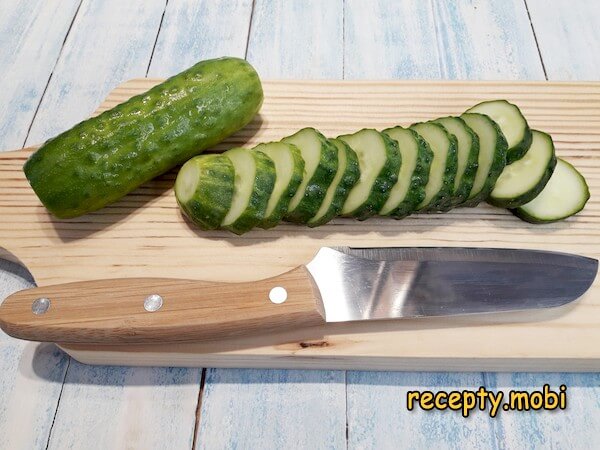
I transfer the slices into a bowl convenient for stirring – preferably glass or enamel, not aluminium (salt reacts with aluminium).
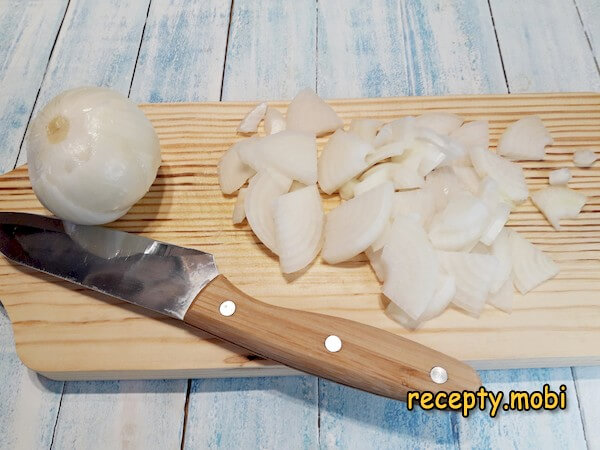
I shred the onion into quarter rings – it is precisely thin quarters that best harmonise with the cucumber rounds.
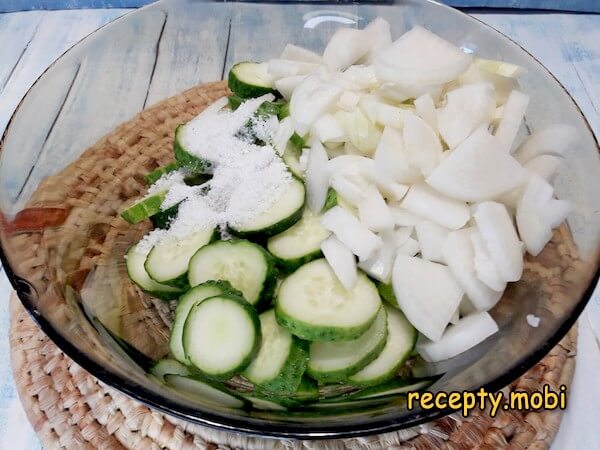
I add them to the cucumbers together with the salt – the salt will draw out the excess moisture from the cucumbers, which is exactly what is needed for the marinating to follow.
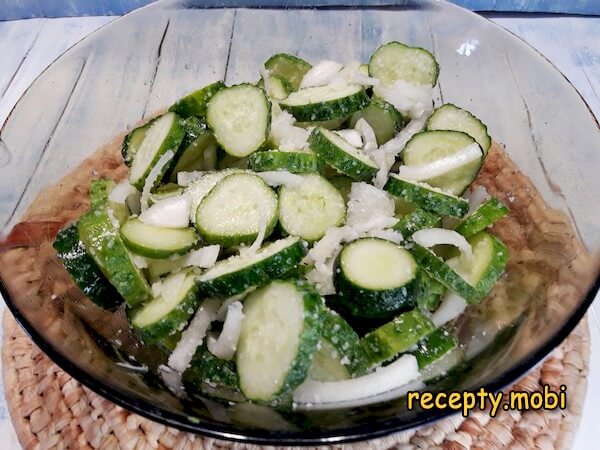
Now the whole mixture needs to be stirred so that the salt is evenly distributed throughout. It is best to do this by hand. Then I leave the cucumbers to stand on the table for exactly 2 hours. They should be stirred every half hour, so the juice is released better. This is the "secret" of proper salting – without it the pickles will be "watery".
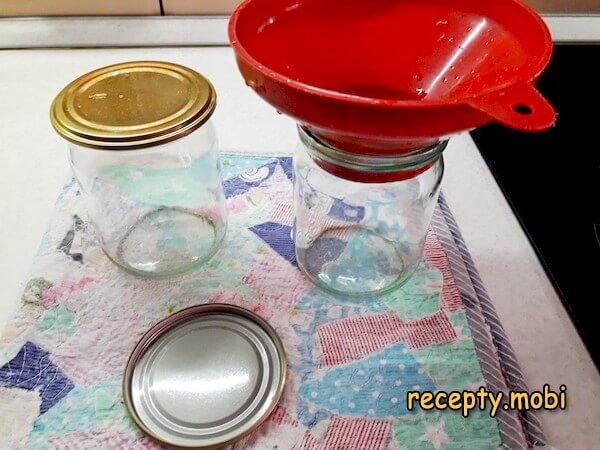
During this time I sterilise the jars by any convenient method. In the microwave, for example: I wash the glass jars, leave a little water (20–30 millilitres) at the bottom and put them in the microwave for 3–4 minutes at maximum power. I boil the lids for 5 minutes. For convenience it is a good idea to get a wide funnel, which should be scalded with boiling water.
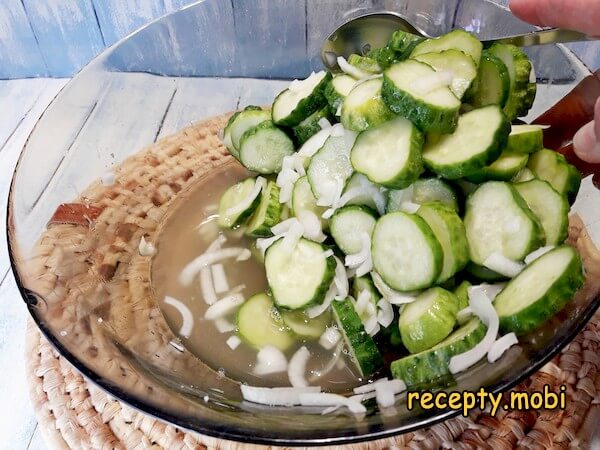
After the indicated time the cucumbers will have released a lot of juice – this is "normal", that is exactly how it should be.
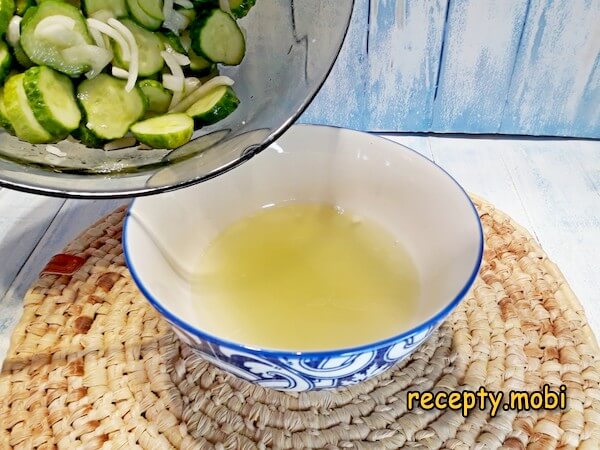
It should be drained off – it will not be needed. Some cooks rinse the slices themselves with water, but it is better not to do this, otherwise the pickles will turn out completely unsalted and too sweet. "Dry", pressed slices – that is the ideal for the next stage.
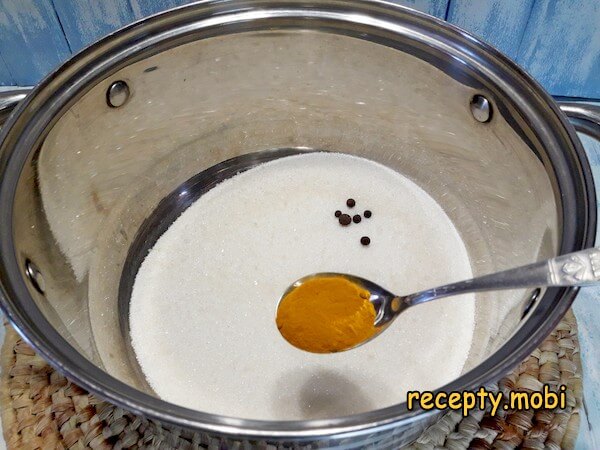
Into a pot where the prepared cucumbers can fit freely, I pour the sugar for the marinade. I add the allspice and turmeric – the base of the "golden" American filling.
I add the Dijon mustard – it is precisely this that gives the pickles their classic "American" character, rather than that of Russian cucumbers.
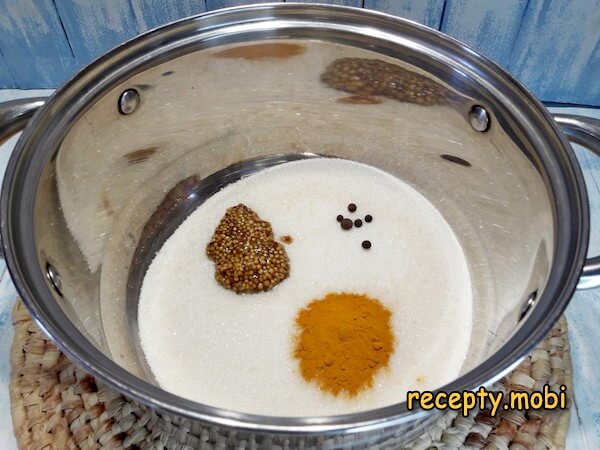
I pour in the vinegar. I stir the whole mixture – this is the future "golden" marinade.
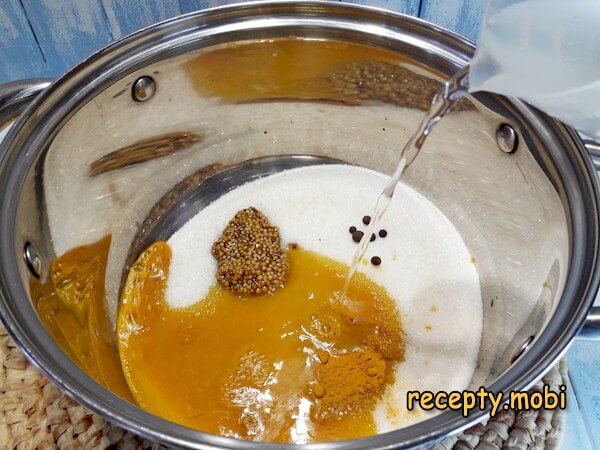
I put the pot with the marinade on the stove and bring it to a boil – the lively bubbles will start the marinating process.
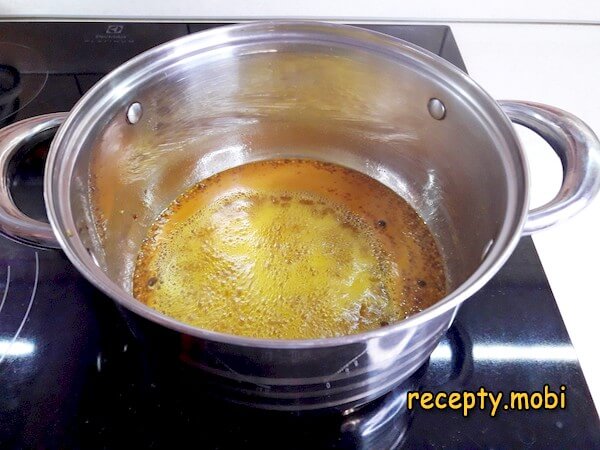
I transfer the cucumber mixture into it – carefully, so that the marinade covers all the slices.
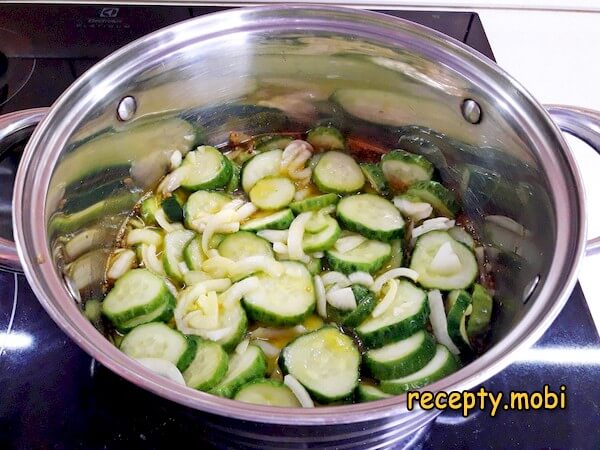
Now I need to wait for the boil to begin and start timing. I carefully lift the lower layers of cucumbers to the top so that all of them are covered by the solution.
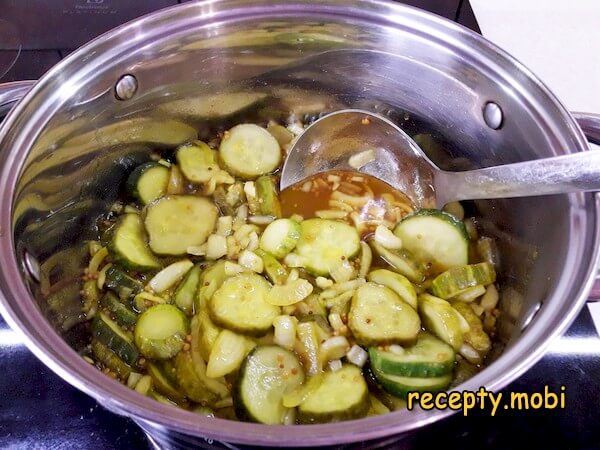
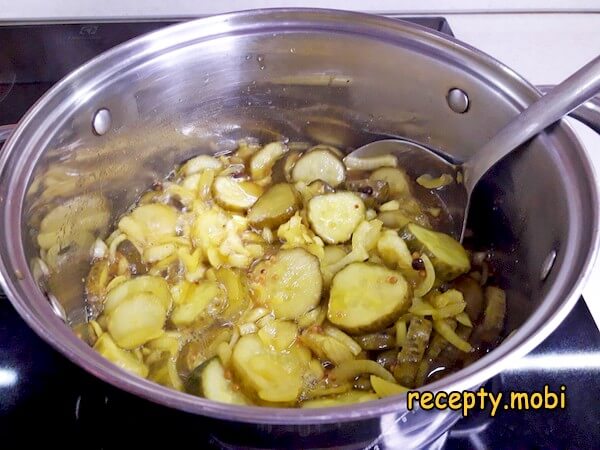
I boil the mixture for exactly 2 minutes. During this time the cucumber rounds will change colour to dark green. I turn off the heat – overcooking will make the pickles "flabby", without crunch.
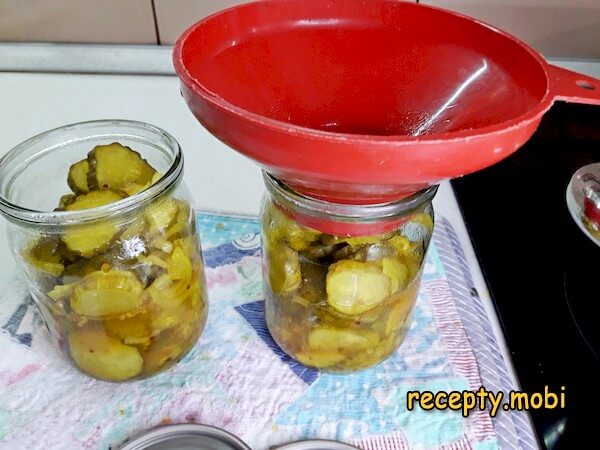
I arrange the pickles in the jars, and it is more convenient to distribute the cucumbers first – without the marinade, in a tight layer.
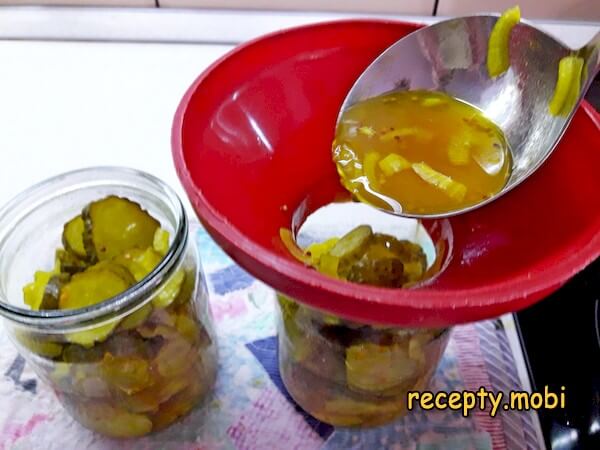
And then I add the hot marinade to them – up to the level of the jar's rim.
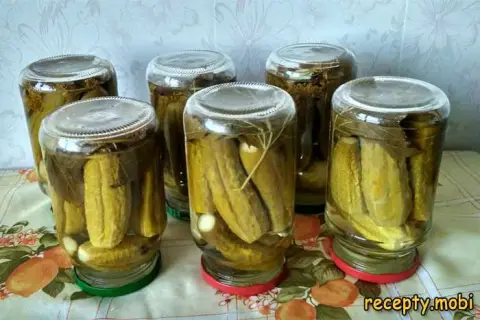
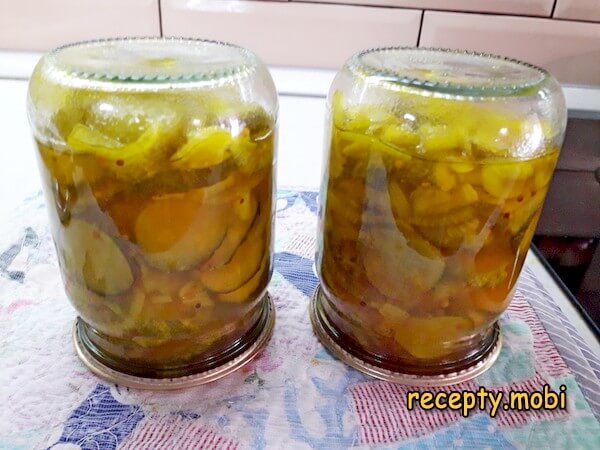
I seal the jars with lids and turn them upside down. I leave them to cool like this – "jar sterilisation" by grandmother's method.


Tips
- 1
BUMPY CUCUMBERS – the "secret" of crunch. Smooth greenhouse cucumbers are no good for pickles – they have no "sturdy" frame and become "flabby" after the marinade. Use only field cucumbers of the "cornichon", "Parisian cornichon", "Zasolochny" or "Masha F1" varieties, with their characteristic "bumps" (little nodules with thin black "hairs"). A size of 6–9 cm is best for cutting into 5 mm rounds. The cucumbers should be freshly picked (1–2 days after harvest), firm to the touch, with no yellow patches. If the cucumbers have already been in the fridge for a week, they have "lost moisture" and the pickles will turn out hollow.
- 2
2 HOURS OF SALTING – the "secret" of texture. Without salting, the cucumbers will "run" when boiled in the marinade, the marinade will be diluted, and the pickles will become "watery". The salt (70 g per 750 g of cucumbers) draws water out of the tissues, making the cucumbers "denser" and "firmer". Stir every 30 minutes so the salt works evenly. After 2 hours, drain off the released juice – it contains salt, and the lost sugar will be made up for in the marinade. A similar principle of "drawing out the juice" works in cucumbers in mustard sauce for winter.
- 3
TURMERIC STRICTLY TO THE NORM – the "secret" of colour without bitterness. Turmeric is the "Achilles heel" of the recipe. 1 teaspoon gives a golden colour, a mild "curry aroma" and a background presence. More than that gives a bitter, metallic aftertaste that will spoil the pickles, and it can no longer be removed. The quality of the turmeric matters too – fresh turmeric (no more than 6 months after opening the packet) gives a bright colour, while old turmeric gives a "pale" yellow and a bitter taste. An alternative is saffron (1–2 threads, very expensive) or cardamom (2–3 pods) – not classic, but it will give an "Indian" tint. Without turmeric the pickles will be "colourless".
- 4
DIJON MUSTARD – the "secret" of the American character. Without Dijon mustard, these are not pickles but "cucumbers marinated with turmeric". Dijon mustard (mild, aromatic, not pungent) is the "soul" of American pickles. Alternatives: wholegrain mustard (for texture), Colman's English mustard (sharper, so halve the dose), Sweet Bavarian Mustard (with honey, a sweeter option). Russian table mustard is categorically unsuitable – it is fiery and breaks the sweet-and-sour balance. The principle of a "mustard marinade" is also used in fermented cucumbers in jars for winter, only there the mustard is not the main ingredient.
FAQ
What is the difference between pickles and ordinary marinated cucumbers? +
The fundamental difference is in the marinade. Russian marinated cucumbers use dill, garlic, bay leaf, pepper and vinegar diluted 50/50 with water – they are sour and salty. American pickles use Dijon mustard, turmeric, allspice, sugar (210 g!) and almost undiluted vinegar – they are SWEET-AND-SOUR. Texture: pickles are cut into 5 mm rounds for burgers, while marinated cucumbers are kept whole or in halves. Serving: pickles are a "filling" for sandwiches, while marinated cucumbers are a "snack" on their own. Pickles originate from Victorian England and, by way of the USA, spread all over the world (a classic of the "Big Mac").
How long and where should pickles be stored? +
In hermetically sealed jars under a tin lid – 1 year at room temperature in a dark place (a kitchen cupboard or pantry). In a cool cellar or basement (8–12°C) – up to 2 years. After opening the jar – 1 month in the fridge. Signs of spoilage: a bulging lid (already during storage), cloudy marinade, bubbles at the bottom, a sour fermentation smell. If you notice any of these – do not eat it! Freezing is not suitable – the cucumbers will "fall apart" afterwards. The ideal "season of residence" is the winter period from November to April, when there are no fresh cucumbers.
What should pickles from cucumbers be served with? +
Their main purpose is American sandwiches. A hamburger, cheeseburger, Big Mac (it does not count without pickles), a chicken sandwich, tuna toasts, a hot dog. They also go with: roast chicken, BBQ steak, pork ribs and a fish spread. As a snack: on a board with cheeses and cured meats, with cold beer or ice-cold whisky. In salads: Russian "vinaigrette" (a little), "Olivier", "herring under a fur coat" (unconventional, but interesting). For a buffet – in slices on cocktail sticks, like "canapés" on a cracker with mustard.
Can vegetables other than cucumbers be used? +
Yes, the name "pickles" is given to any sweet-and-sour marinated vegetables. Classics on the American table: cauliflower pickles (boiled florets), onion pickles (small onions whole), carrot pickles (in sticks), pepper pickles (in half-rings), turnip pickles (in batons), and mixed "mixed pickles" (4–5 kinds in one jar). The marinade proportions are the same: sugar 200–250 g + vinegar 200 ml + salt for the salting + mustard 1 tablespoon + turmeric 1 teaspoon. The boiling time is 2–3 minutes – it varies by type of vegetable (softer vegetables – less time).
- Comment
or post as a guest
Be the first to comment.