avg —
Tomatoes in the Snow with Garlic for Winter

Instructions
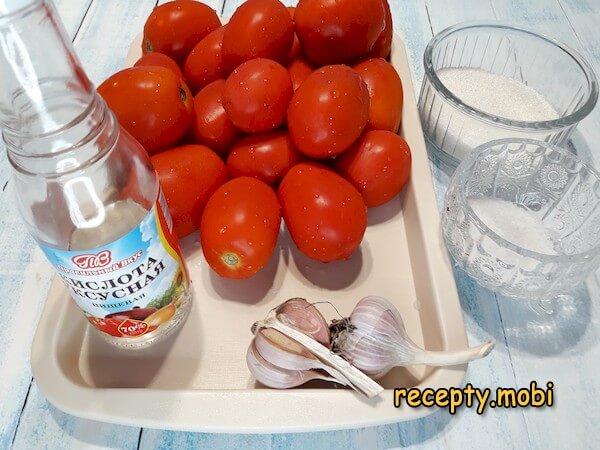
I prepare the ingredients. It is better to choose meaty, dense tomato varieties, such as plum tomatoes — loose, watery varieties can burst during the hot pour. Only rock salt, not iodised, is suitable for sealing: iodine gives a sharp aftertaste and a darkish tint. The vinegar essence is added straight into the jar. The quantity given is for a 1.5-litre jar; a 3-litre jar needs 1 tablespoon, so it is easy to calculate for any size of glass jar.
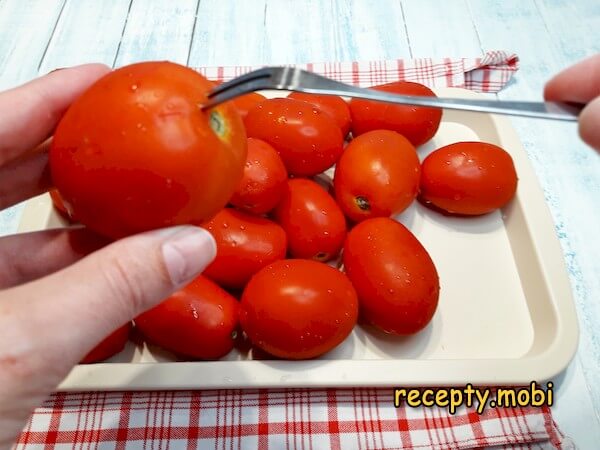
Using whatever method suits you, I sterilise the jars and boil the lids. I wash the tomatoes and pick out fruits of roughly the same size — uniform size means even heating during the hot pour. To stop the skins splitting when the boiling water goes in, I make a few pricks around the stem with a fork or toothpick — the steam inside the fruit escapes through the holes without tearing the skin.
I pack the tomatoes tightly into the prepared jar, but I do not press them down — if you shake the jar a little, the fruits settle into the gaps on their own. Tomatoes that are crammed in can split under the pressure of their neighbours.
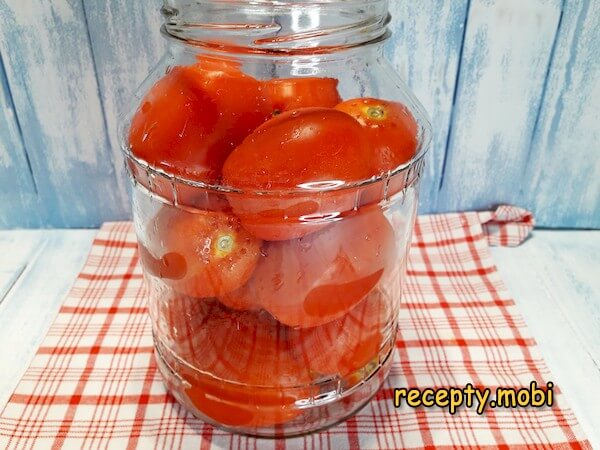
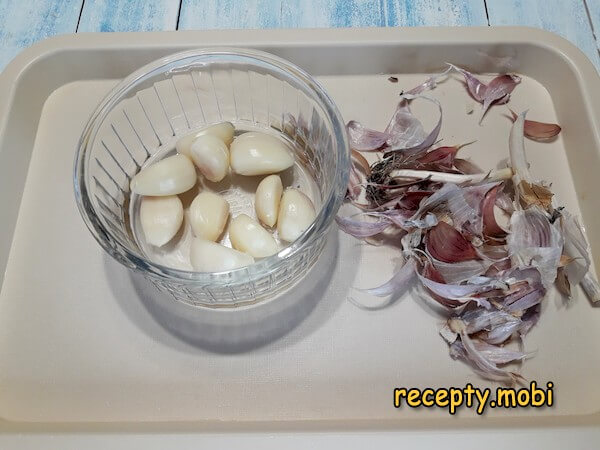
I peel the garlic — stray scales soften in the jar and spoil the look of the finished preserve.
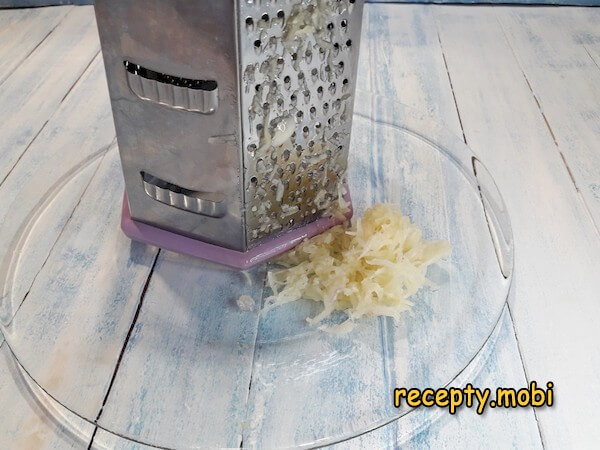
I grate the garlic on a fine grater. You can push it through a garlic press, but grating gives prettier, fluffy shavings that look magical on the tomatoes in the brine, just like "snow".
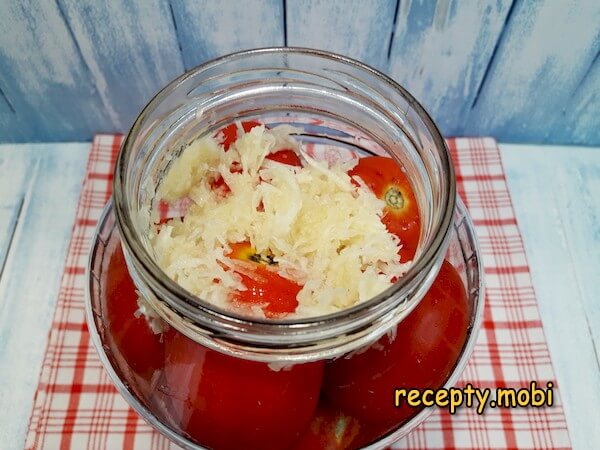
I transfer the garlic shavings into the jar with the tomatoes — they spread over the surface and into the gaps between the fruits.
I boil clean water and pour it into the jar with the preserve. I add the boiling water in portions, down the side of the jar, so the glass does not get a thermal shock and crack.
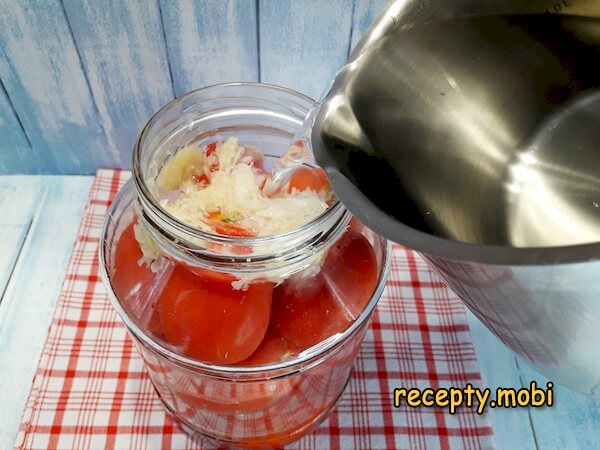
I cover the jar with a lid and let the tomatoes warm through for 20–25 minutes. During this time they partly pasteurise from the inside.

After this time I drain the water into a saucepan — I will use it to make the marinade. This water has already taken on the aroma of the tomatoes and garlic.
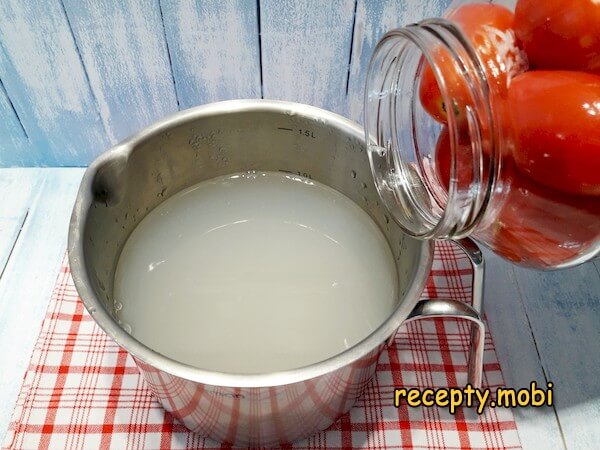
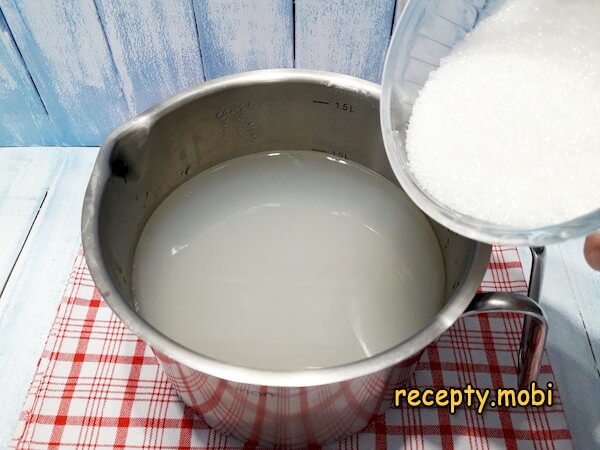
So that there is enough marinade and the calculation is easier, I top up the aromatic water drained from the jar with more clean water up to the 1-litre mark. I add the salt and sugar and boil it all for 30 seconds — that is enough to dissolve the salt and sugar without losing the aroma.
I pour the hot marinade into the jar — right up to the top, to keep the layer of air under the lid to a minimum.

I add a teaspoon of vinegar essence straight into the jar — right now, so that the acid does not boil away while the marinade is cooking. Added this way, the essence works as a preservative at full strength.
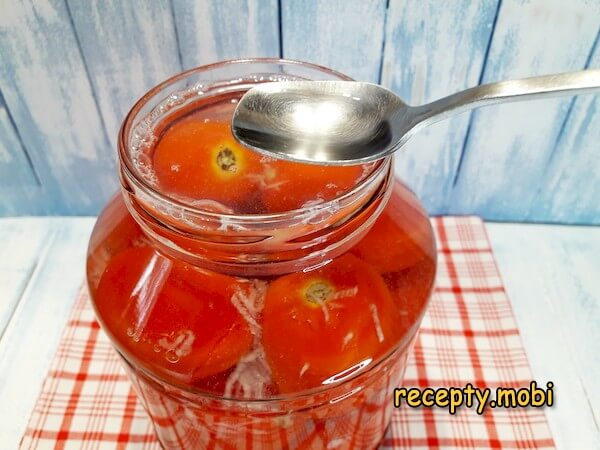
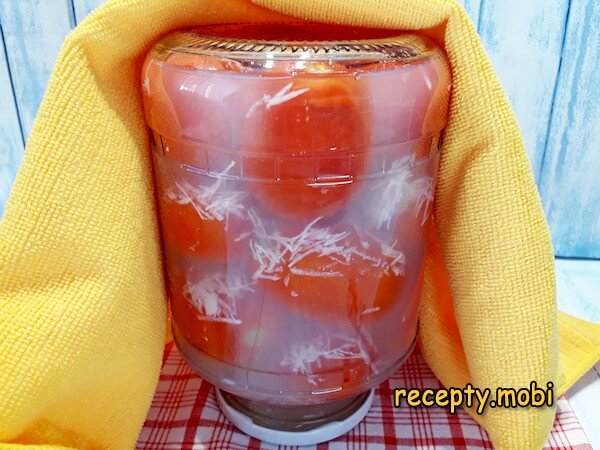
I screw on the lid, turn the jar upside down and wrap it in a warm blanket. In this warm bath the sealed jar should stand for at least 10 hours — slow cooling under the blanket works like a mini autoclave, finishing off any remaining microflora.Tomatoes in snow with garlic for winter are best stored in a cool, dark place. An opened jar of these tomatoes vanishes in an instant — they are simply too tasty. This snack brightens up even the plainest food, whether potatoes or porridge. It really is a striking and very tasty preserve, so do give it a try.


Tips
- 1
PRICKS AT THE STEM END — the "secret" against bursting. Without pricks, the boiling water makes the steam inside the tomato expand sharply and the skin splits. Four or five pricks at the base with a fork let the steam escape gradually, and the fruits stay whole.
- 2
GRATED GARLIC, NOT PRESSED — the "secret" of the "snowy" look. A press squeezes out a paste that settles in uneven lumps in the jar. A grater gives fluffy shavings that spread beautifully over the surface and create the "snow" effect — and that is where the recipe gets its name. The same trick works in tomatoes with horseradish and garlic for winter.
- 3
ESSENCE RIGHT AT THE END — the "secret" of the preservative's strength. Vinegar essence added to a boiling marinade evaporates. Adding it straight into the jar before sealing keeps all the acetic acid, so it works as a preservative at full strength.
- 4
10 HOURS UNDER A BLANKET — the "secret" of long storage. Without wrapping, the jar cools down in about 2 hours — not long enough to complete the pasteurising process. Under a blanket for 10 hours or more, the temperature stays high for a long time and the preserve is heated right through, as in an autoclave. The same principle is used in marinated green tomatoes for winter "Autumn Kaleidoscope".
Video
FAQ
Which tomatoes are best for "tomatoes in snow"? +
The classic choice is meaty, plum-shaped, dense varieties of 50–100 g: Slivka, Roma, Lady's Finger, Black Prince. Alternatives: yellow Yellow Plum (a premium option for colour variety), cherry tomatoes of 25–30 g (a premium choice for looks, though they need more vinegar), and the meaty Rio Grande (premium). Do not use: pink Bull's Heart (the flesh is loose and the fruits burst), overripe soft tomatoes, or ones with cracks or green patches — they lose their shape and spoil the look of the preserve. Best of all are tomatoes picked fresh from the garden on the day of canning.
Can I replace the vinegar essence with regular 9% vinegar? +
Yes, and it is even more convenient for home use. The swap: 1 teaspoon of 70% essence = 7 teaspoons, or about 2.5 tablespoons, of 9% vinegar. Alternatives: apple cider vinegar 6% (3.5 tablespoons — a soft, fruity accent) or white wine vinegar 6% (3.5 tablespoons — a premium option). Do not use: balsamic (dark, it will change the colour of the brine and the "snowy" look) or rice vinegar 4% (too weak for reliable preserving). The essence is more compact by volume, which is handy for small jars; 9% vinegar is more convenient for large batches.
How long do "tomatoes in snow" keep? +
In a cool pantry (8–15°C) — up to 2 years without loss of quality. In an ordinary kitchen cupboard at room temperature — up to 1.5 years. Once the jar is opened — 5–7 days in the fridge under a lid. Signs of spoilage: a bulging lid, cloudy brine with white flakes, fermentation bubbles, or a sour or rotten smell — I throw such a jar away. A properly made preserve develops a richer flavour with age: the garlic passes its aroma to the whole liquid, and the tomatoes become more piquant. After 1–2 months of storage the flavour is at its most balanced.
What do you serve "tomatoes in snow" with garlic with? +
It is a versatile snack. The classics are boiled or fried potatoes, buckwheat or rice. With meat: with kebabs, stewed meat, cutlets, or homemade dumplings. With fish: with fried river fish or boiled sea fish. On a sandwich: black bread with butter and a tomato on top, or rye bread with salo. With drinks: dark beer, vodka, or Georgian Saperavi wine. For a festive table: in a separate bowl with herbs and a slice of lemon. With warm tea: the tomatoes served cold after long storage. They suit both a family lunch and a large gathering equally well.
- Comment
or post as a guest
Be the first to comment.