avg —
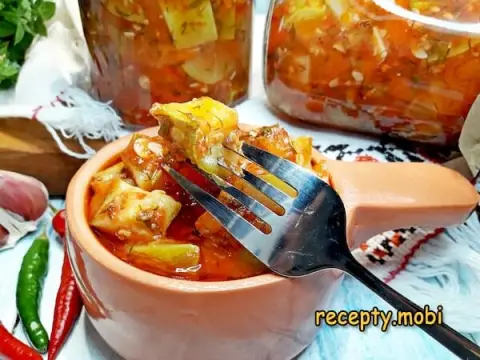
Georgian Style Eggplants for Winter

Instructions
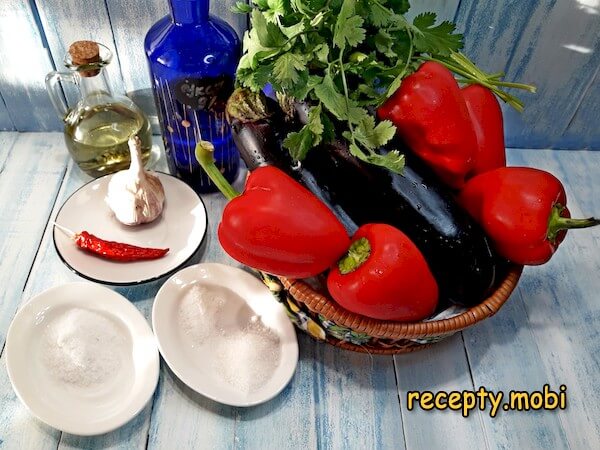
To make Georgian-style eggplants for winter, I get the ingredients ready. It's best to choose young eggplants that aren't too large, so the flesh is firm and there are as few seeds as possible. Ideally take red bell pepper — it gives the preserve a bright, attractive colour. You can adjust the amount of hot chilli to your own taste.
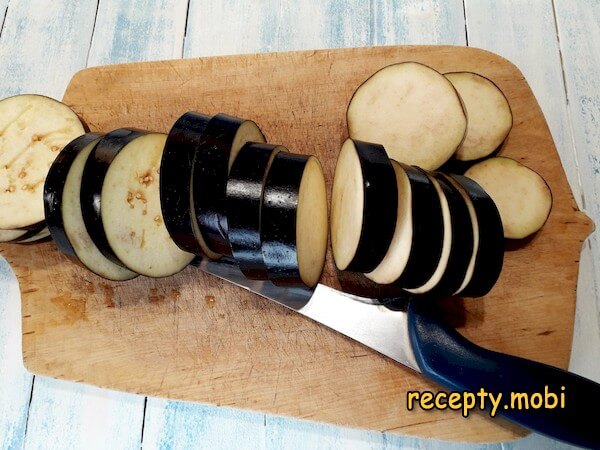
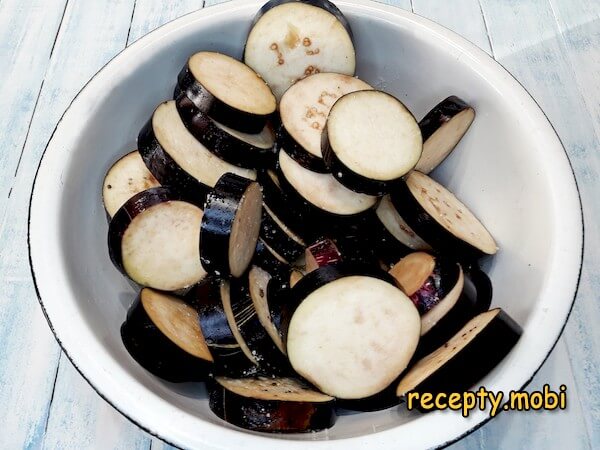
I wash the eggplants, cut off the stem and, without peeling them, slice into rounds 1-1.2 cm thick. The skin is needed so the rounds keep their shape during frying and then look good in the jar.
I put them into a deep bowl and sprinkle with salt (2/3 tablespoon). I mix and leave them like this for at least half an hour — during this time the bitter juice that could spoil the taste of the finished product is released. The salt draws solanine and bitter compounds out of the flesh.
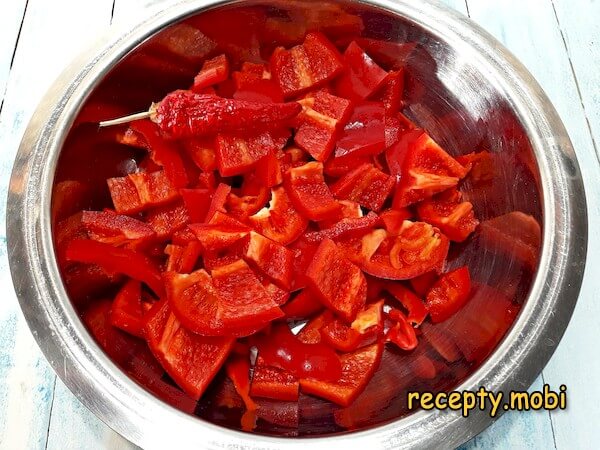
Meanwhile I prepare the dressing. I remove the seed pod from the bell pepper and cut it into pieces suitable for grinding. The chilli can be ground whole together with its seeds — they contain the most heat, which is the whole reason for this ingredient.
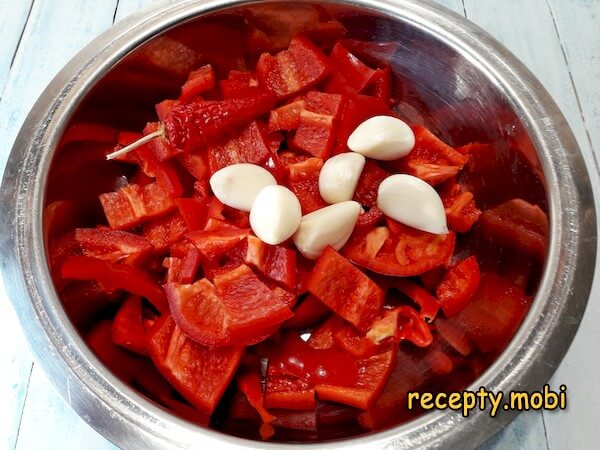
I peel the garlic cloves and add them to the bowl — garlic is especially important for Georgian-style preserves, it gives that characteristic Caucasian pungency.
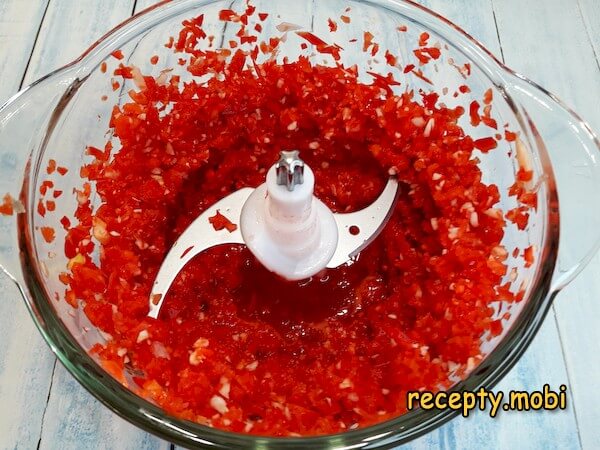
I load everything into a food processor or meat grinder — in a meat grinder the dressing comes out a little different, coarser, but it won't affect the taste. A blender gives a more uniform paste, a meat grinder gives a "grainy" dressing with a recognisable texture.

I grind the vegetables to a mushy consistency — the dressing should become a uniform mass with no large pieces of pepper, otherwise it won't spread well between the layers of eggplant in the jar.
I finely chop the herbs — chop them, rather than grind them in a blender. Ground herbs give an unpleasant swampy tint, while chopped herbs stay fresh and bright in colour in the finished dressing.
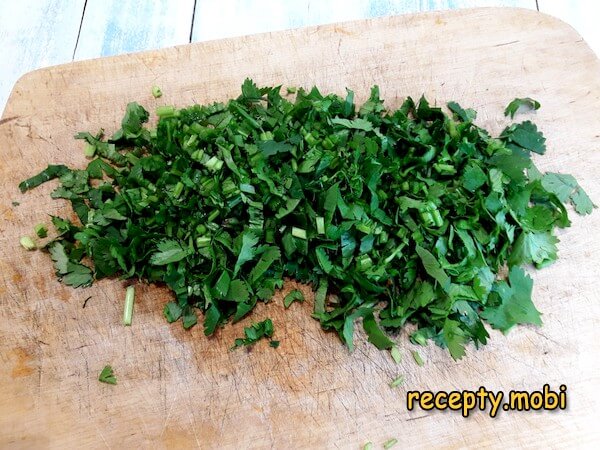
I transfer the pepper ground with garlic and the herbs into a bowl. I add salt, sugar and vinegar — the vinegar right now, so the acid doesn't destroy the vitamins of the fresh herbs during the long sterilisation.
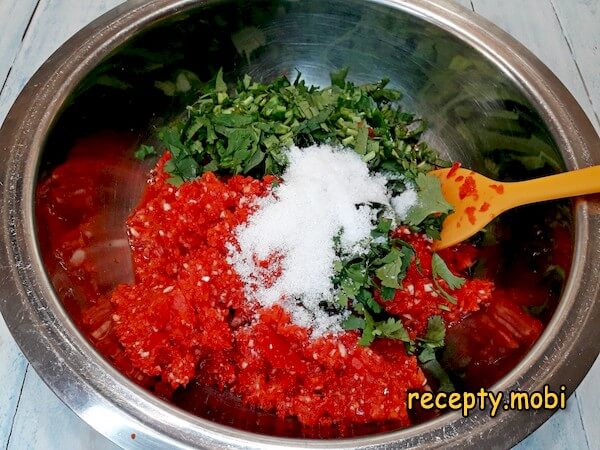
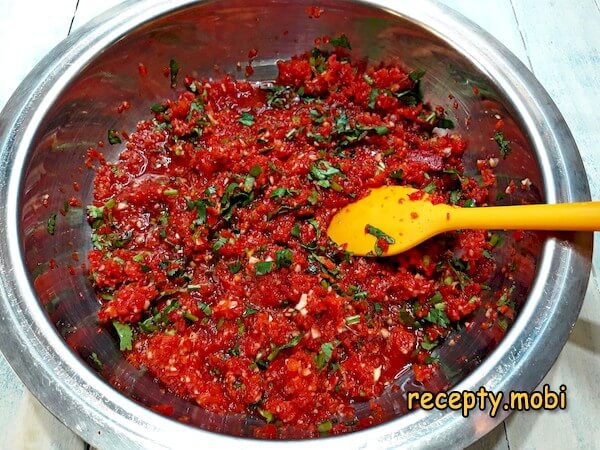
I mix everything and set it aside so the salt and sugar have time to dissolve. I sterilise the jars and lids — usually I hold them 5 minutes over steam or 10 minutes in the oven at 120 degrees.
In a skillet I heat a small amount of oil. I squeeze the moisture out of all the eggplant rounds — that way they absorb less oil during frying and won't splatter. I lay the eggplants into the skillet and set the heat to medium. I fry the rounds on both sides until lightly golden.
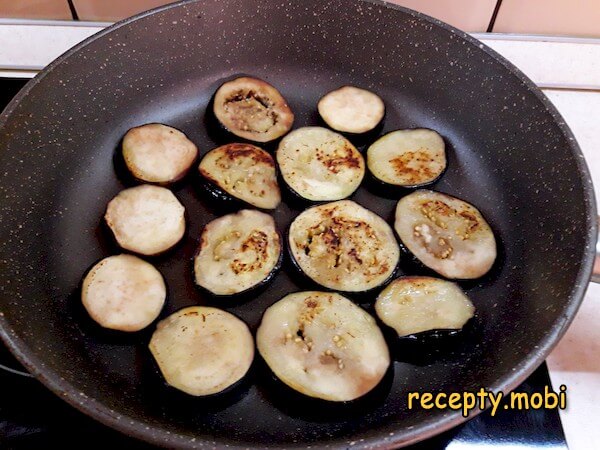
When frying a new batch I add about 2 tablespoons of oil to the skillet. I put the cooked eggplants on a plate — not on paper towels, otherwise they will soak up the beneficial oils that are needed for marinating in the jar.
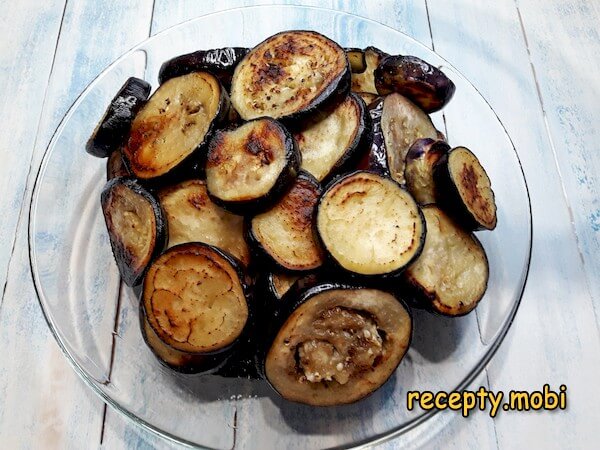
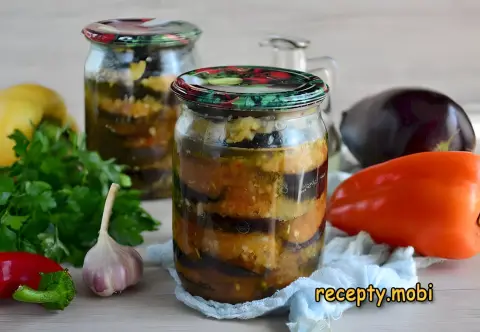
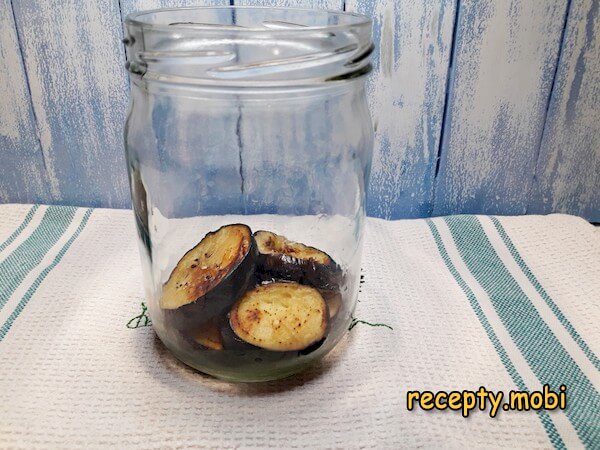
On the bottom of the jar I lay the first layer of eggplants — an even layer of rounds, with no gaps. How densely they are packed determines how much fits in the jar and how juicy the preserve will be.
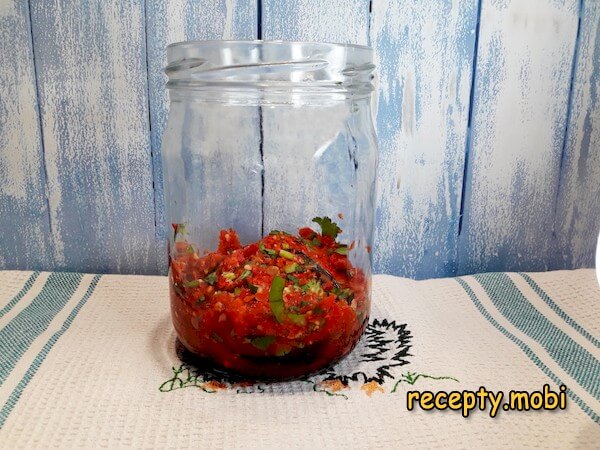
I cover them with dressing — about 2 tablespoons per layer. The dressing should completely cover the top layer of rounds, so they marinate evenly.
Alternating the layers like this, I fill the whole jar — eggplants / dressing / eggplants / dressing. The top layer should be dressing, so the eggplants are completely covered by the marinade.
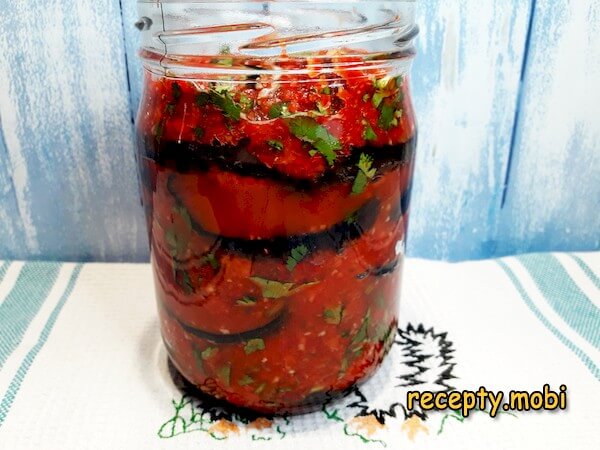
I cover the preserves with lids without screwing them down. You can use either screw-top lids and jars, or the kind that need to be sealed with a key — it depends on what equipment you have.
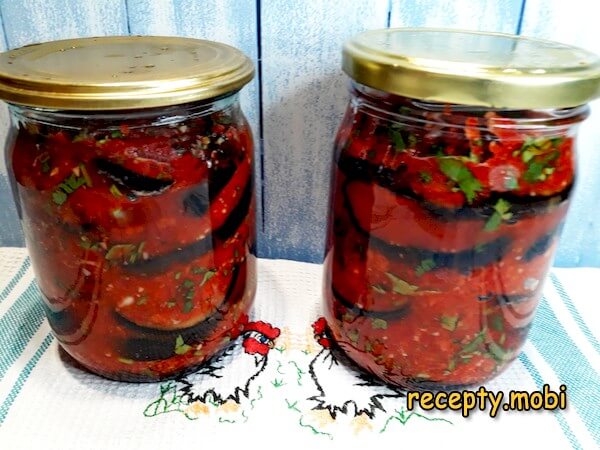
I lay a cotton cloth on the bottom of a large pot and stand the jars on it. I pour in cold water up to the shoulders of the jars and put the whole thing on the stove. After it comes to a boil, I sterilise the preserves in half-litre jars for 15 minutes (in litre jars – 20 minutes). The cotton cloth is needed so the jars don't crack from contact with the hot metal bottom of the pot.
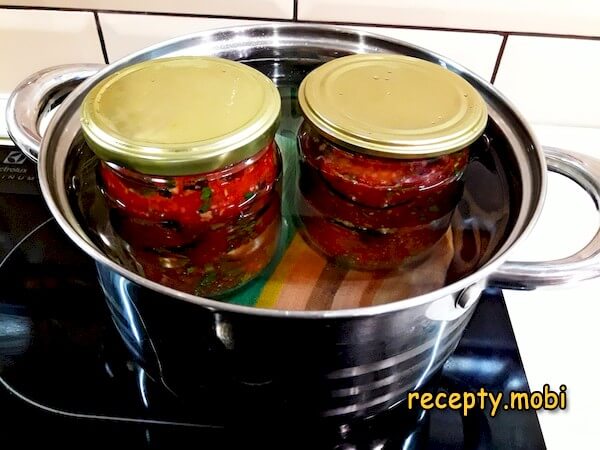
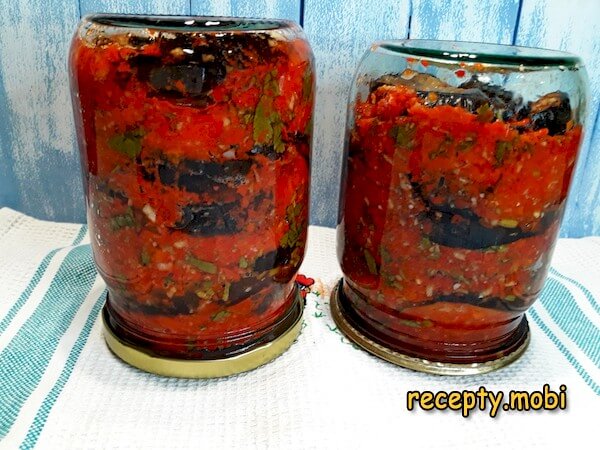
Then I carefully take the jars out and screw the lids on. I check that the seal is tight by turning the preserves upside down — if nothing leaks from under the rim, the seal is holding. I let them cool naturally under a blanket.


Tips
- 1
SALT FOR THE EGGPLANTS — the "secret" against bitterness. Half an hour in coarse salt draws the bitter solanine and dark juices out of the eggplant flesh. Without this step the finished preserve may taste bitter, especially if the eggplants aren't the youngest. After the salt treatment the rounds need to be squeezed of moisture — that way they absorb less oil during frying and won't splatter.
- 2
VINEGAR IN THE DRESSING — the "secret" of even acidity. The vinegar goes into the cold dressing, not separately into the jar — that way it spreads evenly through the whole volume together with the other components. If added separately, the lower layers turn out bland and the upper ones too sour, because the vinegar settles to the bottom.
- 3
ALTERNATING THE LAYERS — the "secret" of even soaking. If you put all the eggplants at the bottom and the dressing on top, the lower layers stay "bare" and don't soak through. Alternating "eggplant / dressing / eggplant" layers ensures every round is in contact with the marinade, and the preserve turns out evenly spiced throughout. The same principle is used in eggplants for winter in Jewish style.
- 4
STERILISING WITH COLD WATER — the "secret" against cracking. You can't put jars into hot water — the sudden change in temperature will cause cracks. Cold water with the jars in it heats up gradually together with them, so the risk of cracking is completely eliminated. The cotton cloth on the bottom of the pot gives extra protection against point contact with the hot metal.
FAQ
Why salt the eggplants before frying? +
Young, fresh eggplants can be fried without pre-treating them with salt, but larger and more mature ones definitely need this preparation. The salt draws solanine out of the flesh — a toxic compound that in large amounts gives bitterness and can cause mild digestive upset. In addition, the salt firms up the texture of the flesh — after salting, eggplants don't absorb as much oil during frying as "fresh" ones do. For half a kilogram of eggplants, 2/3 of a tablespoon of coarse salt and 30-40 minutes of resting is enough.
How long do Georgian-style eggplants keep? +
In a cool pantry at a temperature of 8-15°C — up to one year without loss of quality. In an ordinary kitchen cupboard at room temperature — up to 8-9 months. After opening the jar — 5-7 days in the fridge under a lid, ideally with a layer of vegetable oil poured on top. Signs of spoilage: a bulging lid, cloudy filling with bubbles of fermentation, a film of mould on the surface, a sour or fermented smell — I throw such a jar out without regret. When the technique is followed, the preserve keeps reliably all season.
Can the 9% vinegar be replaced with something else? +
Yes, in equivalent proportions. Substitutes: 6% apple cider vinegar (2.2 tbsp – milder, with a fruity note), 6% white wine vinegar (2.2 tbsp – neutral, the classic for Caucasian preserves), 70% vinegar essence (1/5 tsp = 1.5 tbsp of 9%). Don't use: balsamic (dark, it will change the colour of the dressing), 4% rice vinegar (too weak for reliable preservation); fresh lemon juice isn't suitable either — it doesn't have the acid concentration needed for long storage. For the classic version, use table 9% vinegar.
What do you serve Georgian-style eggplants with? +
A versatile spicy starter. The classic — with boiled potatoes drizzled with butter and sprinkled with green onion. With pork or lamb shashlik: the spicy dressing nicely sets off the fatty meat. With pilaf, with fried fish, with baked chicken — it works everywhere as a bright, spicy accent. As part of an elaborate Georgian table: alongside khachapuri, lobio, ajapsandali. You can cut it into thin strips and wrap it in lavash with herbs — it makes an excellent snack on the go. With alcohol: dry red wine (Saperavi, Kakheti), Georgian chacha.
- Comment
or post as a guest
Be the first to comment.