avg —
Korean Style Asparagus

Instructions
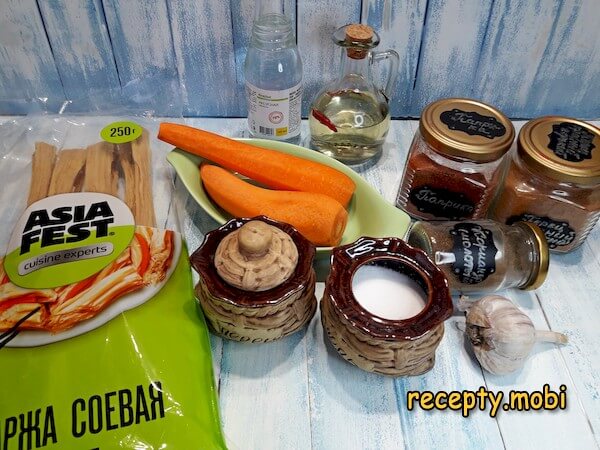
I prepare the ingredients for the Korean-style asparagus. It is important to choose good-quality asparagus, because the taste of the finished dish depends directly on it. You can buy ready-made Korean-style carrots at the market, but it is better to make them yourself the day before so you are sure of the quality – the full technique is in the article on Korean-style carrots at home.
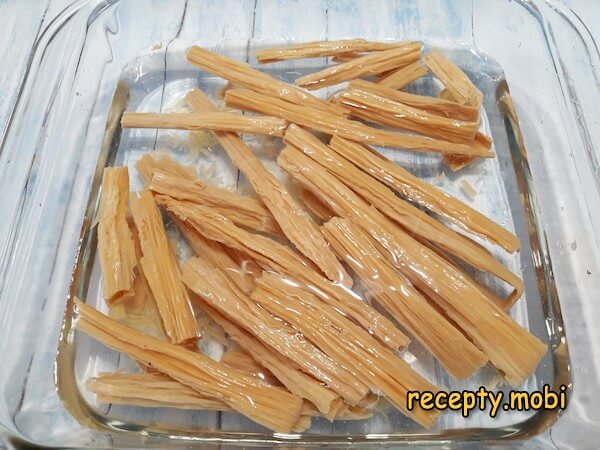
The soy asparagus should be soaked in room-temperature water. Depending on the manufacturer this takes a different amount of time – from 5 to 10 hours. During this period you need to check the asparagus so as not to miss the moment when it is ready, because with prolonged soaking the fibres fall apart and take on an unappealing look. But poorly soaked asparagus is no good for cooking either – its taste will remind you of wood. The golden mean matters here.
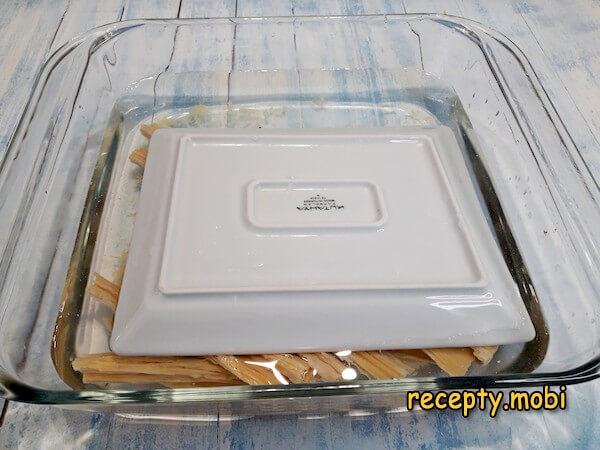
So that the pieces are covered with water on all sides, I place a saucer or small plate on top. I change the water 2–3 times over the whole period and check the state of the fibres – this batch soaked for 10 hours.
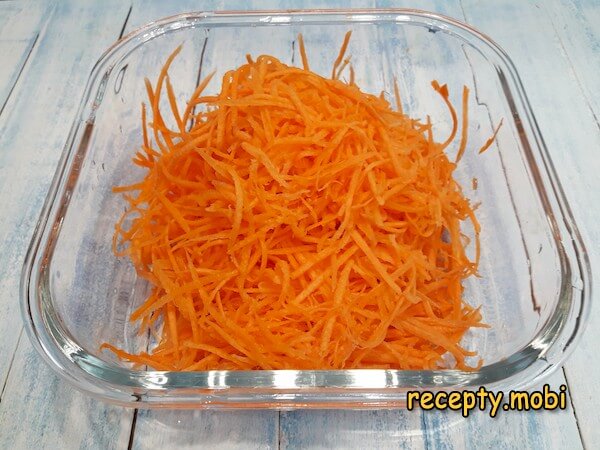
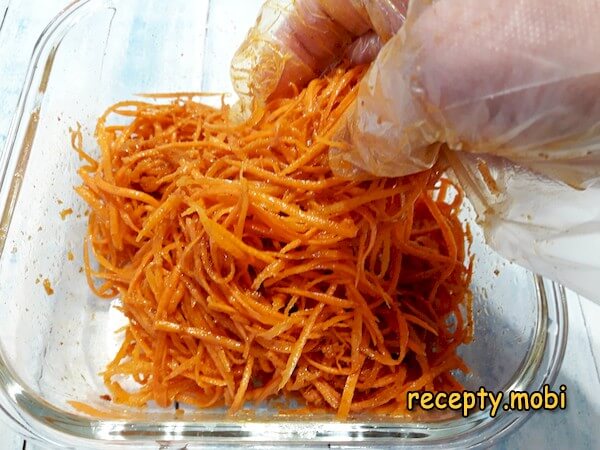
Meanwhile, I make the Korean-style carrots. I grate the root vegetable into long thin strips using a special grater for Korean salads – fine long strips give the right texture for Korean carrots.
I press 2 cloves of garlic through a press – a press is preferable for an even spread of the garlic aroma.
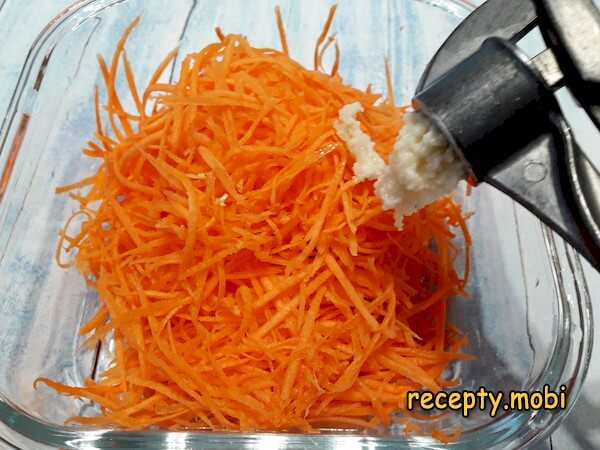
I add the sugar, hot pepper, paprika, and coriander – the classic Korean "bouquet" of spices for a carrot salad.
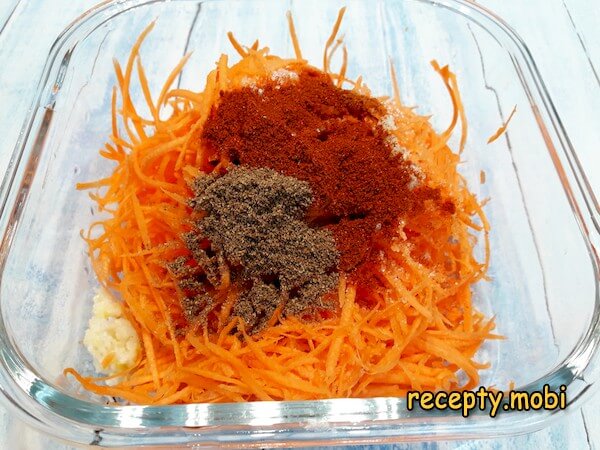
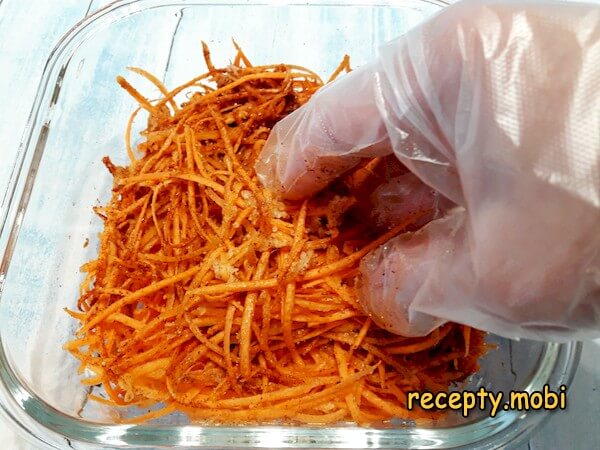
I mix the whole mixture thoroughly – the spices should be spread evenly through the carrot.
I heat the vegetable oil strongly and pour it over the mixture – it has to be strongly heated oil, to a light wisp of smoke. This is the "secret" of Korean salads: hot oil "activates" the aromas of the spices.
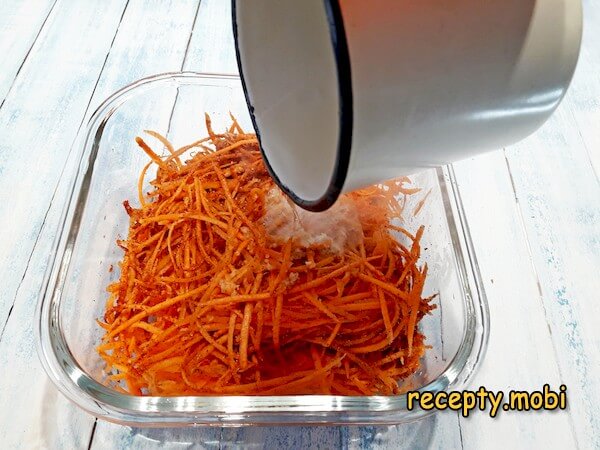
I mix everything well again, cover with a lid, and put it in the fridge to infuse – the longer the dressing stands, the better the carrot soaks up all the components.
When the asparagus has softened, I drain the water from it and lightly press the sticks to release moisture, but not too hard – the asparagus should stay juicy. Over-pressing gives a "dry" finished product.
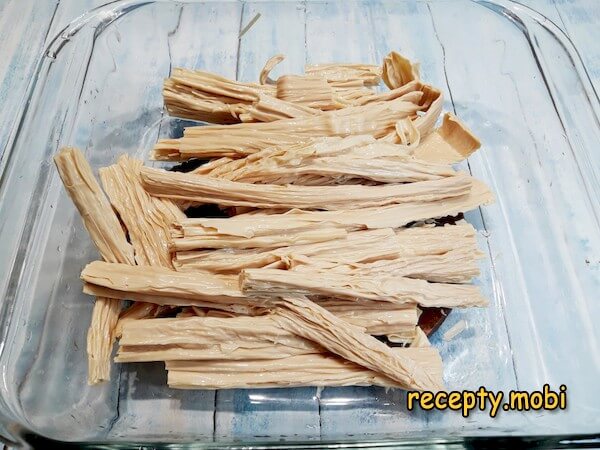
I cut the asparagus sticks into 4-centimetre pieces – this is the "right" size for Korean serving.
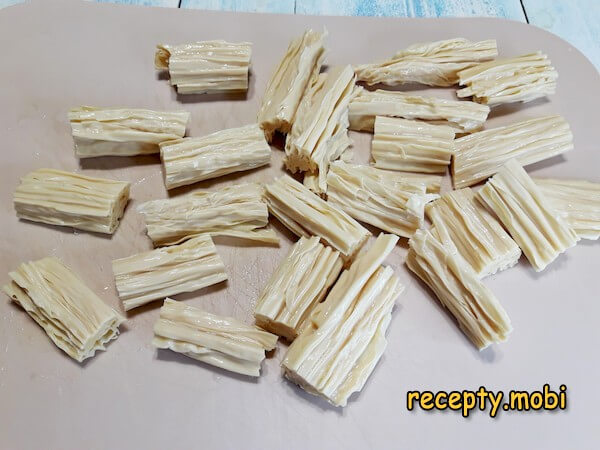
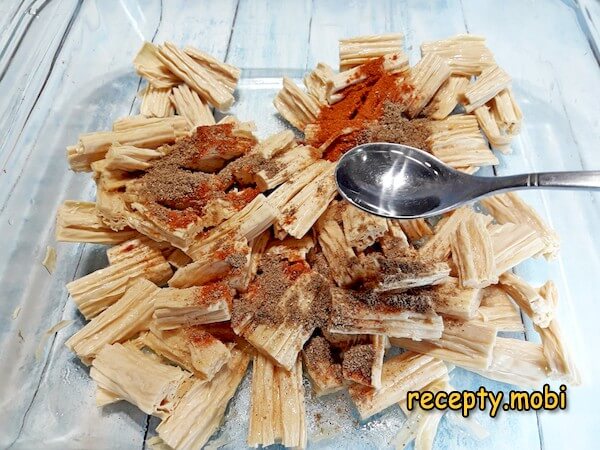
I salt them – right now, after cutting, so the salt is spread evenly over all the pieces.
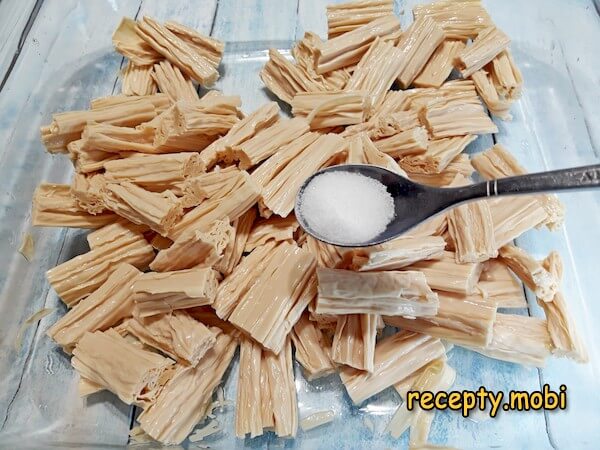
I add sugar – it balances the taste and gives the characteristic Korean sweet-and-spicy profile.
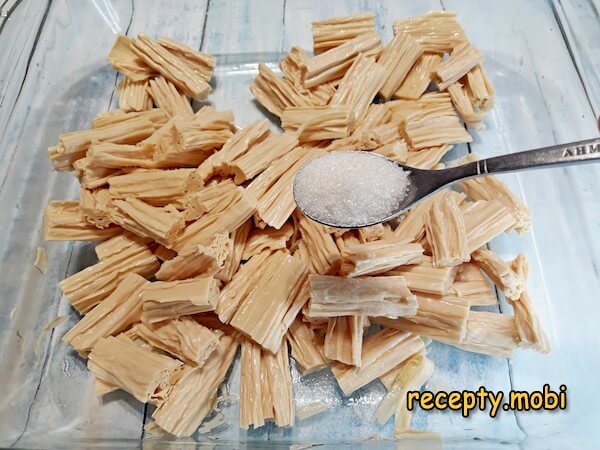
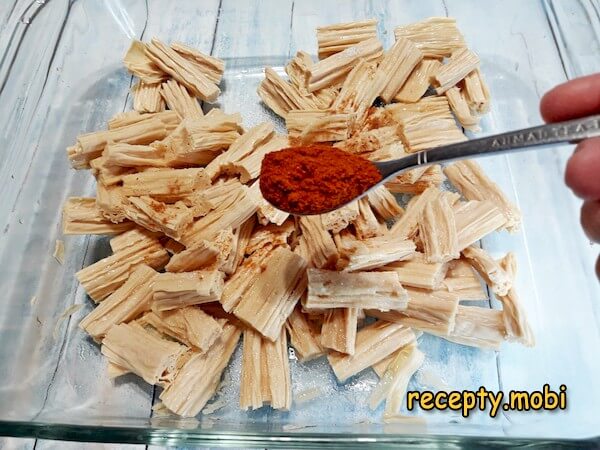
Next – the hot pepper. I adjust the amount to taste: less for mild heat, more for fiery.
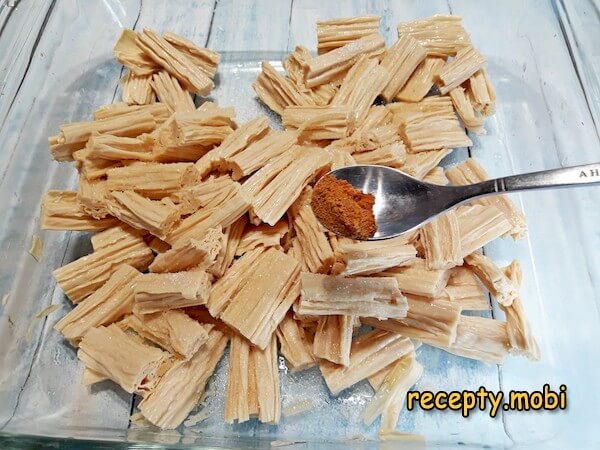
After it – the paprika. It gives a characteristic reddish colour and a light smoky aroma.
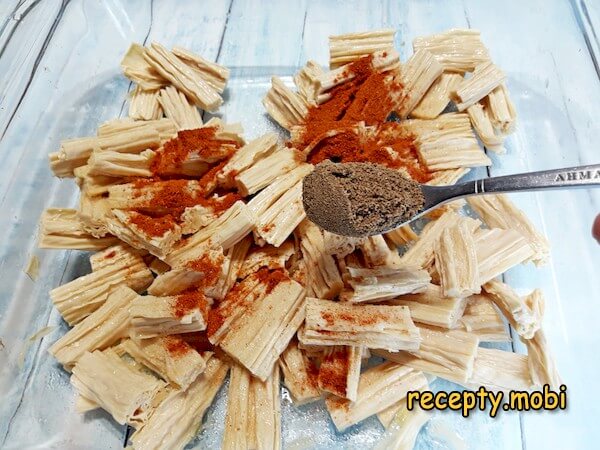
And the coriander – an essential Korean spice for an authentic taste.
I dress it all with the acetic acid – specifically 70% acetic acid, not ordinary 9% vinegar. The concentrated acid gives the "sharpness" a Korean salad needs.
I press in the garlic – through a press for an even spread.
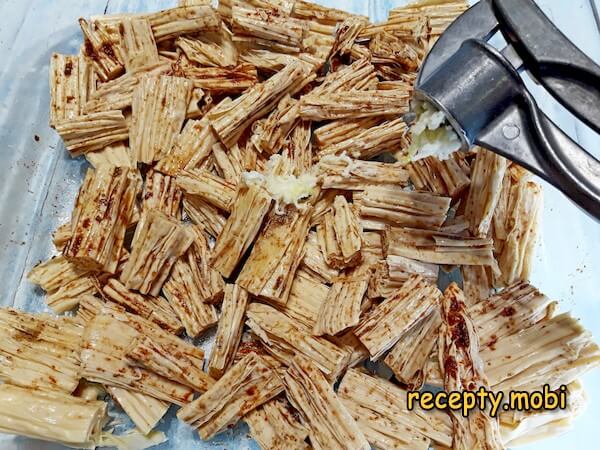
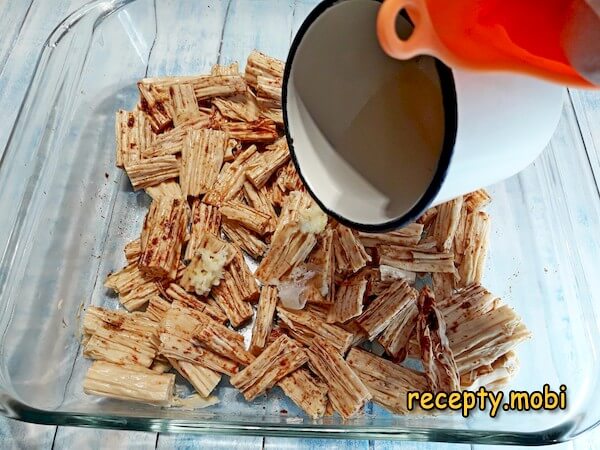
As with the Korean carrots, I heat the vegetable oil strongly and pour it over the asparagus. I mix everything thoroughly – the hot oil "works" the spices and gives them a "roasted" aroma.
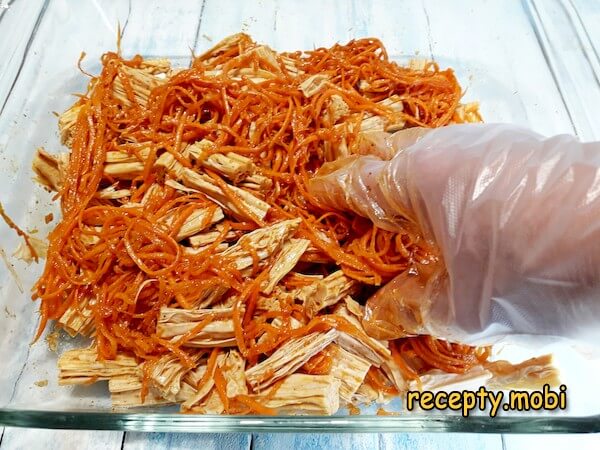
I add the already-prepared Korean carrots to the mixture – joining the two Korean preparations into one.
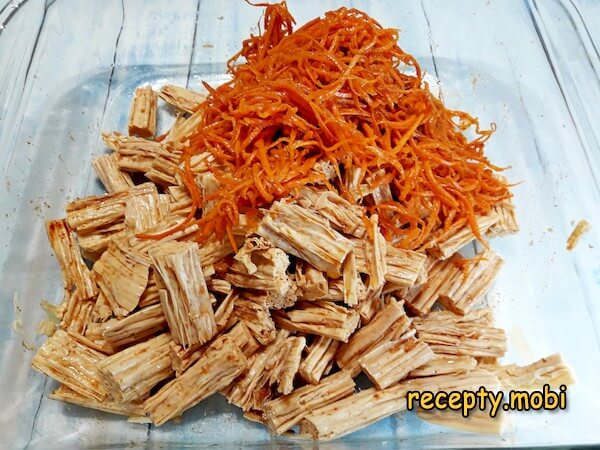
I mix everything again so the components are spread evenly. At this point the cooking is finished, but if you let the dish stand for a little while, at least 20 minutes, the result will be tastier – the ingredients "infuse" into one another.


Tips
- 1
The golden mean of soaking is the "secret" of the right texture. Under-soaked asparagus has a woody texture, while over-soaked asparagus falls apart into mush. The ideal: the asparagus should become pliable and soft, but keep its springiness and stick shape. The time depends on the manufacturer: 5–10 hours. A good guide is to check every 1–2 hours after the 4th hour of soaking.
- 2
Hot oil over the spices is the "secret" of an authentic Korean dressing. This is the main technique of Korean salads. Cold oil simply "mixes" with the spices. Hot oil (to a light wisp of smoke) "works" the spices – they release the most aroma and take on a characteristic "roasted" note. This is the "secret" of Korean cooks that turns an ordinary salad into an authentic one.
- 3
70% acetic acid, not 9% vinegar, is the "secret" of concentrated acidity. Ordinary 9% vinegar does not give the acidic "sharpness" a Korean salad needs – you would need too much. Concentrated 70% acetic acid gives the right proportional "sharp" note in small amounts (2 tsp per 250 g). This is the "secret" of authentic Korean proportions.
- 4
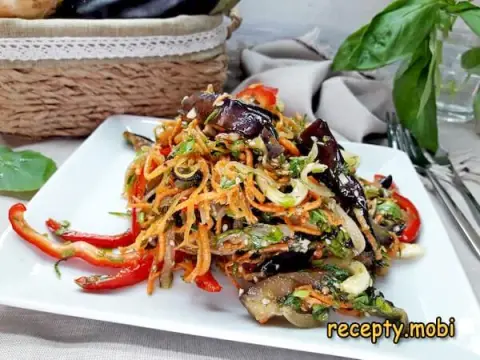
The combo with carrots is the "secret" of a double Korean serving. Soy asparagus on its own is a decent snack, but combined with Korean-style carrots it becomes a "duet of bright Korean flavours". A similar principle of a "Korean salad with a double make-up" works in Korean-style eggplant he – the same hot-oil-over-spices technique for a different ingredient.
FAQ
What is soy asparagus and where can I buy it? +
Soy asparagus (fuchzu, yuba, tofu sticks) is the dried skin that forms when soy milk is boiled. It has nothing to do with real asparagus from the "garden asparagus" plant. It is produced in China, Korea, Japan, and the Russian Far East. You can buy it in supermarkets in the Asian food section, in specialist "Asian" shops, and on online marketplaces (Wildberries, Ozon, Yandex.Market). Good soy asparagus is dry, light yellow, without an unpleasant smell, and with a characteristic fibrous structure. Poor-quality asparagus is dark, with cracks and an unpleasant "musty" smell.
Can I substitute the 70% acetic acid? +
Yes, in equivalent proportions. Substitutes: 9% vinegar (1 tbsp instead of 2 tsp of acid), 6% apple cider vinegar (1.5 tbsp – milder, fruity), 6% white wine vinegar (1.5 tbsp – neutral), 4% rice vinegar (2 tbsp – a more "Asian" character). Fresh lemon juice also works (3 tbsp) – it gives a fresher citrus accent. I do not recommend: balsamic vinegar (dark, it will change the colour) or malt vinegar (a specific English taste that does not suit Asian cuisine).
How long does Korean-style asparagus keep? +
In the fridge in an airtight container – up to 5 days without loss of quality. On the 2nd or 3rd day the taste becomes richer – all the components "infuse" into one another. Take it out 30 minutes before serving – straight from the fridge the asparagus tastes "muted". I do not recommend freezing it – after thawing the texture becomes watery and falls apart. Dry soy asparagus in its original form keeps for years in a dry dark place – take only as much as you need for cooking.
What goes well with Korean-style asparagus? +
It is a versatile Korean snack. The classic Korean serving is with other Korean "banchan": kimchi, pickled cucumbers, pickled daikon radish. With rice: with plain boiled rice or jasmine rice. With meat: with shashlik, barbecue, Korean bulgogi, or fried pork. With fish: with Peking duck or grilled salmon. For a big spread: as part of an assortment of 5–7 different banchan snacks on a Korean table. With drinks: soju (Korean vodka), cold light beer, or green tea.
- Comment
or post as a guest
Be the first to comment.