
avg —
Homemade Cream Cheese

Instructions
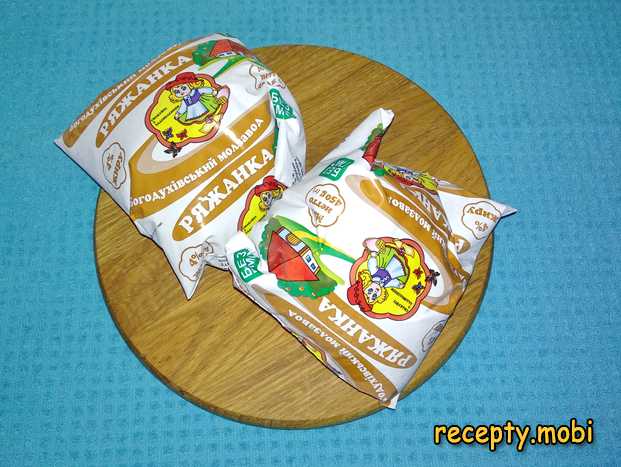
I prepare the ingredients – the simplest possible list. I buy good-quality 4% fermented baked milk from a trusted producer. For a budget option, ordinary fermented baked milk from the nearest shop in standard 450 ml packages will do. Take 2 packages (900 ml in total) – ideal for a family, for 1 portion of cheese.
CRITICAL STEP: put BOTH packages of fermented baked milk straight into the freezer (without opening them) for at least 6 hours, ideally 12 hours or overnight. The aim is to deep-freeze the product until it is fully crystallised. Without full freezing the cheese will not work – this is the secret of the technique.
Alternative cultured dairy products for homemade cream cheese: kefir 2.5–3.2% (gives a more "neutral" flavour without the baked-milk note), plain unsweetened yoghurt (a more "European" version), sour cream 15–20% (a richer, fattier cheese), or a 50/50 mix of fermented baked milk and sour cream (a more intense flavour). Each product gives its own character.
The next day (after 12 hours) I check that they are ready – the packages should be "rock hard", frozen solid all the way to the centre. If the centre is still soft, leave them in the freezer for a few more hours.
I prepare the tools for thawing. I take a deep bowl of 2–3 litres (the whey will drain into it). On top I set a colander or a fine-mesh sieve.
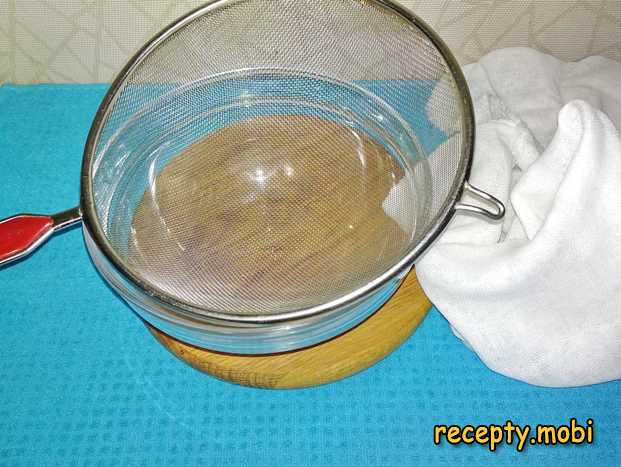
I line the colander with cheesecloth in 4–6 layers – this thickness will hold back the curd flakes and let only the liquid whey through. An alternative is clean cotton fabric (an old towel, muslin). The ends of the cheesecloth should hang over the edges of the colander – I will use them to cover the cheese on top.
I take the frozen packages of fermented baked milk out of the freezer. I carefully open the packages with scissors or a knife – inside there will be an "ice brick" of your fermented baked milk. I transfer the frozen mass into the prepared colander lined with cheesecloth.
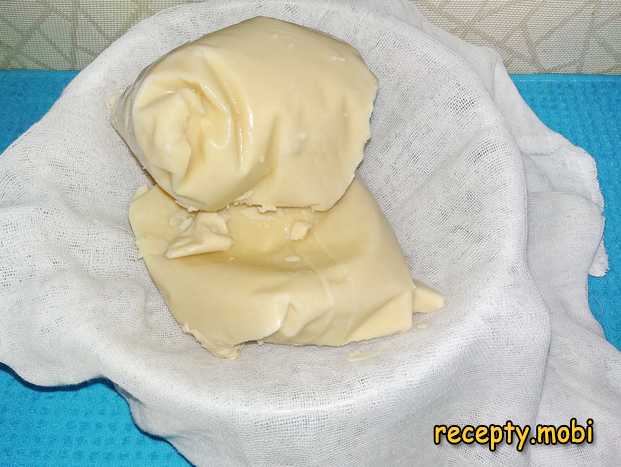
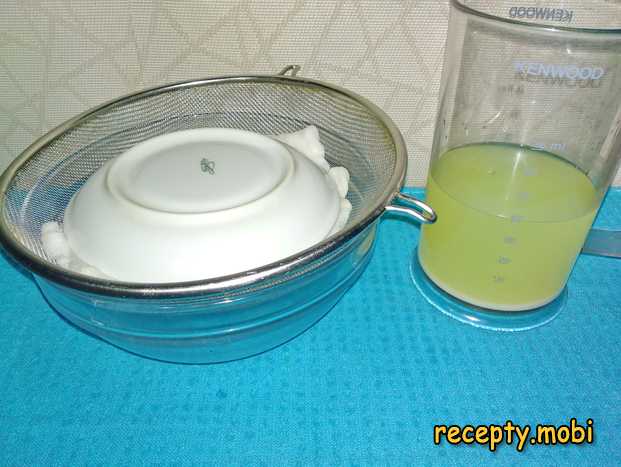
With the free ends of the cheesecloth I cover the frozen fermented baked milk on top – this protects it from dust and ensures even thawing. I leave the bowl with the colander on the table at room temperature (18–22°C) until it is COMPLETELY thawed. This will take 8–12 hours depending on the temperature in the room.
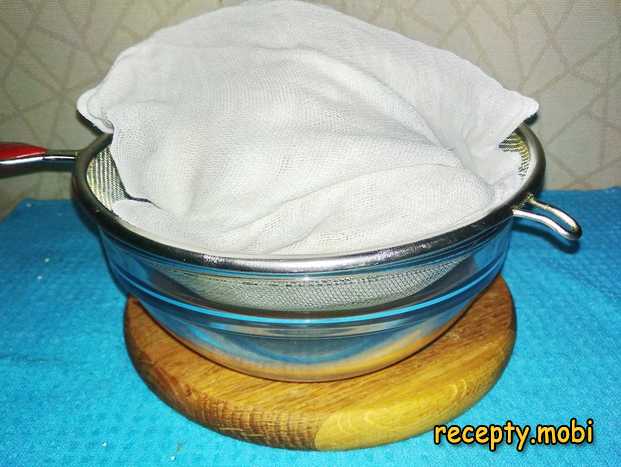
CRITICAL STEP: do NOT heat it or help the thawing along – the fermented baked milk must thaw on its own, slowly. Only then will the curd part separate from the whey correctly. Rapid thawing (in the microwave, on a radiator) will give a poor-quality product.
As it thaws you will see the magic: clear yellow whey drains into the bowl below, while a dense white curd mass stays in the cheesecloth – this is your future cream cheese. Do NOT throw the whey away – it is useful for pancakes, okroshka and homemade bread.
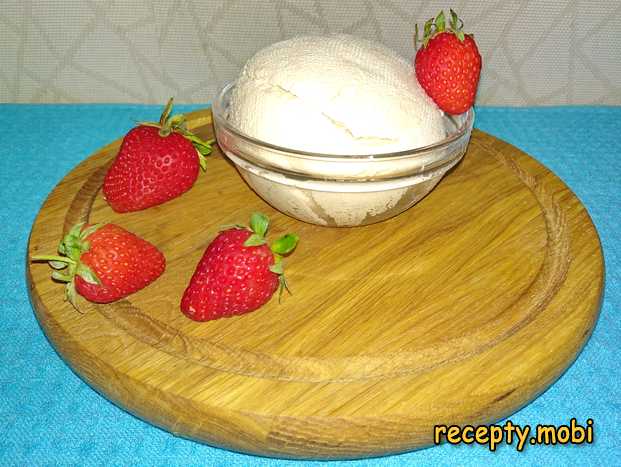
After 8–12 hours the thawing is complete. I carefully open the free ends of the cheesecloth. In the colander there is a dense, uniform cream cheese – a soft cream colour, with the characteristic baked-milk aroma of fermented baked milk.
If you like, for a "drier" cheese I place a small weight on top of the cheese in the cheesecloth (a plate with a 200 ml jar of water). The excess moisture will drain off in 1–2 hours and the cheese will become even denser. For the classic cream cheese texture no weight is needed – the cheese is already perfect.
I transfer the finished cheese into a clean glass jar or a container with a lid. Homemade cream cheese from fermented baked milk is ready! You get 350–400 g of tender cream cheese with a characteristic slightly sweet baked-milk flavour. It is unsalted and not sour, because the fermented baked milk was not heated and underwent no extra fermentation.


Tips
- 1
You MUST freeze the fermented baked milk COMPLETELY (at least 6 hours, ideally overnight) – without this the cheese will not work.
- 2
Thaw it SLOWLY at room temperature – heating or the microwave will ruin the structure of the cheese.
- 3
Do not throw the whey away – use it for pancakes, okroshka and dough. Following a similar principle, I make homemade feta cheese.
- 4
Use 4% fat fermented baked milk – low-fat milk will give little cheese and it will be "dry".
FAQ
What can I use the finished cream cheese for? +
It is a versatile base for many dishes: carrot cake with spices (a classic), New York cheesecake (350 g of cheese in the base), frosting for cupcakes and cakes (whipped with butter and icing sugar), filling for eclairs and profiteroles, salmon sandwiches (spread on rye bread + salmon + dill), a cheese snack to serve with wine (with crackers, nuts, honey), pasta sauce (melted with milk and Parmesan), filling for pancakes with chocolate, a dessert mousse with berries, and frosting for no-bake cheesecakes. A universal replacement for expensive Philadelphia in any recipe.
How does homemade cheese differ from shop-bought cream cheese? +
The main differences. Homemade from fermented baked milk: a slightly sweet baked-milk flavour, a soft cream colour, a fresher aroma, no preservatives or stabilisers, a budget price (40–60 roubles for 350 g). It suits cakes, frostings and sandwiches. Shop-bought (Philadelphia, Mascarpone): the characteristic tangy-creamy taste of Philadelphia, a denser standardised texture, a long shelf life (thanks to preservatives), a price of 250–400 roubles for 200 g. It suits classic cheesecakes and Italian desserts with a pronounced "factory" taste.
How long does homemade cream cheese keep? +
The finished cheese keeps in the refrigerator for up to 7 days in a tightly closed glass jar or container. The longer it is kept, the more whey separates in the jar, so drain it off from time to time to keep the cheese thick. Do not freeze the finished cheese – the structure will "split" on thawing and lose its characteristic creamy consistency. For longer storage, freeze the raw fermented baked milk in its packages (up to 3 months) and make the cheese as needed. It is best to use the cheese on the day it is made for cakes and cheesecakes – the texture is at its most tender.
Can I make a savoury (salted) cream cheese? +
Yes, for a savoury version (like Almette or Boursin) add the following to the finished cheese after the whey has drained: salt (½ tsp per 350 g of cheese), finely chopped herbs (dill, parsley, spring onion), crushed garlic (1 clove through a press), ground black pepper and your favourite spices (paprika, smoked paprika, oregano, basil, Italian herbs). Mix thoroughly with a spatula and leave in the refrigerator for 2 hours to infuse. You get a homemade cream cheese with herbs for sandwiches, filling lavash and topping tartlets. Ideal for a festive table as a snack to serve with wine.
- Comment
or post as a guest
Be the first to comment.