avg —
Salted Mushrooms for Winter

Instructions
I prepare all the ingredients — their exact quantities will be calculated later, after the mushrooms are boiled and weighed. I carefully sort through the honey mushrooms, trimming the stems near the mycelium, and for mature specimens I cut the stems off entirely, leaving only the cap — old stems are tough and fibrous.
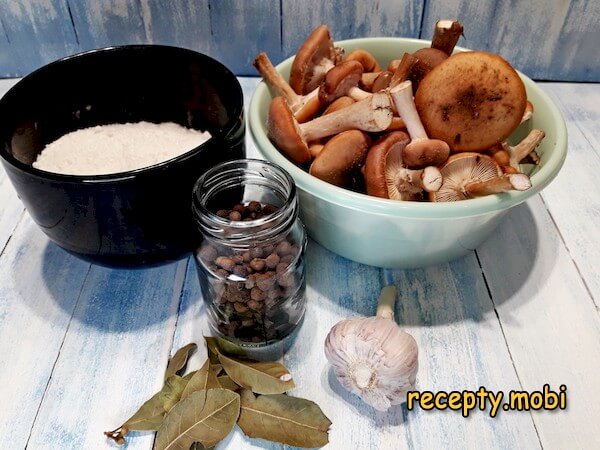
Then I pour cold water over the honey mushrooms and leave them for half an hour — after this they are much easier to clean. Forest honey mushrooms are usually heavily soiled: leaves, pine needles and forest dust all soften and wash off easily after a half-hour soak.
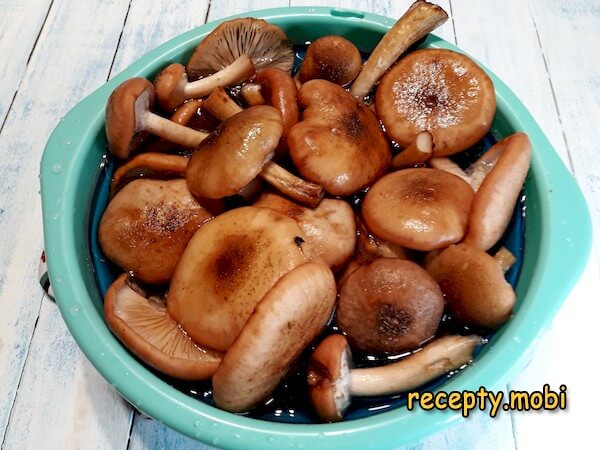
I rinse each mushroom, and cut the large caps into 3-4 pieces — that way all the pieces come out roughly the same size and cook evenly. I leave the small honey mushrooms whole, so they look nice in the jar.
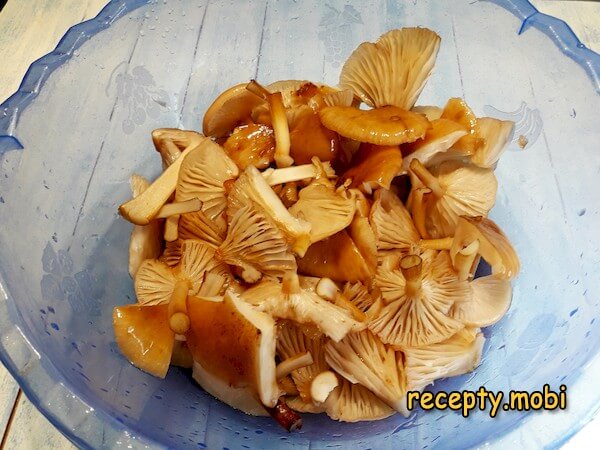
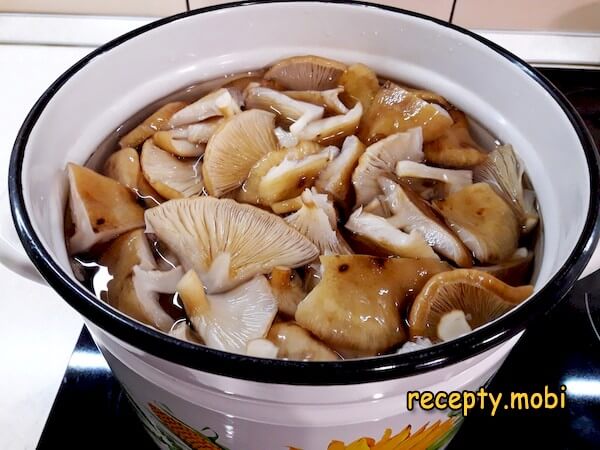
I put the honey mushrooms in a pot and add enough water for them to float freely. I boil the mushrooms for half an hour from the moment the water boils, without adding salt. There's no need to skim the foam, since this cooking water will be poured away — it is "dirty" with forest particles and microflora.
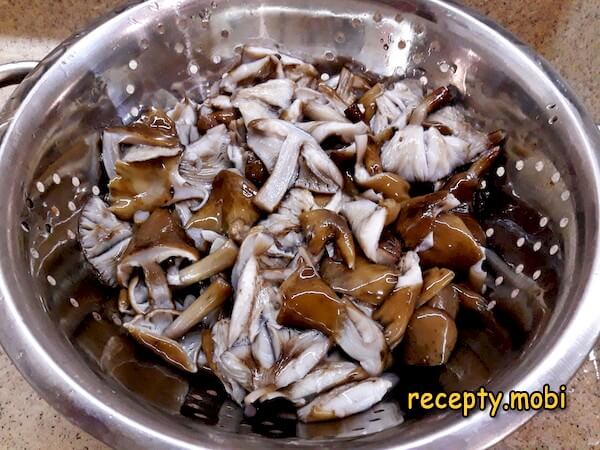
Then I rinse the honey mushrooms under running water and put them in a colander to drain — rinsing removes any remaining slime and keeps the future brine clear.
To work out what container you'll need for salting, it's best to do a preliminary fill. Say it's going to be a litre jar — it needs to be filled with mushrooms to more than two-thirds of its volume. The honey mushrooms should float in the brine, but there shouldn't be too few of them either, or the jar will end up half empty.
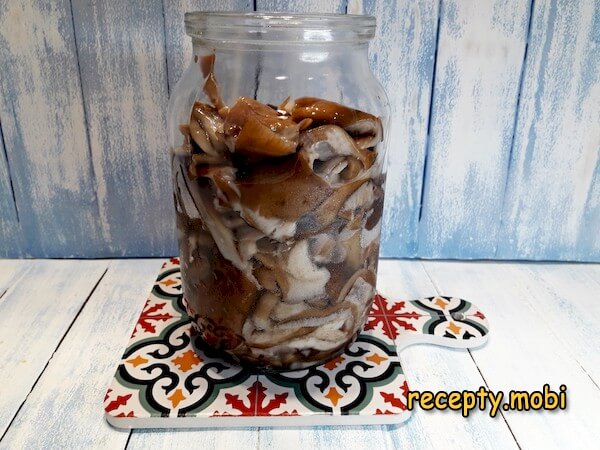
Now the whole contents of the jar need to be weighed — 740 grams of honey mushrooms fit into the litre jar. Knowing the exact weight is needed to calculate the salt and water proportionally for this portion.
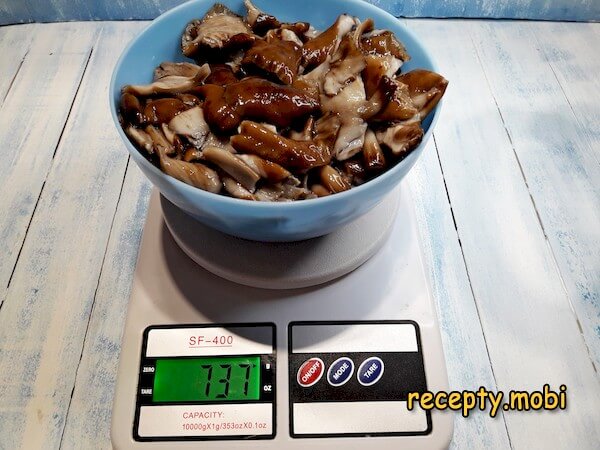
There is a good, proven ratio for calculating the amount of water and salt — you need 1 litre of water for 2 kilograms of boiled mushrooms, and 1.5 tablespoons of salt. After some simple arithmetic, the breakdown for 740 grams of mushrooms works out like this: water – 740 millilitres, salt – 0.5 tablespoon, garlic – 2-3 cloves, bay leaf – 1 piece.
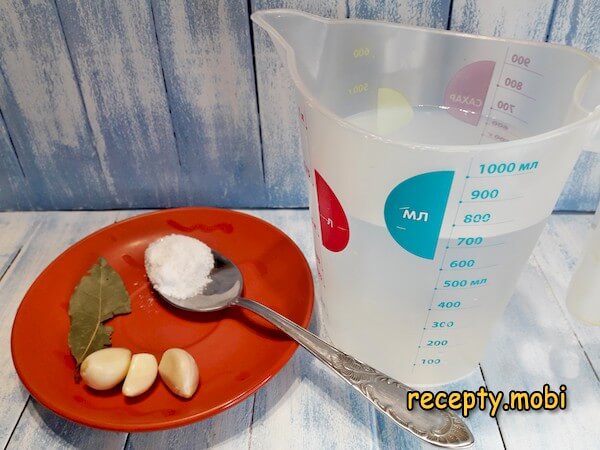
I put the mushrooms in a pot, add the measured amount of water and salt, and add the bay leaf — bay leaf specifically, not other spices, so as not to overpower the natural flavour of the honey mushroom. A whole bouquet of spices would only spoil the "refinement" of the salting here.
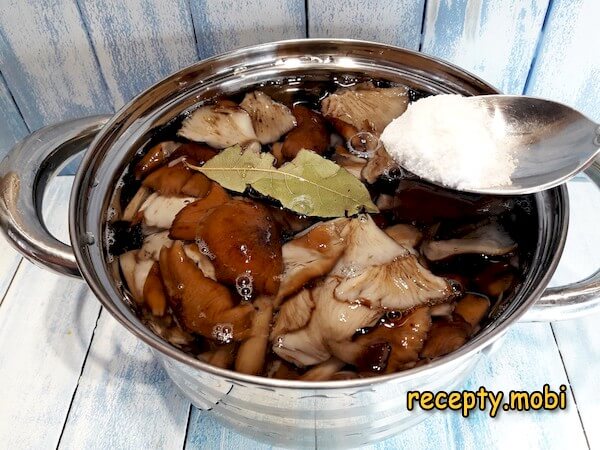
I put the pot on the heat and bring it to a boil — medium heat, so the mushrooms don't fall apart into mush.
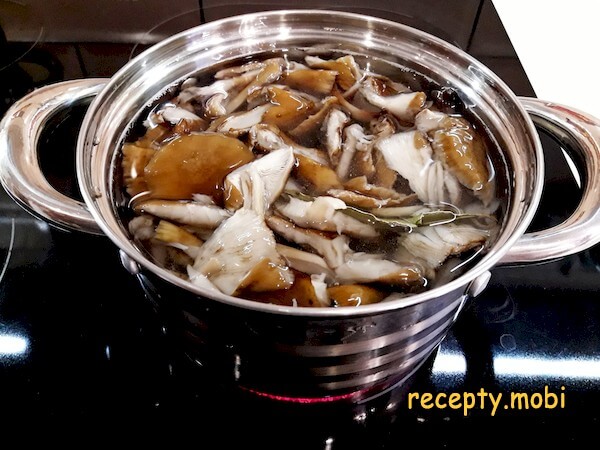
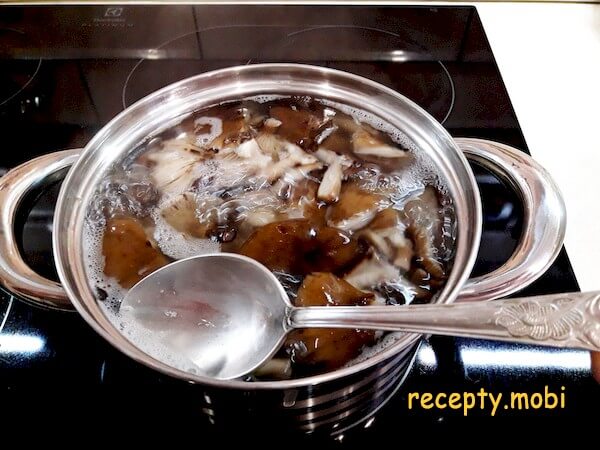
If foam forms, I skim it off. I boil the mushrooms for 5 minutes. You can taste the brine for salt — it should not be too salty, just a little saltier than for normal cooking. An over-salted brine will make the appetiser inedible.
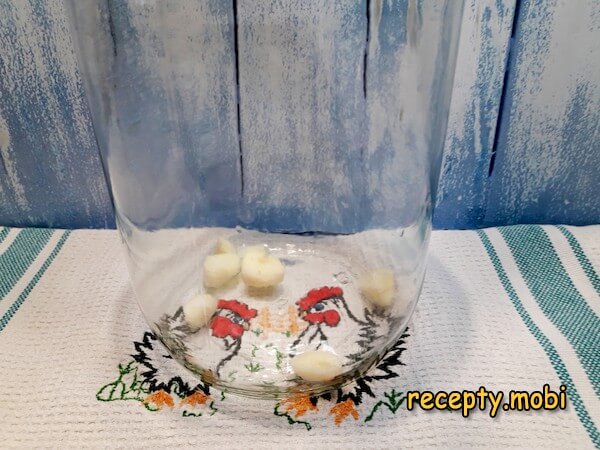
The jar needs a good wash — there's no need to sterilise it, as the honey mushrooms won't ferment in the fridge. I place 1-2 garlic cloves, cut into slices, at the bottom — they will give their aroma to the brine.
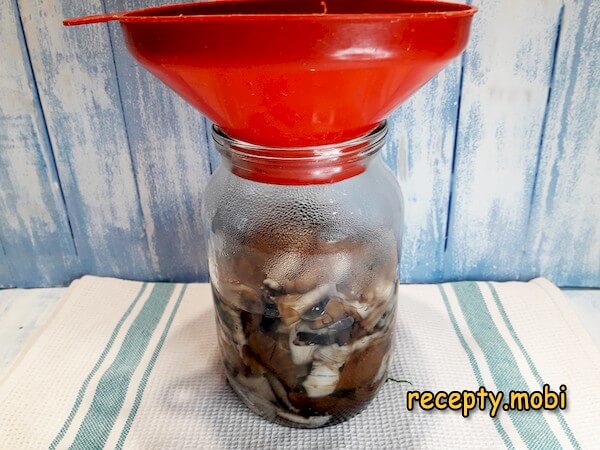
I fill the container with the hot mushrooms to the halfway point — hot specifically, so the brine doesn't cool too quickly and soaks into the mushrooms evenly.
I add the remaining garlic — the garlic is distributed throughout the whole jar, so the aroma is even from top to bottom.
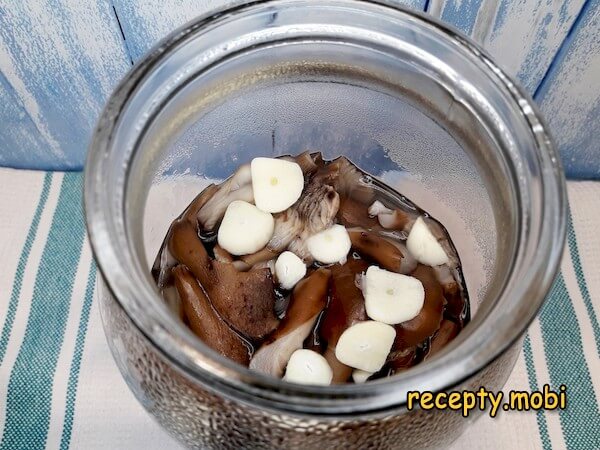
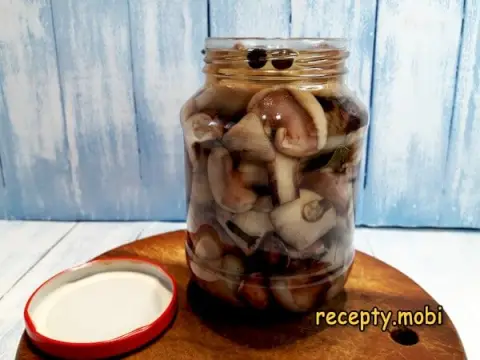
I tip in the rest of the mushrooms, and fill the remaining space with brine right to the top — the honey mushrooms must be completely covered with liquid, otherwise the top layer may go mouldy.
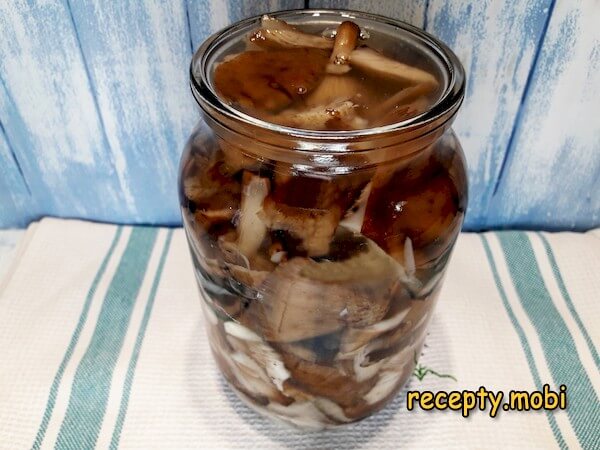
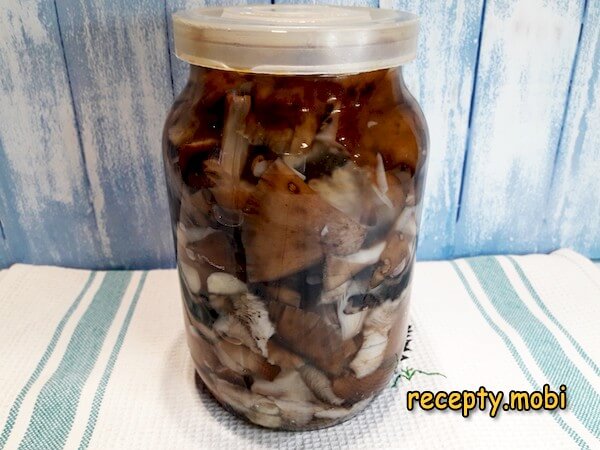
I close the jar with a plastic lid — a metal seal isn't needed for salting, as the preserve is kept in the fridge anyway. Once it has cooled, I put the preserve in the fridge.


Tips
- 1
PRE-SOAKING – the secret to cleanliness. Half an hour in cold water softens the dried-on forest particles, leaves and pine needles on the caps of the honey mushrooms. Without soaking you'd have to scrub each mushroom with a brush — with soaking the dirt comes off by itself during a simple rinse. The same principle is behind the technique in "How to soak dried forest mushrooms" – soaking before processing.
- 2
THE COOKING WATER IS POURED AWAY – the secret to a clear brine. After the first half-hour boil I always pour off the water — it holds forest microflora, ballast substances and foam. A fresh brine made with clean water gives a clear salt solution with no sediment, and the honey mushrooms look appetising in it.
- 3
MINIMUM SPICES – the secret to natural flavour. Salted honey mushrooms differ from pickled ones in that they have a minimum of additions — only salt, bay leaf and garlic. Cloves, allspice or cinnamon would overpower the delicate forest aroma of the honey mushroom. The natural flavour is exactly the "highlight" of salting, and that's the difference from pickling. The same principles work for other forest mushrooms too – more on this in the article "How to cook porcini mushrooms properly".
- 4
STORAGE ONLY IN THE FRIDGE – the secret to safety. Salting without vinegar and without an airtight seal is not suitable for storage at room temperature — the active microflora can cause fermentation. A fridge or cellar at 4-8°C ensures safe storage for up to 4 months. Under a plastic lid the honey mushrooms "breathe".
FAQ
How does salting differ from pickling honey mushrooms? +
The main difference is the basis of preservation. Pickling uses vinegar, which kills most micro-organisms and extends the shelf life to a year. With salting, the basis is a salt solution, whose antimicrobial action is weaker. Salted honey mushrooms keep for 3-4 months only in the fridge, while pickled ones keep for a year at room temperature. In flavour, salting is more natural, without the vinegary tang, while pickling is more piquant. Neither is better nor worse – they are simply different styles of preserving. Salting is usually used for honey mushrooms, milk caps and saffron milk caps; pickling for orange-cap boletes, porcini, mossiness mushrooms and butter mushrooms.
How long do salted honey mushrooms keep? +
In the fridge at 4-8°C under a plastic lid – 3-4 months without loss of quality. In a cellar at 6-10°C – up to 5-6 months. The preserve cannot be kept at room temperature – it will quickly ferment. Once the jar is opened, the honey mushrooms are best eaten within a week, ideally with a layer of vegetable oil on top to protect them from air. Signs of spoilage: cloudy brine, a smell of fermentation, a film of mould, a change in the colour of the caps – I throw such a jar away.
What is the ratio of salt to water for the brine? +
The standard proven ratio is 1.5 tablespoons of coarse rock salt per 1 litre of water per 2 kilograms of boiled mushrooms. This gives a moderately salty brine that you can taste, but which doesn't overwhelm the taste buds. For a saltier version you can increase it to 2 tablespoons per litre – such a brine keeps longer, but requires rinsing the mushrooms before serving. A less salty one (1 tablespoon per litre) is on the edge of safety, and such a preserve won't keep for more than a month even in the fridge.
What to serve with salted honey mushrooms? +
The classic is with boiled potatoes drizzled with butter and sprinkled with green onion. A simple cold appetiser: with sliced onion and vegetable oil. With meat: with shashlik, fried pork, braised beef, home-made pelmeni. In salads: "Vinaigrette", "Forest Glade", "Mushroom" with egg and green onion. With alcohol: vodka with a cold appetiser, dark beer. For a festive table – on a separate plate with a sprig of dill and a slice of lemon. The longer the honey mushrooms stand, the more intense the flavour.
- Comment
or post as a guest
Be the first to comment.