
avg —
Freezing and Canning Stuffed Peppers: 3 Ways and How to Choose

Instructions
Wash the peppers, cut off the lid at the stalk end and remove the seeds and membranes. Blanch in boiling water for 2-4 minutes until pliable, then plunge straight into cold water.
Coarsely grate the carrots and finely dice the onion. Fry the vegetables in vegetable oil (120-150 ml) until soft and lightly golden, then season with salt (1 tsp). This is the vegetable filling.
Fill each pepper with the warm vegetable filling, without packing it in too tightly.
Arrange the stuffed peppers snugly but gently in clean sterile jars, upright with the cut side up.
Make the sauce: bring the tomato juice to the boil, add the salt (40 g), sugar (80 g), black peppercorns, allspice and bay leaves. Simmer for 5 minutes, pour in the vinegar (4 tbsp) and take off the heat.
Pour the boiling tomato sauce over the peppers in the jars so they are completely covered, stopping 1-1.5 cm below the rim.
Sterilise the jars in a pan of hot water (water up to the shoulders of the jars), timing from the boil: 0.5 l - 15-20 min, 1 l - 20-25 min, 3 l - 35-45 min.
Seal with sterile lids, turn upside down and wrap in a blanket until completely cool. Store in a cellar or a dark larder.
Three ways to preserve stuffed peppers for winter: which to choose
| Preserving method | Filling type | What you get | Sterilisation | Where to store | Storage life | How to serve in winter |
|---|---|---|---|---|---|---|
| Method 1. Freezing raw as a ready-to-cook meal | Meat and rice or vegetable, raw | Ready-to-cook, needs finishing | Not needed | Freezer at -18 °C | 3-4 months (up to 6 is acceptable) | Braise or bake straight from frozen, 40-50 min |
| Method 2. Sealed in jars in tomato sauce | Vegetable, acidified (with vinegar) | Ready-to-eat appetiser | Essential (timings by jar size: see below) | Cellar or a dark larder | Up to 12 months | Open and serve cold, or warm through in a saucepan |
| Method 3. Empty pepper shells for future stuffing | No filling, just blanched peppers | Ready-to-stuff preparation | Not needed for freezing, needed for brining | Freezer or a jar of brine | Freezer 8-10 months, brine 6-8 months | Defrost, stuff and cook as if fresh |
Variations
Method 1. Freezing raw stuffed peppers with meat and rice (a ready-to-cook batch)
This is the safest way to put up stuffed peppers with a meat filling: the raw stuffed peppers simply go into the freezer, and in winter you take them out and braise them into a ready dinner. Freezing removes the risk of botulism, which is why meat is fine here, unlike in a sealed jar. This option suits anyone who wants a hearty, quick lunch waiting in the freezer, with no fussing over grain and mince on a cold day.
Ingredients per batch:
- sweet peppers 1.5 kg (10-12 medium ones)
- pork and beef mince 700 g
- short grain rice 150 g dry weight
- onions 200 g (2 medium onions)
- salt 1.5 tsp
- ground black pepper 0.5 tsp
- vegetable oil for softening the onions 2 tbsp. No tomato
- vinegar or sugar needed: there is no sauce in this method
- Wash the peppers, cut off the lid at the stalk end, and scrape out the seeds and membranes. Blanch in boiling water for 2-4 minutes (closer to 2 minutes for thin-walled peppers, up to 4 for thick-walled ones), plunge straight into cold water and pat dry. Blanching makes the walls supple, so the peppers will not crack as you fill them.
- Rinse the rice and boil it in salted water until half cooked, about 7-8 minutes from the moment it comes to the boil. Drain in a sieve and let it cool: the grains should still be slightly firm inside, so that in winter they finish cooking in the sauce and soak it up rather than turning mushy.
- Finely chop the onions and soften them in 2 tbsp of oil until tender and lightly golden, 5-7 minutes. Leave to cool.
- Combine the mince, the cooled rice, the softened onions, 1.5 tsp of salt and the pepper. Knead by hand for 2-3 minutes until you have an even, slightly sticky mixture.
- Fill the peppers loosely, leaving about 1 cm to the rim. Never pack them tightly: the rice will swell during cooking and the pepper will burst.
- Lay the peppers on a board or tray in a single layer, not touching each other, and firm them up in the freezer for 2-3 hours until solid. This stops them freezing together into one big lump in the bag.
- Transfer the part-frozen peppers into bags or containers in portions of 4-6, press out the air and label with the date.
Storage and safety: keep at -18 °C for up to 6 months. Cook them straight from frozen, otherwise the peppers will lose their shape. Never seal this meat filling into airtight jars: at home, without deep freezing, that is a direct route to botulism.
Method 2. Sealing stuffed peppers in jars with tomato sauce (vegetable filling)
This one is a ready-made starter for the pantry shelf: blanched peppers with a vegetable filling are covered with hot tomato sauce and vinegar, sterilised and sealed. The filling here is strictly vegetable, because it is the pairing of an acidic environment with sterilisation that makes the jar safe, and meat must never be sealed in airtight jars at home. This version is for anyone who loves opening a jar in winter and serving peppers in tomato juice straight away; it is often called "finger-licking good".
Ingredients:
- peppers 1.5 kg; for the filling
- carrots 500 g
- onions 300 g
- vegetable oil 60 ml
- salt to taste. For the sauce: tomato juice or sieved tomatoes 1.5 litres
- sugar 70-100 g
- salt 1 level tbsp, 9% vinegar 3-4 tbsp
- bay leaves 2
- black peppercorns 5-6
- Prepare the peppers and blanch them for 2-4 minutes, then plunge into cold water.
- Grate the carrots, chop the onions, and soften them in oil until tender, 10-12 minutes; salt at the end and leave to cool.
- Fill the peppers with the vegetable filling.
- Make the sauce: bring the tomato to the boil, add the salt, the sugar (go closer to 100 g if you like it sweeter), the bay leaves and the peppercorns, and simmer for 5 minutes. Pour in the vinegar at the end (add an extra 1 tbsp for a sharper taste) and turn off the heat.
- Stand the peppers upright in sterilised 1 litre jars, cut side up, so they hold their shape and do not float.
- Pour over the boiling tomato sauce so it covers the peppers completely, leaving 1-1.5 cm free at the top of the jar.
- Sterilise the jars in a pan of boiling water: 20-25 minutes for 1 litre jars from the moment the water boils.
- Seal, turn upside down and wrap in a blanket until completely cool, about a day.
Storage and safety: keep in a dark, cool place for up to a year. There is a reason for the 1 litre jars: the peppers sterilise evenly in them and are easy to lift out. Before eating, check that the lid has not bulged and that the sauce is still clear, not cloudy.
Method 3. Peppers stuffed with vegetables for winter: carrot, cabbage and onion (a meat-free classic)
This is a hearty meat-free starter without a single gram of meat: the peppers are packed with braised vegetables and cabbage, then sealed in tomato sauce. It comes out budget-friendly, rich in fibre and just as delicious as a cold starter or a warm side dish. A version for Lent and for vegetarians, and for anyone wanting more variety on the preserves shelf beyond the meat and the plain carrot peppers.
Ingredients:
- peppers 1.5 kg; for the filling
- carrots 500 g
- onions 300 g
- cabbage about 300 g (a quarter of a small head)
- a celery stick if you like
- vegetable oil 60 ml
- salt to taste. The sauce is the same as in method 2: tomato 1.5 litres
- sugar 70-100 g
- salt 1 tbsp, 9% vinegar 3-4 tbsp
- spices
- Prepare the peppers and blanch for 2-4 minutes, then plunge into cold water.
- Shred the cabbage finely, salt it lightly, scrunch it with your hands and squeeze out the excess water. That way it will not release juice in the pan and the sauce will stay clear.
- Grate the carrots, chop the onion and celery, and soften in oil for 5-7 minutes; add the squeezed cabbage and braise everything together until tender, 12-15 minutes. Salt at the end and leave to cool.
- Fill the peppers with the vegetable filling and stand them upright in sterilised 1 litre jars.
- Cover completely with boiling tomato sauce, leaving 1-1.5 cm free at the top.
- Sterilise the 1 litre jars for 20-25 minutes, seal, turn upside down and wrap until cool.
Storage and safety: keep somewhere cool for up to a year. The acidic vinegar sauce and sterilisation are just as essential here: without them, even a vegetable jar cannot be stored.
Meat and rice filling: for freezing only, never for jars
This is the classic filling, the same as for cabbage rolls, but it goes strictly into the freezer. The principle is identical to cabbage rolls; the only difference is the wrapper: instead of a cabbage leaf, the filling sits in a little pepper cup that lends a gentle sweetness as it braises. Mix the mince with slightly undercooked rice at roughly 4 parts meat to 1 part dry rice (for example, 700 g of mince to about 170 g of dry rice), then add softened onions from 1-2 bulbs, 1.5 tsp of salt and some ground pepper. Use short grain rice and boil it only until half done, so that in winter it finishes cooking in the sauce and absorbs it instead of turning to porridge ahead of time. Fill the peppers loosely, leaving room for the rice to swell. Remember the key point: sealing the meat version into airtight jars at home is dangerous because of the botulism risk, so meat with rice is either frozen following method 1 or cooked straight away.
Vegetable and meat-free filling
Carrots, onions, plus cabbage and root vegetables if you like: this is the only filling that is safe to seal in jars. For one batch take 500 g of carrots and 300 g of onions, and if you wish, a quarter of a cabbage head and a celery stick. Soften the vegetables in vegetable oil until tender and lightly caramelised, salting only at the very end. In the acidic tomato sauce with vinegar this filling handles sterilisation well, so the jar keeps for up to a year. If you want something more filling, add buckwheat boiled until half done, roughly a glassful for this batch: meat-free peppers with grain are sealed in exactly the same way, always with sterilisation. Another trick that works: stir a spoonful of tomato paste and a pinch of sugar into the softening vegetables, and the flavour becomes deeper and closer to lecho.
Mushroom filling
Fried button mushrooms or wild mushrooms with onion and carrot make a fragrant meat-free alternative to the vegetables. For one batch take 400 g of mushrooms, chop them finely and fry over a medium heat until all the moisture has evaporated, about 12-15 minutes, until they begin to brown. Soften a carrot and an onion separately (1 of each) and combine with the mushrooms, salting at the end. For jars, the mushroom version is only acceptable with sterilisation and vinegar, but it is far safer to freeze it following method 1: mushrooms are naturally low in acid and call for particular care in home preserving. And do not skimp on time when driving off the mushroom liquid: leave it in the filling and the sauce in the jar will turn cloudy.
What to use instead of rice: bulgur, buckwheat or no grain at all
Rice swaps easily for bulgur, buckwheat or cracked corn, and you can skip the grain altogether. Use bulgur in the same volume as rice, but do not boil it; simply steep it in boiling water for 10 minutes: it will finish cooking later. Buckwheat is boiled until half done; it brings a pleasant nutty note and works beautifully in a meat-free filling. With no grain at all, make the filling entirely meat or entirely vegetable; the peppers turn out denser and juicier, but more calorific too. One rule covers every grain: add it undercooked, because during freezing and the braising that follows it finishes cooking on its own and does not collapse into mush.
A spicy version with chilli
For a fiery version of this preserve, add heat to the vegetable filling or to the sauce. For the basic batch use 1-2 chilli pods, deseeded, diced finely and added straight to the softening vegetables, plus 3-4 garlic cloves dropped into the sauce a minute before the end of cooking, so they release their aroma without losing their bite. Bear in mind: heat is not a preservative, so the vinegar and full sterilisation remain non-negotiable. Wear gloves when handling chillies, and be sure to taste the sauce for salt, acidity and heat before filling the jars: there will be no adjusting the flavour in winter.
How to choose and prepare peppers for preserving
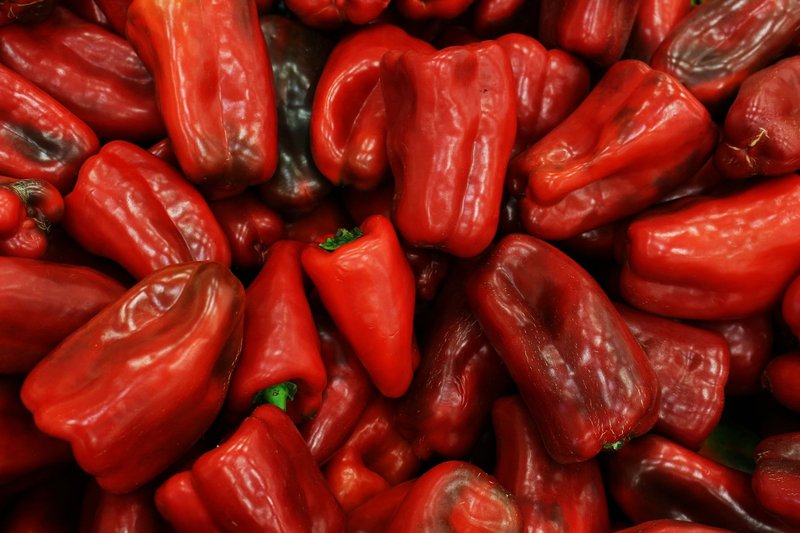
Choose fleshy peppers with walls at least 6 mm thick, smallish and even, so they fit into the jar upright. The best varieties for stuffing are Bogatyr, California Wonder and Gogoshary: they have dense, juicy walls and the right cup shape. Wash the peppers, cut off the lid at the stalk end, and clean out the seeds and membranes. Before stuffing, blanch them in boiling water for 2-4 minutes (less for thin-walled, longer for thick-walled), then plunge into cold water. Blanching makes the walls supple, so the peppers do not crack when filled and settle more snugly in the jar. It helps to match the peppers to the height of the jar in advance and trim any that are too long at the rim.
Empty, unstuffed peppers are worth putting up too, and they come to the rescue when there is no time for stuffing. For the freezer, nest the blanched cups inside one another, freeze them and keep for 8-10 months; in winter, thaw them slightly until pliable and stuff them just like fresh ones. For keeping in brine, pack the blanched peppers into jars, cover with boiling brine made with 60 g of salt per 1 litre of water, sterilise for 15 minutes and keep in the cold for up to 6-8 months. Rinse the excess salt off these peppers before stuffing.
How to cook and serve your preserves in winter
The frozen batch is cooked straight from the freezer, while a sealed jar is simply opened and warmed through if you like. Put the peppers from the freezer into a deep pan or a heavy casserole, cover with tomato sauce or a soured cream gravy and braise under a lid for 40-50 minutes over a medium heat. You can also bake them in the oven at 180 °C for about 50 minutes, or use a multicooker on the stew setting for 1 hour. There is no need to defrost them first; in fact it does more harm than good: the peppers will lose their shape and turn soggy. Serve peppers from the jar as a cold starter, or warm them in a pan for 5-7 minutes; 2-3 minutes in the microwave is enough. Serve with soured cream, fresh herbs and a spoonful of that same tomato sauce.
Canning safety: why it matters more than flavour
Stuffed peppers for winter are a low-acid, relatively perishable preserve, so safety here is taken more seriously than taste. The main danger of a sealed jar is botulism: the bacterium Clostridium botulinum multiplies without access to air, in warmth and at low acidity, and its toxin has no smell or taste and is not destroyed by ordinary reheating. That is exactly why a meat filling (mince with rice) must never be sealed in jars at home: meat is low in acid, the environment inside the jar is anaerobic, and these are ideal conditions for the toxin. There are only two safe routes for meat: freeze it as a raw ready-to-cook meal or cook it straight away, and seal only an acidified vegetable filling in jars.
Why vinegar and acidity matter. The 9% vinegar in the sauce (4 tbsp per 1.5 litres of tomato in the recipe card) brings the pH below 4.6, and in such an acidic environment the botulinum toxin cannot form. The vinegar is there not so much for flavour as a preservative and an insurance policy. You can replace it with citric acid (1 heaped tsp for this volume) or cider vinegar (use slightly more, as it is weaker), but you must never remove the acid from a jarred preserve entirely. Stuffed peppers for winter without vinegar are only possible with freezing, not in a jar.
How long to sterilise by jar size. Time is counted from the moment the water in the pan comes to the boil, with the jars standing on a rack or a cloth and the water up to their shoulders:
- 0.5 litre jar: 15-20 minutes
- 1 litre jar: 20-25 minutes
- 3 litre jar: 35-45 minutes
Can you skip sterilisation. Stuffed peppers for winter without sterilisation are only made using the double or triple hot-fill method, pouring boiling water over them and then a boiling acidic marinade, but for filled peppers this is unreliable: the centre of the filling never reaches a safe temperature. For a guarantee, it is better to sterilise. The one completely reliable way to avoid sterilisation is freezing.
Signs of a spoiled jar (do not taste it, throw it away at once). A bulging or domed lid, cloudiness and flakes in the sauce, gas bubbles, a sour or yeasty smell on opening, a telltale pop and hissing (fermentation), mould on the surface, cloudy sediment with a sharp smell. Any one of these signs is reason to throw the jar away with its contents, without tasting.
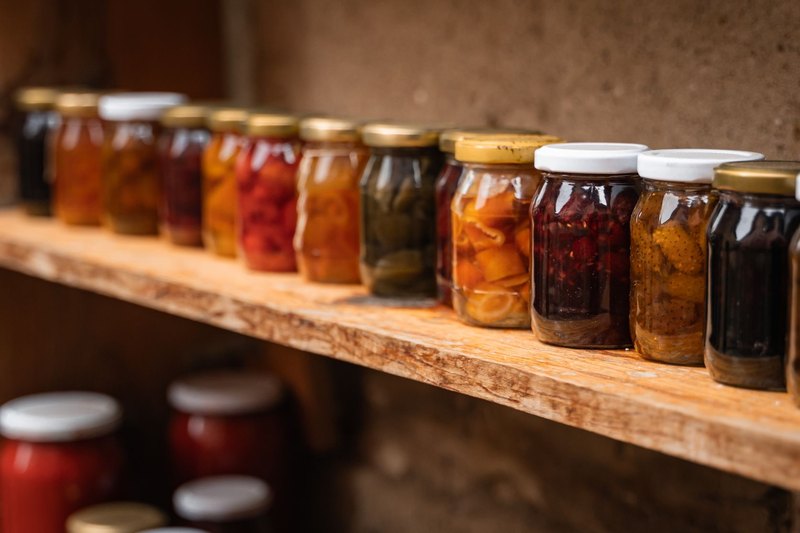
Storage and shelf life: where and for how long
| Where to store | Conditions | Which version suits | Storage life |
|---|---|---|---|
| Freezer | -18 °C, portioned bags | Raw ready-to-cook (meat and rice, vegetable), empty pepper shells | 3-4 months is ideal, up to 6 months acceptable; empty pepper shells 8-10 months |
| Cellar or basement | 0-8 °C, dark, no damp | Vegetable preserve in tomato with vinegar | Up to 12 months |
| Flat, dark larder | 18-22 °C, away from light and radiators | Vegetable preserve with vinegar and full sterilisation | 6-8 months, keep an eye on the lids |
| After opening | Fridge, covered | Any opened jar, defrosted ready-to-cook peppers | 3-4 days; cook defrosted raw peppers straight away |
Important: never refreeze defrosted peppers. Give any jar that has stood at room temperature in a flat for more than 8 months an especially careful check before serving.
Nutrition and yield per jar
| Version | Kcal per 100 g | Protein | Fat | Carbohydrates |
|---|---|---|---|---|
| Vegetable in tomato (main recipe) | ~55 kcal | ~1.2 g | ~3.2 g | ~6 g |
| Meat-free vegetable with grain | ~80 kcal | ~2 g | ~3.5 g | ~10 g |
| Meat and rice (frozen, as cooked) | ~130 kcal | ~6.5 g | ~7.5 g | ~9 g |
| Mushroom | ~70 kcal | ~2.5 g | ~4 g | ~6 g |
Yield and packing. The recipe card quantities (1.5 kg of peppers, roughly 15-18 of them) give about 3 one-litre jars of ready appetiser. Jar guidelines: a 0.5 litre jar holds 2-3 medium peppers and about 200 ml of sauce; a 1 litre jar - 4-5 peppers and 350-400 ml of sauce; a 3 litre jar - 12-15 peppers and 1.2-1.4 litres of sauce. A serving is 2-3 peppers (roughly 250-350 g).
Troubleshooting
A pepper split or came apart at the wall during jarring
There are two causes: the peppers were not blanched (a raw wall is stiff and cracks) or the filling was packed in too tightly and the grain swelled as it heated. Blanch the peppers for 2-4 minutes until pliable, do not pack the filling right up to the brim, leave a couple of millimetres, and use half-cooked rice.
The sauce went cloudy after a few days
Most often the culprit is poorly washed peppers, insufficient sterilisation or extra moisture in the filling (cabbage or mushrooms released juice). Do not keep such a jar at room temperature: if the lid has not yet bulged, move it to the fridge and eat within 2-3 days; if there is gas or an off smell, throw it away. Next time, squeeze watery vegetables and do not shorten the sterilisation time.
The lid has bulged
A bulging lid is a sign of fermentation or gas-producing bacteria, and the jar is spoiled. Do not open it in the kitchen over food, do not taste it, dispose of it with its contents. Checking a suspicious jar by tasting is the one thing you must never do: botulinum toxin has no smell or taste. The usual cause is an under-sterilised jar, too little acid (not enough vinegar) or an attempt to seal a meat filling. The way out: keep strictly to the sterilisation times and the vinegar quantity, and never jar meat.
The preserve has fermented, with a pop and a yeasty smell
Fermentation means yeasts got into the jar, or there was not enough acid and sterilisation. The product must not be eaten. To prevent it, add vinegar as specified, use only clean sterile jars and fresh lids, and do not leave sweet vegetable fillings sitting warm for long before filling the jars.
The jars stood near a radiator or in the light and the lids blew off
Warmth and sunlight cut the shelf life of a preserve sharply: the sauce darkens, fermentation starts and the lids bulge. In a flat, keep the jars in a dark larder or cupboard at 18-22 °C, away from radiators and windows; a cellar at 0-8 °C is better still. A jar whose lid has already blown is spoiled: throw it away without tasting.
The preserve tastes under-salted or bland
Salt and sugar work both for flavour and partly for keeping quality, so do not cut them back heavily. If a finished jar is on the bland side, season at serving and add fresh garlic or herbs. Next time, taste the sauce before filling the jars: it should be slightly more intense than you like, as the peppers absorb some of the salt.
Peppers from the freezer collapsed and lost their shape during cooking
This happens when the ready-to-cook peppers were defrosted in advance. Frozen stuffed peppers should go into the sauce straight from the freezer and cook without defrosting. Another cause is rice that was fully cooked before freezing: always add the grain half-cooked.
Video

FAQ
Do stuffed peppers for winter need vinegar, and what can replace it? +
For sealing in jars, vinegar is essential: it keeps the acidity below pH 4.6 and protects the preserve from botulism. In this recipe that is 4 tbsp of 9% vinegar per 1.5 litres of tomato; it can be replaced with 1 heaped tsp of citric acid for the same volume, or with cider vinegar (use slightly more). Only the frozen version can go entirely without vinegar; the details are in the canning safety section above.
Can you seal stuffed peppers with meat and rice in jars for winter, and is it safe? +
No: a meat filling must never be sealed in airtight jars at home. Meat is low in acid, and a sealed jar creates an oxygen-free environment, ideal for botulinum toxin. Stuffed peppers with meat and rice are put up for winter only by freezing the raw ready-to-cook version, or they are cooked straight away. Meat preserves are only safe from a pressure canner at 116-120 °C.
How long should you sterilise the jars, and can you do without sterilisation? +
Count from the moment the water in the pan boils: a 0.5 litre jar takes 15-20 minutes, a 1 litre jar 20-25 minutes, a 3 litre jar 35-45 minutes, with the jars on a rack or a cloth and the water up to their shoulders. Skipping sterilisation with a hot-fill method is unreliable for filled peppers: the centre of the filling never reaches a safe temperature. The only completely reliable way to avoid sterilisation is freezing.
Should stuffed peppers be frozen raw or pre-cooked? +
Freezing them raw as a ready-to-cook meal works best: simply clean the peppers and blanch them for 2-4 minutes to make them pliable, then stuff with raw mince and half-cooked rice. There is no need to cook the filling in advance: in winter the peppers are braised or baked straight from the freezer, and everything cooks through. Raw freezing keeps the shape and flavour better.
How do you cook frozen stuffed peppers in winter: saucepan, oven or slow cooker? +
Straight from the freezer, without defrosting. Put the peppers in a saucepan or a heavy pot, pour over tomato sauce or a soured cream gravy and braise under a lid for 40-50 minutes over a medium heat. In the oven, bake at 180 °C for about 50 minutes in a dish with sauce, loosely covered with foil so they do not dry out. In a slow cooker, use the stew setting for about 1 hour. Defrosting first only makes the peppers lose their shape.
How many peppers fit into a 1 litre and a 3 litre jar, and how much sauce do you need? +
A 1 litre jar holds 4-5 medium peppers and 350-400 ml of sauce, a 3 litre jar holds 12-15 peppers and 1.2-1.4 litres of sauce, and a 0.5 litre jar takes 2-3 peppers and about 200 ml. Stand the peppers upright, cut side up, and pour over boiling tomato sauce so it covers them completely, stopping 1-1.5 cm below the rim.
What can replace rice in the filling: bulgur, buckwheat or no grain? +
Bulgur (the same volume, soaked in hot water for 10 minutes instead of boiling), buckwheat boiled until half done, or no grain at all for a denser, juicier pepper. Whichever you choose, add it half-cooked so it finishes during braising. The details are in the section on rice substitutes above.
Which peppers should you choose for stuffing for winter? +
Fleshy peppers with walls at least 6 mm thick, on the small side and even in shape, so they stand upright in the jar. Bogatyr, California Wonder and Gogoshary are reliable varieties; thin-walled salad peppers overcook and tear. More detail is in the section on choosing and preparing peppers above.
How long do stuffed peppers keep: in the freezer, in jars and after opening? +
In the freezer, the raw ready-to-cook version keeps for 3-4 months (up to 6 at a steady -18 °C), and empty pepper shells for 8-10 months. Sealed jars of the vegetable preserve keep for up to 12 months in a cellar and 6-8 months in a dark larder in a flat at 18-22 °C, away from light and radiators; check the lids for bulging from time to time. Once opened, keep the jar covered in the fridge and eat within 3-4 days. Never refreeze defrosted peppers, and never store meat versions anywhere but the freezer.
How do these stuffed peppers for winter differ from cabbage rolls? +
The filling and the way of serving are similar, which is why the meat-and-rice version is often called stuffed peppers in the style of cabbage rolls. The difference is the wrapper: cabbage rolls use a cabbage leaf, while here it is a sweet pepper cup that holds its shape and adds sweetness. The preserving methods are the same: freeze the ready-to-cook version, or jar the vegetable filling.
Related recipes
- Comment
or post as a guest
Be the first to comment.