avg —
Mushroom Marinade for One Liter of Water for Winter

Instructions
I prepare the ingredients. 9% vinegar can be replaced with vinegar essence (70-80%) diluted in 1:8 ratio with water. Jars and lids sterilise in advance.
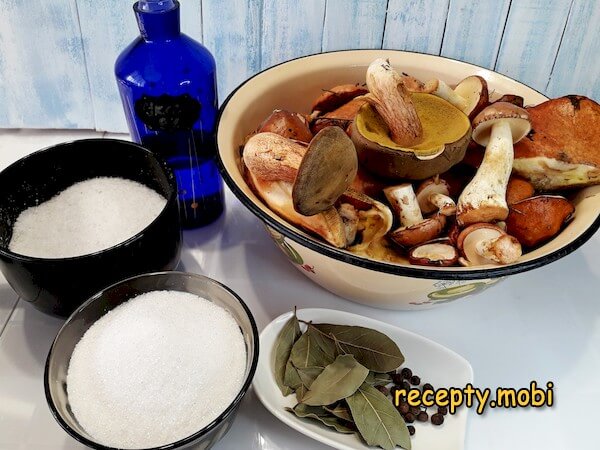
I clean the mushrooms of forest debris and pre-boil them in unsalted water (time varies by species — see FAQ for guidance). All marinade ingredients measure ready.

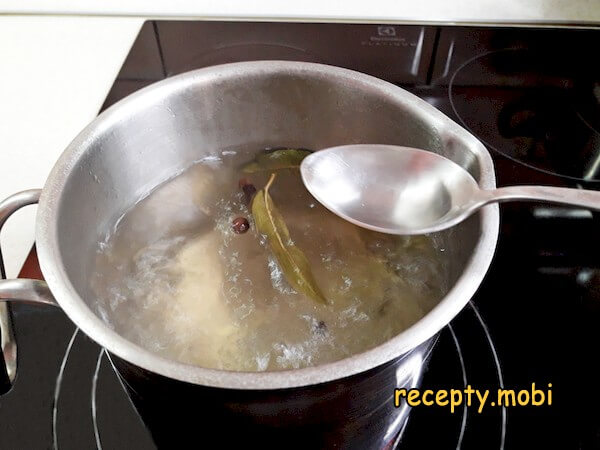
Water pours into a saucepan. All dry ingredients (salt, sugar, bay leaf, allspice, peppercorns, cloves) join.
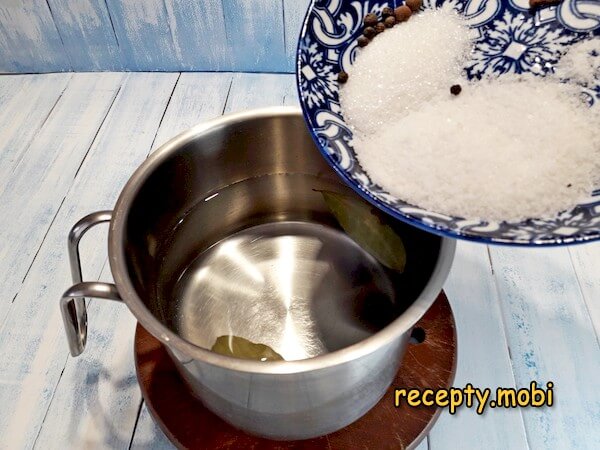
I stir the mixture with a spoon to dissolve salt and sugar.
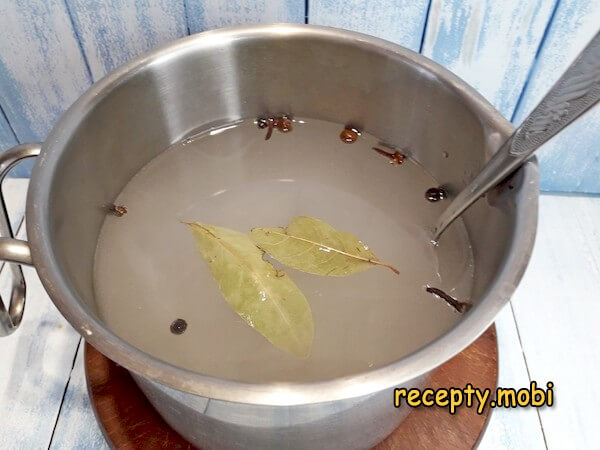
Saucepan onto the stove, bring to a boil.
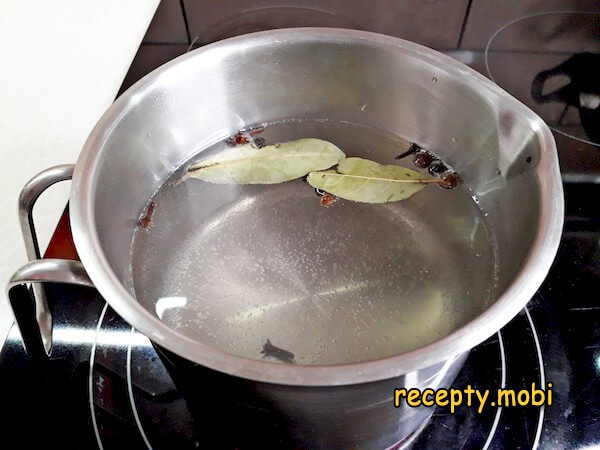
Vinegar pours in.
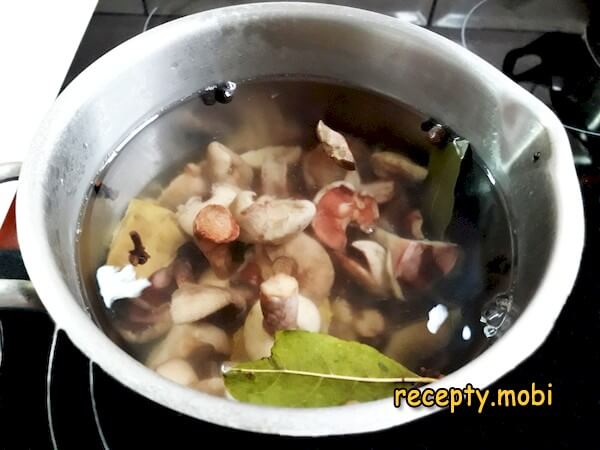
Pre-boiled mushrooms go directly into the marinade and boil 5 minutes. This sequence applies to mushrooms pre-boiled for 40 minutes (most wild boletes) or those needing no additional heat treatment (champignons, saffron milk caps). For mushrooms requiring longer cook in marinade: boil 15 minutes WITHOUT vinegar, THEN add vinegar and boil 5 more minutes.
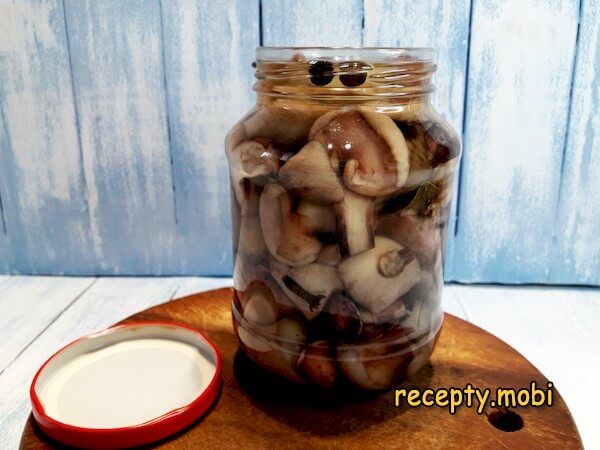
Mushrooms distribute into jars — should occupy about 75% of jar volume, floating freely in marinade poured to the very top.
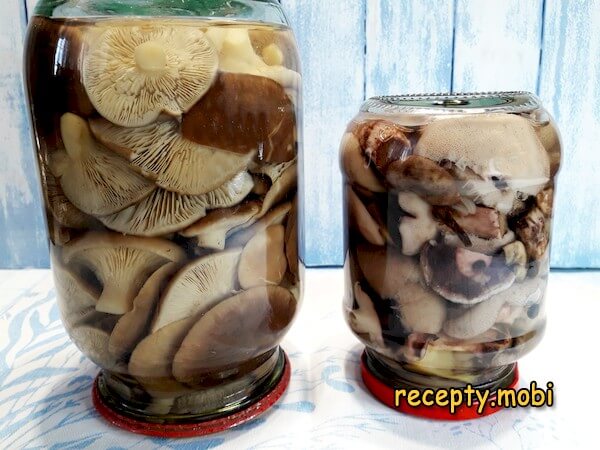
Lids screw on tight, jars invert. Wrap in a warm blanket; leave until completely cool.This 1-liter marinade serves about 2 liter jars (800 g mushrooms). Scale proportionally for larger batches. The universal composition works reliably with all common mushroom species. To serve from the jar: rinse mushrooms briefly under running water, dress with chopped green onions and herbs, drizzle with cold-pressed vegetable oil — the classic Russian zakuska treatment.


Tips
- 1
PRE-BOIL TIMES BY SPECIES. The pre-boil step (in unsalted water before this marinade) is critical and species-specific. Approximate guide: porcini (Boletus edulis) — 30-40 min; aspen mushrooms (Leccinum aurantiacum) — 30 min; honey mushrooms (Armillaria) — 20-25 min; butter mushrooms (Suillus) — 25 min; champignons (Agaricus bisporus) — no pre-boil needed; saffron milk caps (Lactarius deliciosus) — no pre-boil needed; russulas — 15 min. The pre-boil cleans, firms, and partially detoxifies wild specimens.
- 2
THE TWO COOKING SEQUENCES MATTER. Step 7 describes two paths. Path A (mushrooms already cooked for 40+ min): just 5 min in vinegar marinade. Path B (mushrooms need more cooking): 15 min in marinade WITHOUT vinegar, then add vinegar for final 5 min. The vinegar's late addition in path B preserves its acidic punch — early addition would dull during long cook. For another wild-mushroom no-sterilisation preserve worth comparing, see Cucumber and Tomato Assortment for Winter in a Liter Jar.
- 3
THE 75% FILL RULE. Step 8's jar-fill instruction (75% mushrooms, 25% headspace for marinade) gives proper marinade-to-mushroom ratio. Overstuffed jars (mushrooms above 80%) leave insufficient marinade — top mushrooms emerge dry. Understuffed jars (mushrooms below 65%) are inefficient use of jar space. The 75% target is the sweet spot — every mushroom marinade-bathed, jar volume optimized.
- 4
THE SCALE-UP MATH. The recipe is calibrated per liter of water. For 2 liters: double everything (4 tbsp salt, 2 tbsp sugar, 8 tbsp vinegar, etc.). For 3 liters: triple. For 0.5 liter: halve. Linear scaling works perfectly because the brine ratios are what determine preservation safety. Don't change individual component ratios when scaling — that compromises the chemistry. For another shelf-stable cucumber-vinegar preserve worth trying, try Pickled Cucumbers for Winter in a Liter Jar with Vinegar.
FAQ
Why is this called "for one liter of water"? +
The recipe presents itself as a base formula tied to water volume rather than mushroom weight, because mushroom species vary so much in density and water content. Standardising on the marinade liquid (1 liter water) makes the recipe scale predictably across all mushroom types. Russian-Eastern European preserve recipes commonly express ratios this way — "marinade for X liters of water" is the standard format. Calculating mushroom volume per liter of marinade keeps preservation safety consistent.
Which mushrooms should be avoided? +
Some mushroom species don't preserve well or have safety concerns. Avoid: chanterelles (texture goes spongy in vinegar), oyster mushrooms (too soft, fall apart), shiitake (better for drying than pickling), morels (need different processing — toxic if undercooked), most fresh wild mushrooms you can't 100% identify (toxic species look similar to safe ones — never marinate forager-mushrooms without expert ID). Stick to commercially available mushrooms or species you can confidently identify. The recipe is for safe consumption, not adventurous foraging.
How long do the marinated mushrooms keep? +
Properly sealed jars at room temperature in a dark cupboard keep 12+ months. Cool basement extends to 18 months. Once opened, transfer to fridge and use within 2-3 weeks. Mushrooms continue softening slightly over months but retain good texture for 6+ months. If you spot mould, fizzing, or bulging lids, discard the entire jar. Properly preserved mushrooms with this acidic marinade don't ferment.
Can I add other aromatics to the marinade? +
The base recipe is intentionally minimalist — these aromatics complement most mushrooms without dominating. For variations: add 2-3 dill umbels (Russian classic for "dill-pickle" character), 2 garlic cloves sliced (sharp accent), a small piece of horseradish root (traditional Russian addition), or 1 tsp coriander seeds (Caucasian leaning). Avoid: cinnamon (clashes with mushroom), cardamom (overpowers), heavy curry-style spices (wrong cuisine direction). The pure simple marinade lets the mushroom species character shine through.
- Comment
or post as a guest
Be the first to comment.