Thursday salt - what is it for and how to prepare it
Russian black salt, known as chetvergovaya or "Thursday salt", is a centuries-old tradition prepared once a year on Clean Thursday before Easter. Beyond its symbolic meaning, the finished salt is genuinely special: roasting it at high heat with rye bread or flour and a handful of spicy herbs gives it a mild, earthy, slightly smoky flavour that pairs beautifully with boiled eggs, grilled meat, dark bread and fresh radishes. The method is simple — mix coarse rock salt with a rye-bread mash or flour, roast at 250 °C until it darkens, then grind it to a powder. Below I share the classic methods along with how to use and store the finished salt.
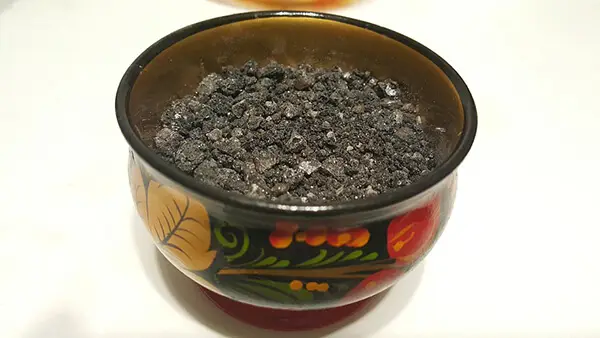
Thursday salt is a special product made from ordinary salt through a roasting process. In Russian Orthodox tradition it was prepared only once a year — during Holy Week, on the night of Clean Thursday, or in the morning or daytime of that day. That is where the name "Thursday salt" comes from. It is also called "Black salt", a reference to the dark colour the salt takes on under high heat. Beyond its ritual meaning, the roasted salt also has practical benefits: a lower heavy-metal content, far less chlorine, and minerals added by the ash. This article covers what the salt is for, how it is useful, what it tastes like, the traditional and modern ways of preparing it, and how to store it.
What is Thursday salt for and how to use it
In the past, Thursday salt was blessed in church and used for the Easter meal. On Easter day, painted eggs were eaten only with this salt. It was prepared in large amounts, and whatever was left was used as ordinary salt until the next Clean Thursday. It was kept away from prying eyes.
There was a belief that it protected the household from the evil eye and from illness. With the same aim, a pinch was added to the water when bathing infants. So that the home would always know plenty, a cellar of Black salt was kept on the dining table at all times. Protective power was attributed only to salt that had been blessed in church.
A sick person was given water with this salt to drink. A pinch was slowly stirred into a glass of water while saying:
"As the salt was tempered by fire, so may the body of (name) be filled with health. Amen!"
Everyone decides for themselves how to treat such beliefs. In those days nothing was said about the benefits of Black salt, because its chemical make-up was studied only later.
What is Thursday salt useful for
During roasting the chemical make-up of the salt changes, and it becomes more useful than ordinary white salt. The content of heavy metals drops many times over, and chlorine almost completely disappears — and it is chlorine that, after salty food, causes the thirst that leads to swelling.
The ash that forms during cooking enriches the salt with useful microelements:
- potassium;
- iodine;
- zinc;
- calcium;
- selenium;
- copper and others.
Roasted salt also contains carbon, which helps remove waste and toxins from the body. After preparation you are left with a new product that has different properties.
What is Thursday salt like in taste
People who have tried Thursday salt feel differently about its taste. Some like it for the aroma and flavour of the spices; others notice a particular hydrogen-sulfide aftertaste. As they say, there is no arguing about taste. Besides, it is made in different ways, with different proportions of salt and additions.
Still, it is worth making — not only as a nod to tradition, but for its useful qualities.
How to prepare Thursday salt
The recipes for Thursday salt have been adapted to modern conditions, so it can now be made in any kitchen. You can vary the ratio of salt to additions depending on how salty you want the result. Keep in mind that you should turn on the extractor hood or create a draught, because there will be smoke.
Iodised salt, or salt with other additives, will not do.
With spicy herbs
You will need:
- coarse salt – 1 kg;
- leaves of any dried spicy herbs – a large handful;
- rye bread – 1 kg.
How to make it:
- Crush a handful of dried mint, lemon balm, oregano or any other spicy herbs and mix them with 1 kg of rock salt.
- Add about 1 kg of crushed rye bread. Stale bread can be grated.
- Mix everything well and spread it in a layer on a baking sheet. Put the sheet in an oven heated to 250 °C and stir from time to time. After a while the salt will compact — break it up where you can so you can keep stirring.
- After about 40 minutes the bread will start to blacken, char and smoke. At this point turn off the oven, stir everything again, and leave it until cool. The bread should blacken and only just begin to smoke; badly burnt bread will taste bitter.
- Once cool, pass it through a meat grinder or grind it another way.
Based on kvass mash
Not everyone has kvass mash left over from fermenting wort, but it can be replaced with soaked rye bread. For 1 kg of salt, take about 3 loaves of bread or more.
You will need:
- coarse salt – 1 kg;
- kvass mash – 1 kg, or rye bread – 3 loaves;
- spices to taste.
How to make it:
- If you use bread, soak it in water and soften it to a uniform mass.
- Add salt and any spices to taste to the soaked bread or kvass mash. Mix well.
- Spread it in a layer on a baking sheet and put it in the oven at 250 °C.
- After about 10 minutes, break up the dried layer and load it back into the oven. Stir occasionally.
- After 30 to 40 minutes the mass will start to char, and the burnt bread will give off fumes. Stir and leave it to cool.
- Thoroughly grind the cooled mass.
With oat flakes or flour
You will need:
- coarse salt – 200 g;
- oat flakes or rye flour – 200 g;
- any spices – 2 tsp;
- water – as needed.
How to make it:
- Mix the oat flakes (or flour) with the spices.
- Stirring constantly, slowly pour in cold water until you have a stiff dough.
- Add salt to the dough and mix well.
- Divide the mass into pieces the size of a medium potato and wrap each one in 3 layers of foil.
- Bake the lumps until the dough turns black. You can do this in the oven at high heat, in a Russian stove, or in the coals of a fire, the way potatoes are baked. Baking takes about forty minutes to an hour. Build a large fire, because the coals cool quickly and the heat has to be kept up by feeding in partly burnt wood from the edges.
- After about 40 to 60 minutes, once the mass has baked and turned black, leave it in the foil (in the oven, stove or fire) until it cools.
- Once cool, free the Thursday salt from the foil, grind it in a mortar or another way, and sift it.
The sifted dust can be added to water for bathing and washing, or used to make face and hand masks.
How Thursday salt was made in the old days
In the past, Thursday salt was made in a Russian stove over dry birch wood. In such conditions the temperature reaches 800 degrees or more. There were different recipes; one of the simplest is this.
To 1 kg of coarse salt, add two slices of soaked rye bread and a handful of crushed healing herbs. The herbs can be any kind — for example oregano, St John's wort, caraway, even wormwood. This mixture was placed in a cast-iron pot on glowing coals and kept there for several hours, until the salt turned black. Then it was cooled and ground. During the work, the "Our Father" or a special prayer was read three times:
"Clean Thursday, keep and have mercy from worms and from every pest."
How to store
In the past, finished Thursday salt was kept in canvas bags in a dry, secluded place, away from anyone else's eyes. It also keeps well in glass jars — and in glass the aroma of the herbs lasts longer. Transfer the prepared salt into a glass container, cover it with thick paper, and store it in a dark place.
Tips and Tricks
Ventilation matters. Turning on the extractor hood or making a draught is important: burning bread and spices give off a lot of smoke that can set off a smoke detector and settle on kitchen surfaces. Run the hood at full power and open the windows — cross-ventilation is best. In a poorly ventilated flat it is easier to make the salt in summer with the windows open, or outdoors.
Use coarse salt with no additives. Iodised salt, or salt with anti-caking agents, is not suitable — only plain coarse rock salt gives a good result. Check the label before you buy.
Blacken the bread, do not burn it to ash. The bread should char and turn black but only just begin to smoke. If it burns to ash, the salt turns bitter and loses much of its benefit. Stop when the mass is evenly black with the first faint smoke and no flames. It is better to slightly undercook than to overcook.
Pick the method that suits you. The herb method is the traditional one — a balanced flavour and a large amount (1 kg lasts for months), a good choice for Easter. The kvass-mash method is handy when you have leftovers from making kvass. The oat-or-flour method (wrapped in foil) gives a smaller amount and very little smoke, since the foil holds it in, so it is the easiest in a flat and a good first attempt.
❓ Frequently asked questions
When is Thursday salt traditionally made?
By old Russian tradition, only once a year — on Clean Thursday of Holy Week, just before Easter. It was made on the night before Clean Thursday, or in the morning or daytime of that day. The salt was then blessed in church during the Easter service and used for the Easter meal, especially with painted eggs. Today Thursday salt is made at any convenient time, without tying it to the church calendar — for its benefits and its taste. It was kept for a whole year, until the next Clean Thursday.
How is Thursday salt different from ordinary salt?
During high-temperature roasting the chemical make-up of the salt changes considerably. The content of heavy metals drops many times over, and chlorine almost completely disappears — it is chlorine that causes thirst and swelling after salty food. Ash from the bread and herbs enriches the salt with microelements: potassium, iodine, zinc, calcium, selenium and copper. Carbon from the roasted mass helps remove waste and toxins. In effect, roasting produces a new product with different properties — black in colour and with a spicy aroma.
Can rye bread be replaced with something else?
Yes. There are three base options in these recipes: rye bread (the classic), kvass mash (the old-time version), and oat flakes or rye flour (for baking in foil). Any fermentable rye or grain base will do — it gives carbon when roasted and enriches the salt with microelements. White bread is not suitable (too little fibre and minerals), and ready-made seasoned croutons would spoil the taste. For the classic version, dark rye bread is best — it gives the richest aroma and the darkest colour.
How long does Thursday salt keep?
In a glass jar with a tight lid, in a dry, dark place — up to a year (until the next Clean Thursday, by tradition). Salt does not really spoil, but the aroma of the herbs fades over time. In canvas bags in a dry room — up to 6 to 8 months. Do not store it in plastic (it absorbs smells) or in a bright place (light speeds up the loss of aroma). If it gets damp the salt may clump — then dry it in the oven at 100 °C on parchment for about 10 minutes.