avg —
Georgian-style cabbage with beetroot

Instructions
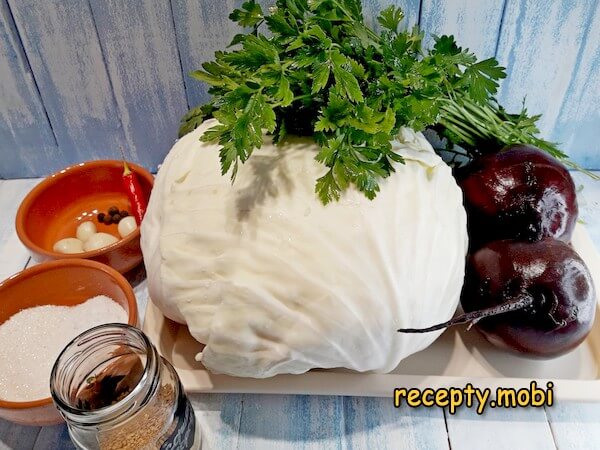
I prepare the ingredients for Georgian-style cabbage with beetroot. If you like, you can reduce the parsley bunch a little and add some cilantro – it will strengthen the Georgian accent. I choose cabbage with firm leaves of good quality: a limp head will not give the characteristic crunch. The spiciness of the dish is adjusted with the chili pepper. You can ferment the vegetables in any container made of glass, stainless steel, or enamel, but a regular three-litre jar is the most convenient.
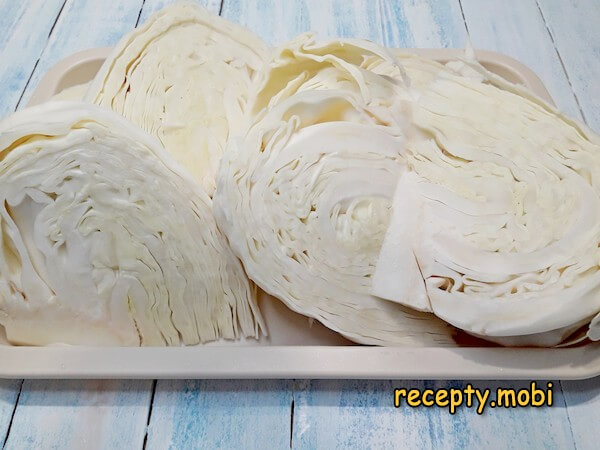
I cut the cabbage into segments that widen towards the edge, making sure to include a bit of the core in each piece – the core holds the whole segment together so it does not fall apart, and it makes the dish easier to serve at the table. This is the key difference from ordinary shredded sauerkraut.
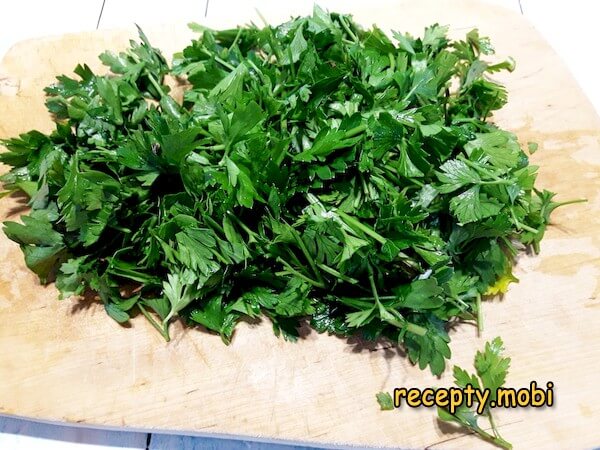
I chop the parsley, but not too finely – a fine chop turns to mush during the long fermentation.
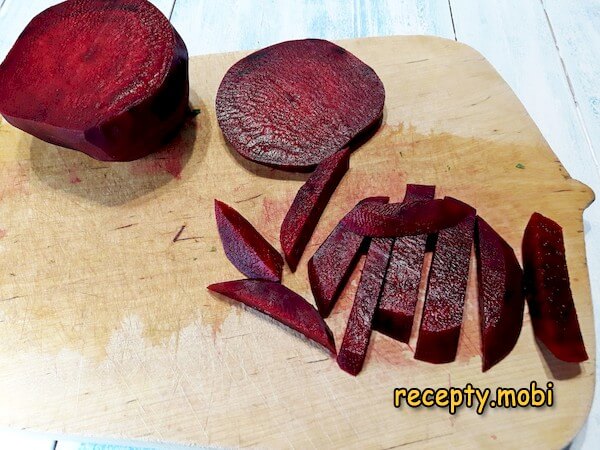
I peel the beet and cut it first into 0.5 cm slices, then shred it into fairly thick strips. They ferment along with the cabbage and stay pleasant to eat, and the overall amount of beet does not overpower the taste of the cabbage at all.
In a separate bowl, I mix the parsley, beet, coriander seeds, and allspice into a single mixture that will form the layer between the layers of cabbage.

I finely chop the chili pepper and add it to this mixture – a fine chop distributes the heat evenly.

I pour about a third of the prepared mixture into the bottom of a clean, dry jar – it becomes an aromatic cushion for the cabbage.

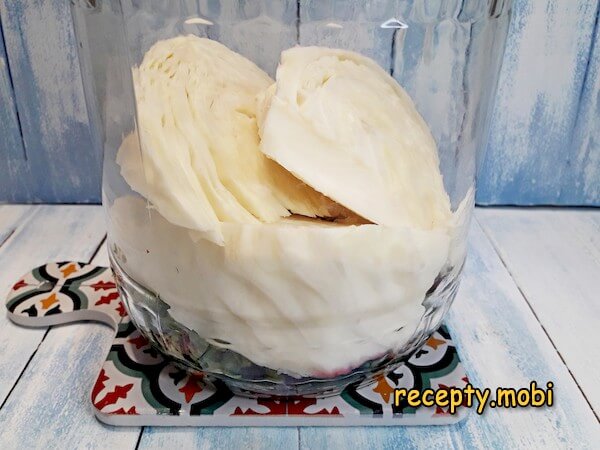
Next, I pack several cabbage segments in snugly – without pressing, just tightly. Tamping them down would crush the cabbage and it would lose its crunch.
I cover it with the remaining half of the green-and-maroon mixture – the beet and parsley should be distributed evenly between the layers of cabbage.

On top of that, I scatter some of the cut garlic cloves (you can add them all at once) – the garlic gives its aroma to the brine.

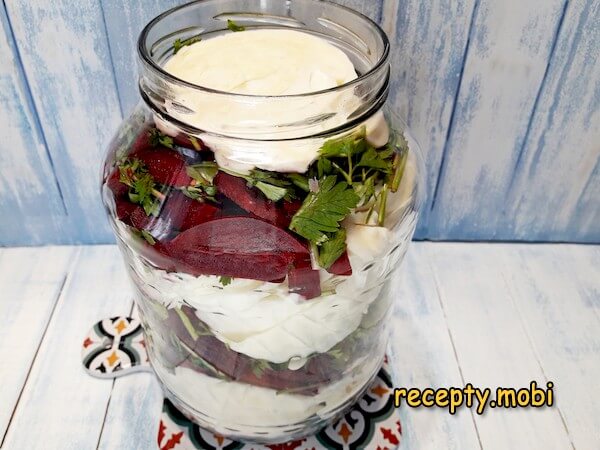
I fill the whole jar in the same order – alternating layers of cabbage and the green-and-maroon mixture.

I press one piece of cabbage – ideally the largest – down firmly on top. It acts as a stopper that keeps the contents from rising and floating up out of the brine. Without this stopper, the cabbage on top can end up above the brine and grow mould.
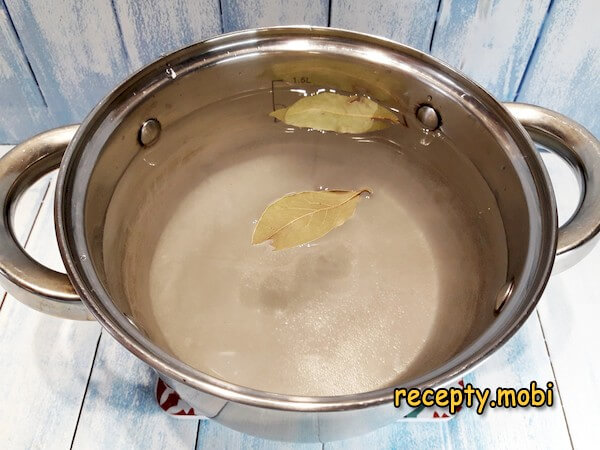
I prepare the brine by combining the salt, bay leaves, and sugar in the water. I boil everything on the stove for about 5 minutes so the bay leaves release their aroma, after which they can be discarded – there is no point keeping them in longer, the aroma has already been given off.
I pour the hot brine into the jar all the way to the top – the hot liquid speeds up the start of fermentation and pasteurises the vegetables without losing their fermentation activity.

I set a plate under the jar – during fermentation the liquid may leak out. I cover it with a lid but do not screw it tight – the gas needs to escape freely, otherwise the jar will burst. I leave it to stand at room temperature for several days. The length of the souring will reveal itself as it goes.

After a day, the brine takes on a delicate pink hue, but fermentation has not started yet – the beet gives off its colour quickly.

On the second day, a dark maroon hue already appears – the beet has fully soaked the brine with colour.
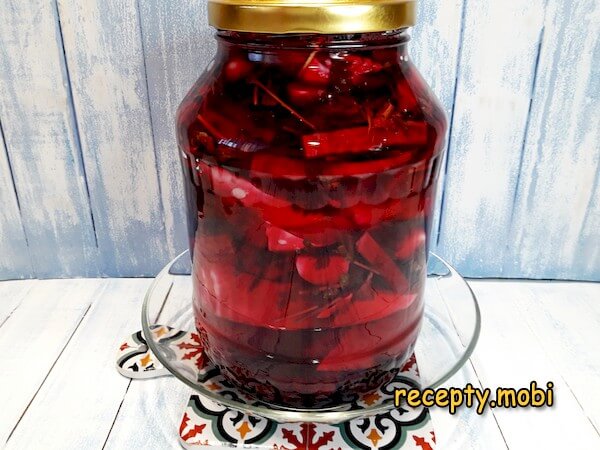
And fermentation begins, with air bubbles rising. Now and then you can gently press the top piece of cabbage down so it does not float up. When the bubbles stop forming, the fermentation process is finished. You can also taste a cabbage leaf. If the room is not very warm, the souring may stretch to 8 days. I move the finished batch to the fridge.



Tips
- 1
SEGMENTS WITH A BIT OF CORE – the secret to serving. Without catching a bit of the core, the segments fall apart into separate leaves when served. With a piece of core, each one holds its shape like a "rosette" and looks attractive on the plate.
- 2
A CABBAGE-PIECE STOPPER – the secret against mould. Without a stopper, the cabbage on top floats up, becomes exposed, and grows mould. A large piece of cabbage pressed down firmly on top holds everything under the brine, so mould has nowhere to take hold. The same trick works in Pickled Cauliflower with Beetroot 'Pink Clouds'.
- 3
HOT BRINE FOR THE START – the secret of fast fermentation. Cold brine starts fermentation only after 3–4 days, and sometimes does not start at all. Hot brine pasteurises the cabbage, activates the lactic-acid bacteria, and fermentation begins on the 1st–2nd day.
- 4
A LID THAT IS NOT SCREWED TIGHT – the secret against the jar bursting. A screwed-on lid traps the CO2 from fermentation, the pressure rises, and the jar can burst. A lid simply set on top lets the gas escape and the jar stays intact. The same principle is used in sauerkraut with cranberries.
FAQ
Which cabbage should I choose for Georgian-style fermentation? +
The classic choice is late, dense varieties of white cabbage with pale, crisp leaves – "Slava", "Podarok", "Amager", "Kolobok" (1 kg fills a three-litre jar). Alternatives: Chinese cabbage (premium, more tender, ferments about a day faster), Savoy cabbage (premium, more exotic), red cabbage (premium, adds bright colour on top of the beet). Do not use: early varieties with loose leaves (they fall apart into mush), young cabbage with white leaves (too little fibre for crunch), or limp cabbage with drying leaves (it ferments poorly). A fresh head from the autumn harvest is ideal.
How much beet should I add for the right colour? +
The classic amount is 350–400 g of beet per 1 kg of cabbage, which gives a rich pink-maroon colour. Less (200–250 g) gives a delicate pink hue and a more "cabbagey" taste. More (500–600 g) gives a dark maroon, almost purple colour and a more pronounced beet flavour. Beet varieties: the classic table types "Bordo", "Tsilindra", "Egyptian Flat" (for an attractive cross-section), or premium "Boyarynya" with an even colour. Do not use: fodder beet (it tastes bitter) or sugar beet (no colour). The roots should be firm, with no dried-out patches.
How long does Georgian-style fermented cabbage keep? +
In the fridge in a tightly closed container – up to 1 month. In the second week the flavour becomes richer and the crunch is preserved. From the third week the "freshness" of the aroma begins to fade, but the cabbage is still good. Signs of spoilage: mould on the surface (even a little), a sharp unpleasant smell of rot, or grey or brown patches on the cabbage – I throw such a jar out. It is not worth freezing – after thawing the cabbage loses its crunch and becomes watery. It is ideal to eat it within 2–3 weeks of being ready.
What should I serve Georgian-style cabbage with? +
It is a versatile appetiser. The classic of the Georgian table – with shashlik, mchadi, lobio, and Adjarian khachapuri. For the Russian table: with fried potatoes or mashed potato, buckwheat with butter, or cutlets. With meat: with pork, beef, or lamb. With drinks: Georgian wine such as "Saperavi" or "Khvanchkara", chacha, dark beer, or vodka with a cold snack. On a sandwich: black bread with butter and the cabbage on top as a piquant layer. For a festive table: on a separate plate with cilantro. It is versatile – fresh, bright, and appetising.
- Comment
or post as a guest
Be the first to comment.