
avg —
Cherry Tomato Whole Jam

Instructions
I choose ripe but definitely firm cherry tomatoes with whole, undamaged skin. Soft or cracked tomatoes will fall apart during cooking and will not hold their shape. I take the tomatoes off the sprigs one by one, gently pulling out the stems. I wash them in cold water and pat them dry with a paper towel.
I cover the cherries with sugar in a thick-bottomed saucepan and leave them for 30 minutes. In this time the tomatoes release their juice and the sugar partly dissolves. This is a preparatory step that stops the sugar from burning to the bottom at the start of cooking. Do not skip this infusing time.
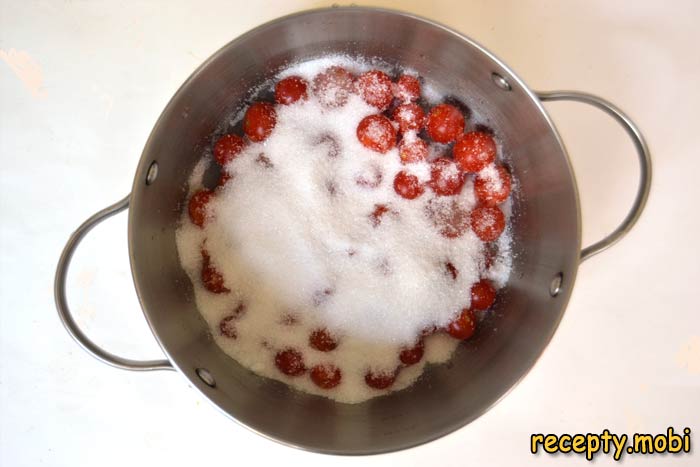
I set the saucepan over low heat and cook for 15 minutes, stirring gently from time to time with a spatula. No spoon – a wooden or silicone spatula with a flat edge carefully "turns" the tomatoes over without damaging them. Vigorous stirring is sure to break the whole cherries.
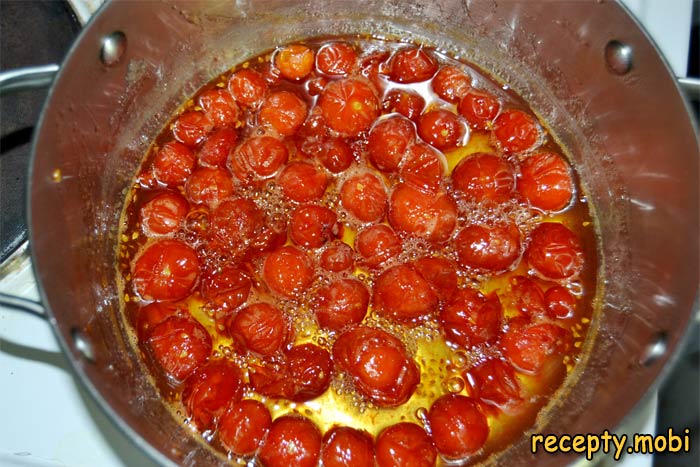
I take it off the heat and leave the jam to infuse for 8 hours in a cool place. During this time the tomatoes soak up the syrup from all sides, their cells absorb the sugar and "firm up". Without this pause the trick of keeping the cherries whole will not work – they are sure to burst during a long boil.
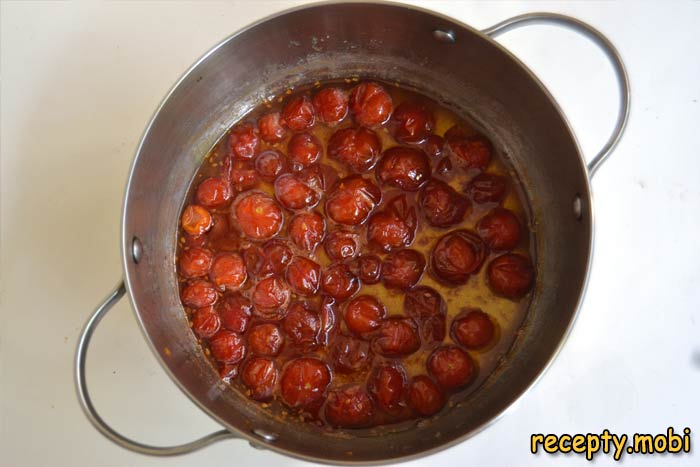
I set the saucepan back over low heat and cook for another 15 minutes, stirring carefully. The second cooking concentrates the syrup further – it becomes thicker and clearer. I take it off the heat and leave it for another 8 hours for the final infusing.
For the third time I cook for 15 minutes over low heat, and right at the end I add freshly squeezed lemon juice (from 1/8 of a lemon). The lemon juice works on two levels: it balances the sweetness and "fixes" the colour of the tomatoes, while also acting as a natural preservative for long storage.
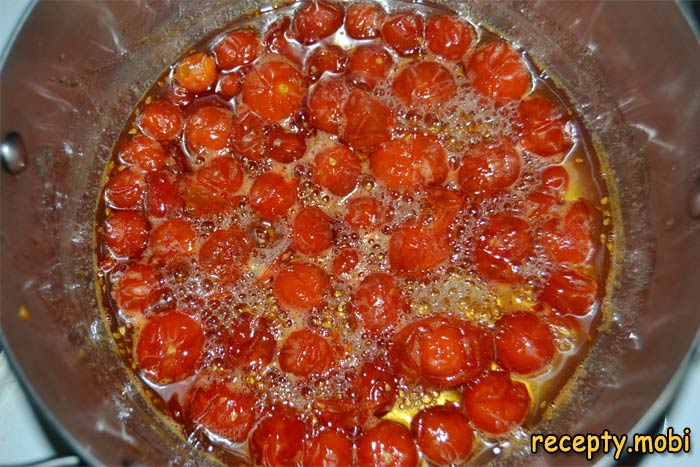
I pour the hot jam into sterilised small jars of 180–250 ml and seal them straight away with sterile lids. Small jars are ideal for an unusual jam – it is eaten slowly, and in a large jar it can spoil while being stored after opening.
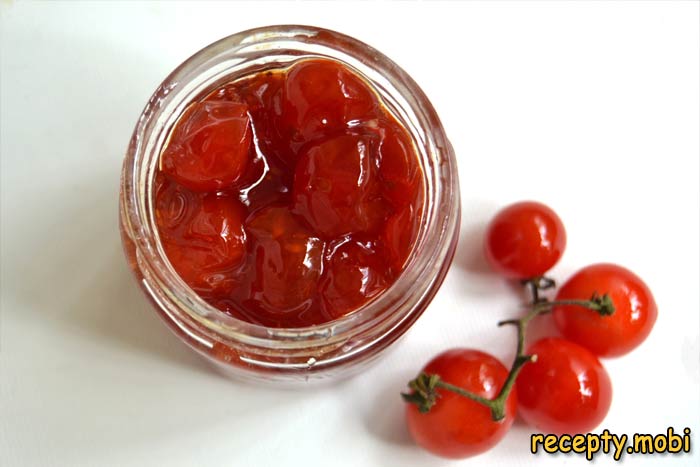
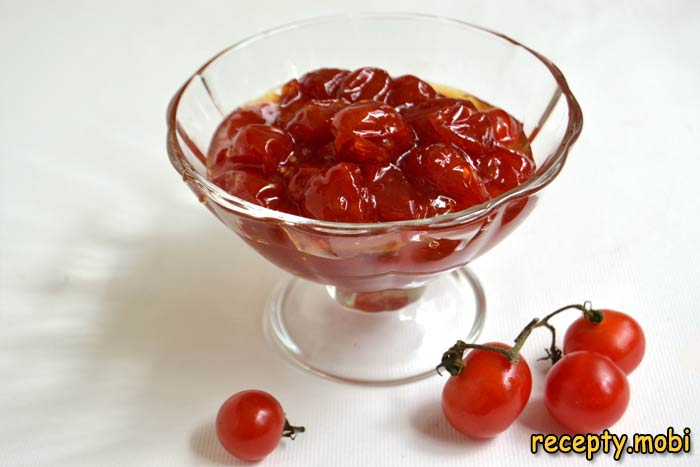
I turn the jars upside down to check the seal and wrap them in a blanket for 12 hours until completely cool. I store them in a cool dark place for up to a year. The cherry tomato jam is ready! I serve it with a cheese board or with tea and biscuits.


Tips
- 1
Cook strictly in three stages with long 8-hour pauses – this is essential. A single long boil will break the tomatoes apart.
- 2
Choose only firm, hard cherries with whole skin – soft or cracked ones are not suitable for this jam.
- 3
Stir very carefully with a silicone or wooden spatula without damaging the berries. I use a similar principle to make gooseberry jam.
- 4
Use a thick-bottomed saucepan for even heating – a thin bottom will scorch the sugar and give the syrup a darkish colour.
Types of sweet cherry tomato preserve: which method to choose
Sweet cherry tomato jam can be made in several ways, and the one you choose affects how the fruit looks, how thick the syrup turns out and how long you spend at the stove. The classic three-stage boiling gives the prettiest whole berries in a clear syrup, but if you want something quicker there are simpler options too. Anyone who enjoys unusual sweet preserves should also take a look at stoned hawthorn jam: the gentle cooking principle there is much the same.
| Method | Result | Fruit | Time |
|---|---|---|---|
| Three stages (the classic) | Clear amber syrup, berries whole and firm | Stay whole | 3 boils of 5-7 minutes each, cooling fully in between |
| Single stage | Thinner syrup, fruit may wrinkle a little | Some split | 15-20 minutes after it comes to the boil |
| With a gelling agent | Thick syrup, closer to a conserve | Whole, but set in a firm jelly | 5-10 minutes, with the pectin added at the end |
| Jam (pureed) | A smooth spread for toast and baking | Cook down into a pulp | 20-25 minutes, reducing as it cooks |
For an eye-catching presentation or a gift, go for the classic three-stage method. If your cherry tomatoes are overripe or cracked, it makes more sense to turn them into jam, where their shape no longer matters.
How to choose cherry tomatoes
The quality of your preserve is decided the moment you buy the fruit. For jam you need firm tomatoes that will hold up to boiling and not fall apart.
- Pick ripe but firm cherry tomatoes with no cracks, dents or pale patches: overripe ones will burst at the very first boil.
- Favour small, dense varieties, ideally plum-shaped or elongated: they have fewer seed chambers and thicker walls.
- Choose cherry tomatoes of roughly the same size so they soak up the syrup evenly.
- The skin should be smooth and glossy: a dull, wrinkled surface means the tomato has already started to wilt.
If you sort out firm, smallish tomatoes on the same principle, you can also bottle them whole in their own juice: see tomatoes in their own juice for winter, where the shape of the fruit matters just as much.
What makes the jam amber and clear
The secret to a beautiful jam lies not in rare ingredients but in care. A few simple steps help you keep both the colour and the whole berries.
- Prick each berry with a cocktail stick in 2-3 places: the syrup gets inside while the skin stays intact during heating.
- An overnight rest with sugar: the tomatoes release their juice, so you cook in a ready-made syrup rather than boiling off water.
- Short boils of 5-7 minutes with full cooling in between: the fruit has time to soak through without falling apart.
- Do not stir with a spoon; instead swirl the pan: this keeps the berries whole and the syrup clear.
- A squeeze of lemon or a pinch of citric acid: it brightens the colour, stops the jam crystallising and balances the sweetness.
Spices go in right at the end of the final boil: a cinnamon stick, a couple of cloves, a vanilla pod or a star anise give that fragrant, spiced aroma this unusual preserve is all about.
Sterilisation and preserve safety
In a sweet jam the main preservative is sugar. Do not cut the 1:1 ratio too far: the less sugar there is, the higher the risk of fermentation and mould. Cherry tomatoes are a low-acid food, so the added lemon juice or citric acid plays a double role: it improves the flavour and raises the acidity, which gives the preserve extra protection.
- Wash the jars with bicarbonate of soda and sterilise them over steam or in the oven for 10-15 minutes, and boil the lids for 5 minutes.
- Ladle the jam hot into hot jars, seal at once, turn them upside down and wrap them up until they have cooled completely.
- Do not reduce the amount of sugar or skip the acid: these are the very things that keep the preserve safe.
- Store in a cool, dark place, a cellar or the fridge, away from radiators and sunlight.
Throw out, without tasting, any jar with a bulging lid, mould, cloudy syrup or signs of fermentation. If you would like to master preserves that need no long boiling, start with safe, tried-and-tested options such as apple compote without sterilisation, where the natural fruit acid works together with the hot fill.
Common mistakes and how to avoid them
- You cut the sugar to make it less cloying: the preserve ferments and grows mould. Keep the ratio no lower than 1:1.
- You did not prick the berries: the skin bursts while the flesh stays dry and never soaks up the syrup.
- You boiled it in one long stage: the cherry tomatoes wrinkle and lose their shape. Short boils with cooling keep them whole.
- You poured hot jam into cold jars: the glass cracks. The containers should be warm and dry.
- You overcooked the syrup to a caramel colour: the jam turns bitter and crystallises quickly. Aim for an amber, not a brown, shade.
FAQ
Why cook the jam in three stages rather than all at once? +
Cooking in three stages with 8-hour pauses is the classic technique for preserving whole berries (strawberries, cherries, cherry tomatoes). With each short cook the tomatoes "shrink" slightly, and during the pause they soak the sugar syrup back up. After three cycles the cherry cells are firmed up with sugar, so they will not fall apart during the third cooking. With a single long boil (45 minutes) the tomatoes break down into a purée straight away – you end up with an ordinary tomato jam without the signature "wow-effect" of whole berries.
Can the jam be made with ordinary tomatoes? +
Yes, you can use ordinary medium-sized tomatoes, but no longer "whole". Cut them into slices or quarters and cook them by the same three-stage method. The result will be different: you get a more "jam-like" preserve with pieces rather than striking whole cherries in clear syrup. You can also try small plum tomatoes – they too hold their shape. Green, unripe tomatoes with plenty of sugar give the classic "green tomato jam" – a completely different recipe.
How long does the finished cherry jam keep? +
In sealed, sterilised jars in a cool dark place (a cellar or pantry) – up to a year without loss of quality. Once a jar is opened, move it to the fridge and use it within 2–3 weeks. Small jars of 180–250 ml are best for such unusual jams – a portion is eaten quickly before it has time to turn. The signs of spoilage are the usual ones: mould, fermentation, a bulging lid, a change in colour – throw it away without regret.
What goes with this unusual cherry tomato jam? +
It is perfect with a cheese board – with goat's cheese, brie, camembert, parmesan. The contrast of salty cheese and sweet tomato jam is an elegant restaurant pairing. It is also served with morning toast spread with soft cream cheese, with homemade pancakes, syrniki and fritters. It is interesting added to hot meat (pork, duck) as a sweet-and-sour sauce. For dessert, drizzle it over ice cream or stir it into Greek yoghurt. With tea, it makes an unusual treat to offer guests.
Do you need to peel cherry tomatoes? +
No, for the classic version the skin is left on: it holds the shape of the berry and stops it going mushy. It is enough to prick each fruit with a cocktail stick so the syrup can get inside. If you want a really delicate texture, you can dip the cherry tomatoes into boiling water for 20-30 seconds, then into cold water and slip off the skins, but such fruit needs to be cooked more gently.
Which spices go well with cherry tomato jam? +
Cinnamon, cloves and vanilla work best of all, giving a warm, dessert-like aroma. For a bolder flavour you can add star anise, a piece of ginger or a strip of orange zest. The spices go in at the end of the final boil and are often removed before jarring so the flavour does not become too sharp.
What should I do if the jam crystallises in storage? +
This is not spoilage but sugar crystallising. Tip the jam into a saucepan, add a tablespoon of water or lemon juice and warm it over a low heat until the crystals dissolve. After that you can use it again or transfer it to a clean jar.
Can lemon be replaced with citric acid? +
Yes, for every 200 g of sugar a small pinch is enough, about a quarter of a teaspoon of citric acid dissolved in a spoonful of water. It brightens the colour and guards against crystallising just as well, but it does not add the citrus notes that fresh lemon brings. The flavour will be a touch more neutral.
Why did the tomatoes split or wrinkle during cooking? +
The usual culprits are overripe fruit, too vigorous a boil or not enough cooling between stages. Cook over a gentle heat, do not stir with a spoon but simply swirl the pan, and always let the jam cool completely before the next boil. Firm, smallish cherry tomatoes hold their shape noticeably better than soft ones.
How much jam do you get from 250 grams of cherry tomatoes? +
With these proportions you end up with about 200-250 ml of finished jam, that is, a not-quite-full half-litre jar. The recipe scales easily: increase the tomatoes, sugar and lemon in proportion, keeping the 1:1 sugar ratio. For a winter store it is handy to make a double or triple batch at once.
Related preserves
- Comment
or post as a guest
Be the first to comment.