avg —
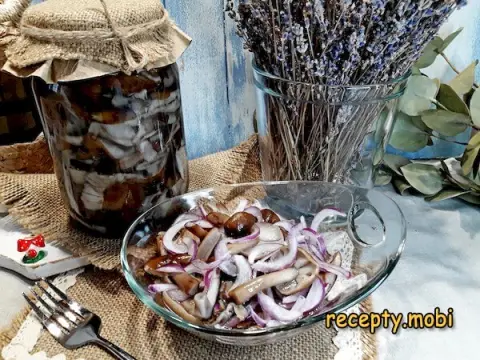
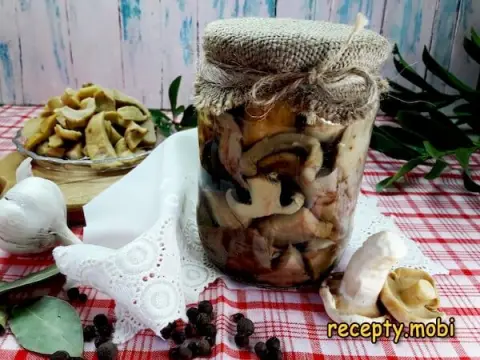
Mushroom Marinade for One Liter of Water for Winter
Instructions
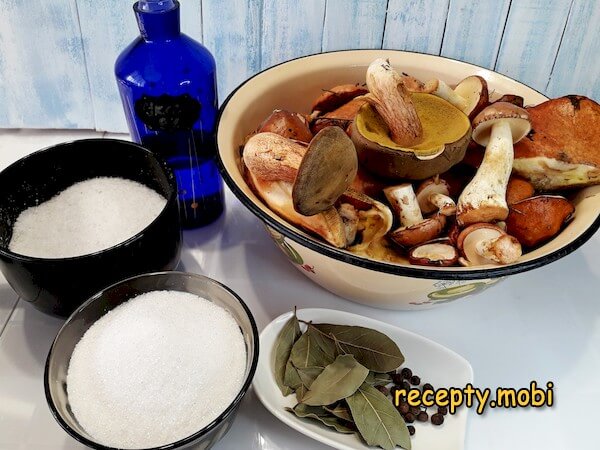
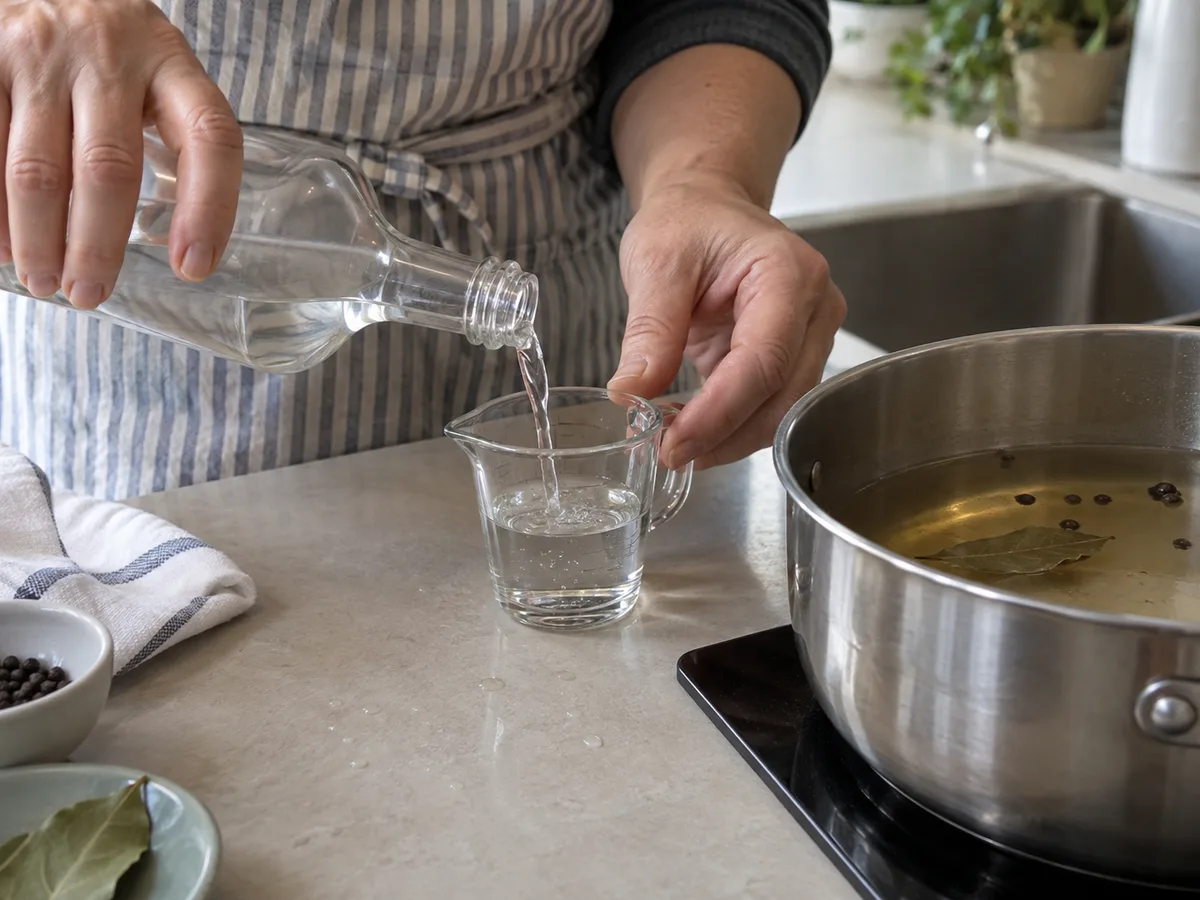
I prepare all the ingredients. Ready-made 9% vinegar can be replaced with 70% vinegar essence: dilute it with water, 1 part essence to 7 parts water. I wash the jars and lids with baking soda in advance and scald them with boiling water.
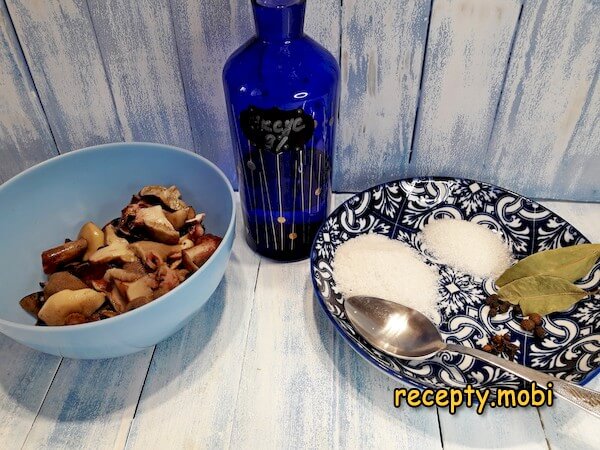
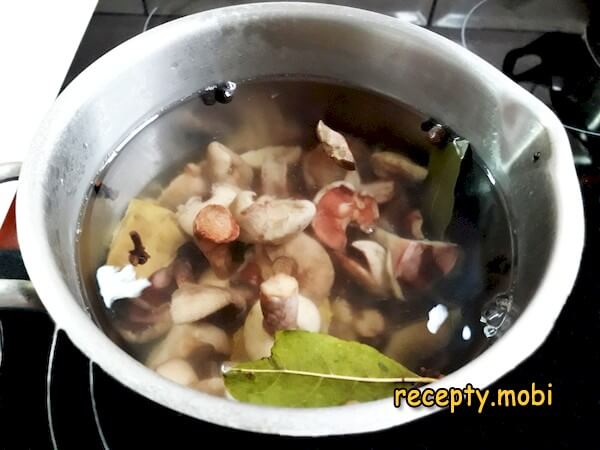
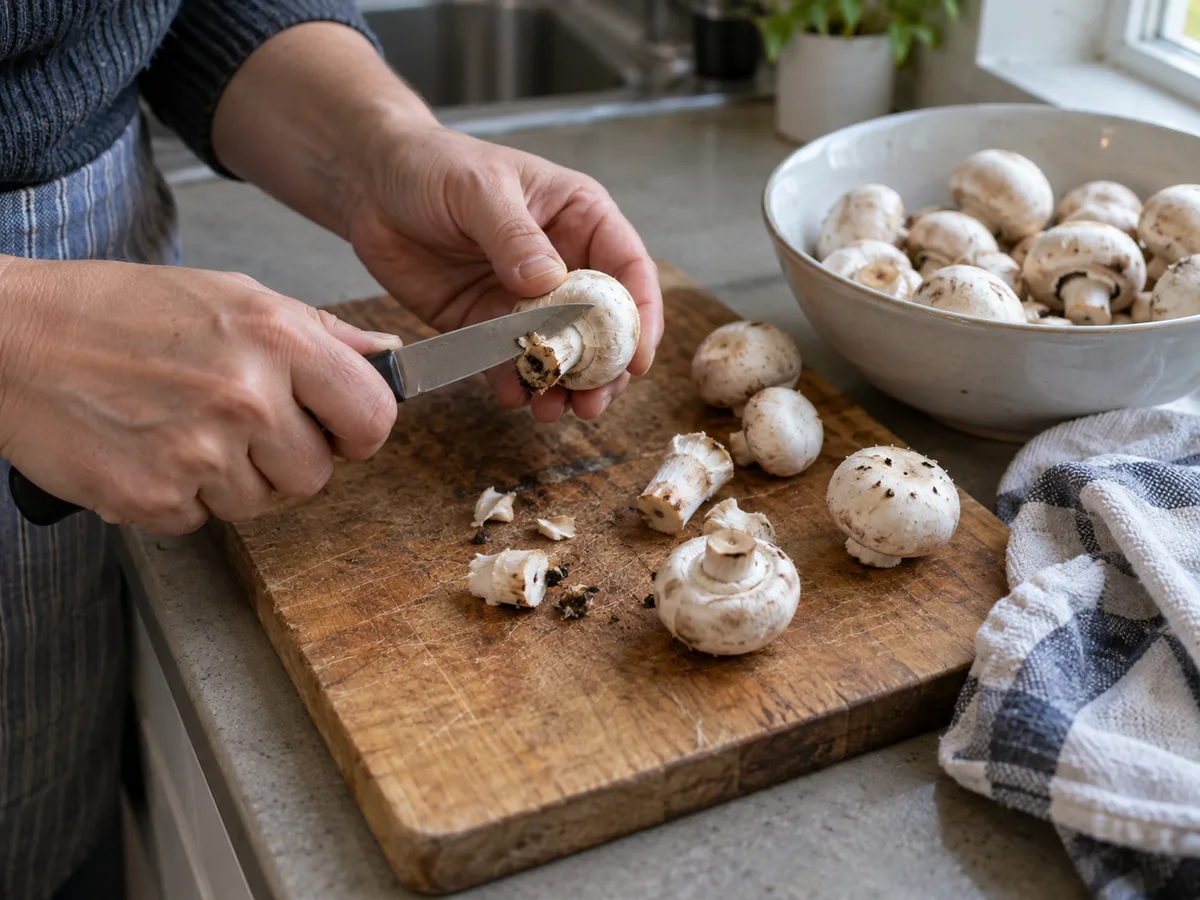
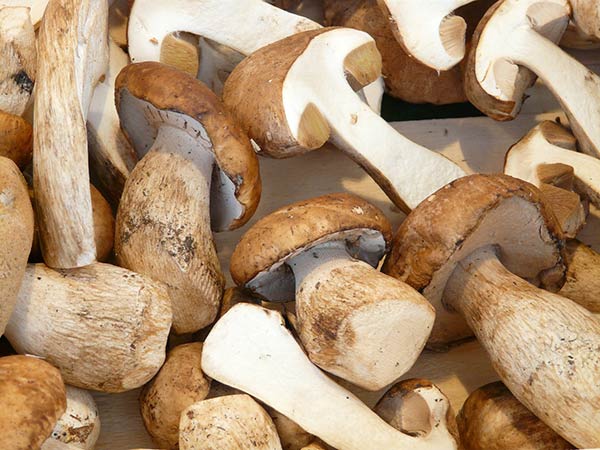
I clean the mushrooms of debris and boil them (the time depends on the variety) in water without salt. Salt at the pre-boiling stage slows the release of bitterness in some varieties, so I do not add it at this stage. At the same time I measure out all the ingredients for the marinade.
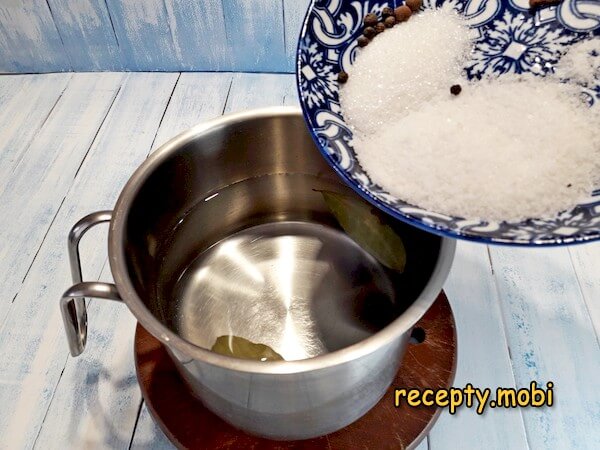
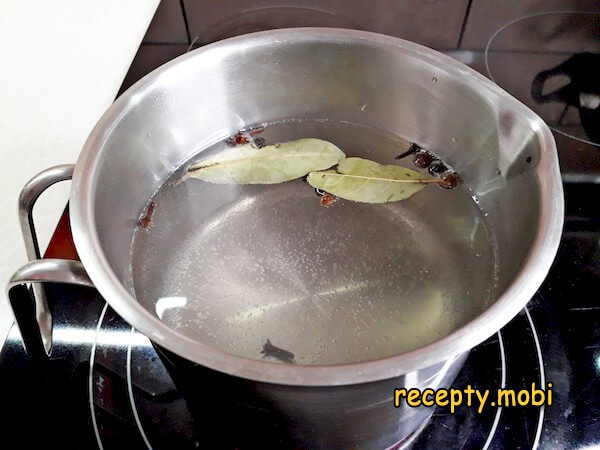
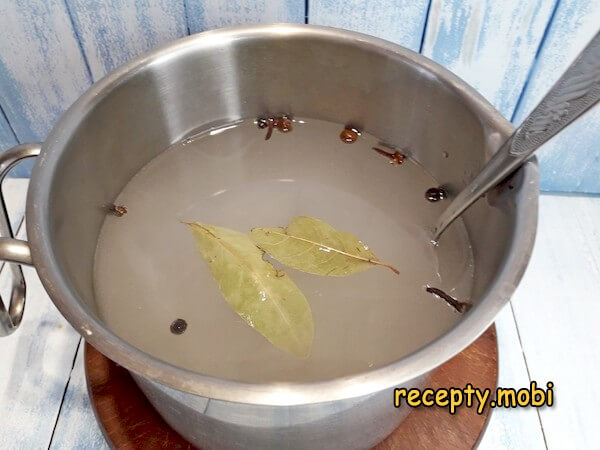
I pour water into a saucepan and add all the dry ingredients - salt, sugar, bay leaf, allspice, black pepper and cloves. Adding all the spices at once gives them time to open up during boiling.
I stir the mixture with a spoon - the salt and sugar should dissolve completely, otherwise they will settle at the bottom of the jars and spoil the look of the finished preserve.
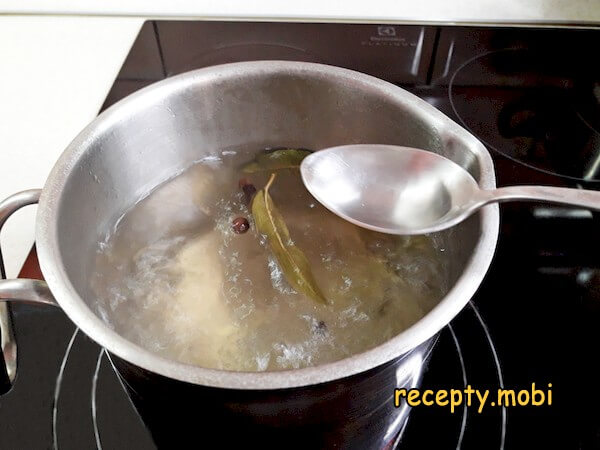
I put the saucepan on the stove and bring it to a boil. Boiling water is needed both to dissolve the salt and sugar and to pasteurise the spices - some spices (especially cloves) need heat treatment to release their aroma.
I pour in the vinegar at exactly this stage and not earlier - long boiling of vinegar evaporates the acetic acid, and the marinade loses its strength as a preservative.
I immediately add the mushrooms to the marinade and cook them for 5 minutes. This sequence applies to those mushrooms that were pre-boiled for a long time (about 40 minutes) or to those that do not need additional heat treatment. The other mushrooms I cook in the marinade without vinegar for 15 minutes, then pour in the vinegar and cook for another 5 minutes - this way the mushrooms have time to cook through completely, and the vinegar does not lose its strength.
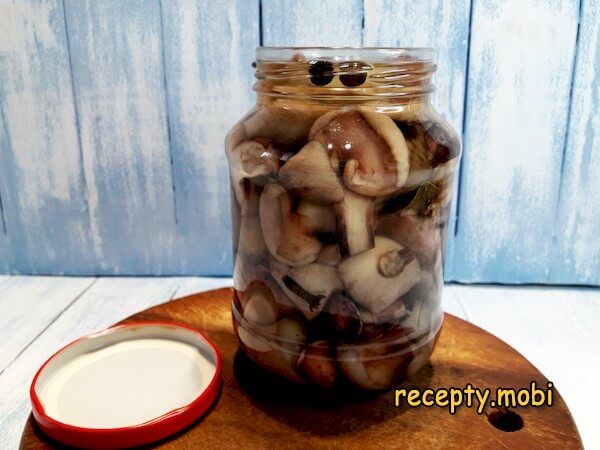
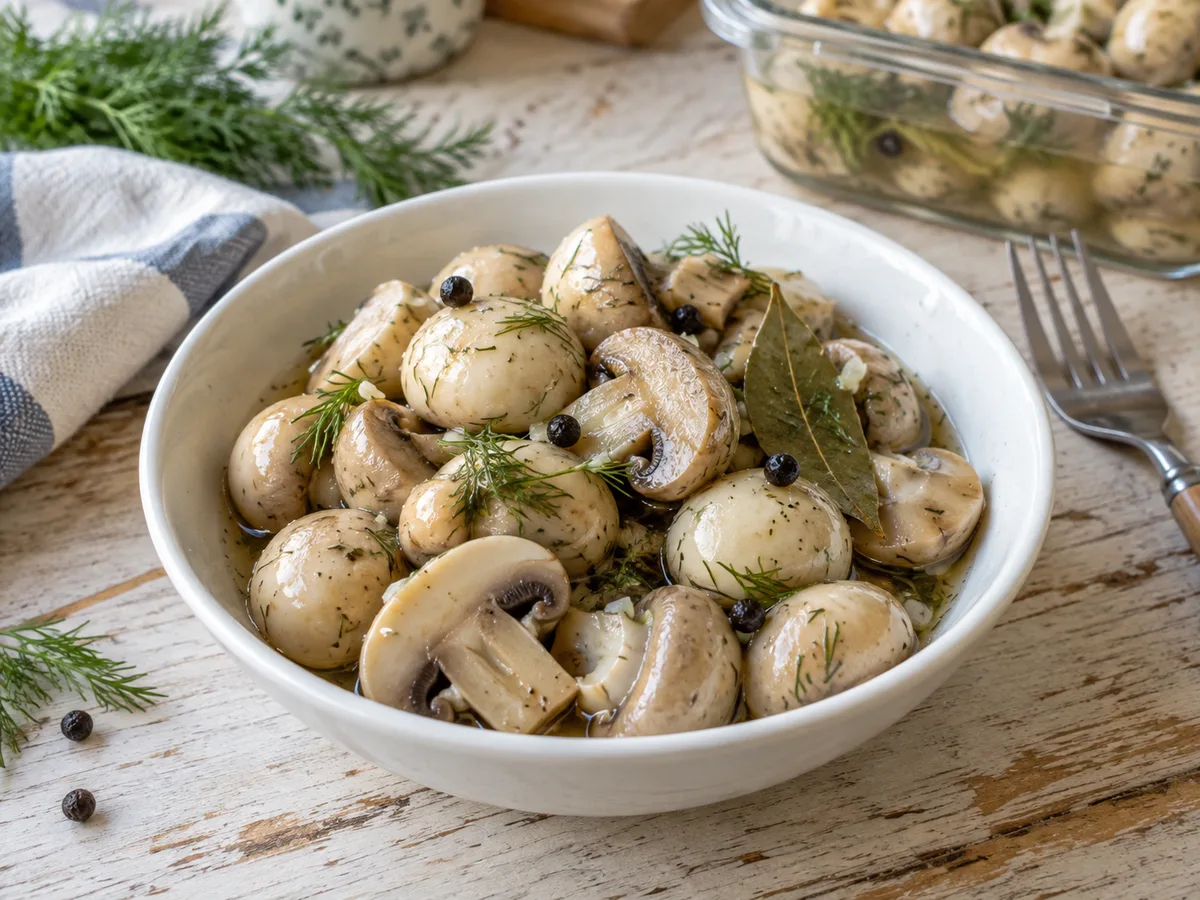
I distribute the mushrooms among the jars - they should take up about 75% of the volume of the glass container and float freely in the marinade, which is poured right to the top. Mushrooms that are packed in tightly will not soak up the marinade evenly.
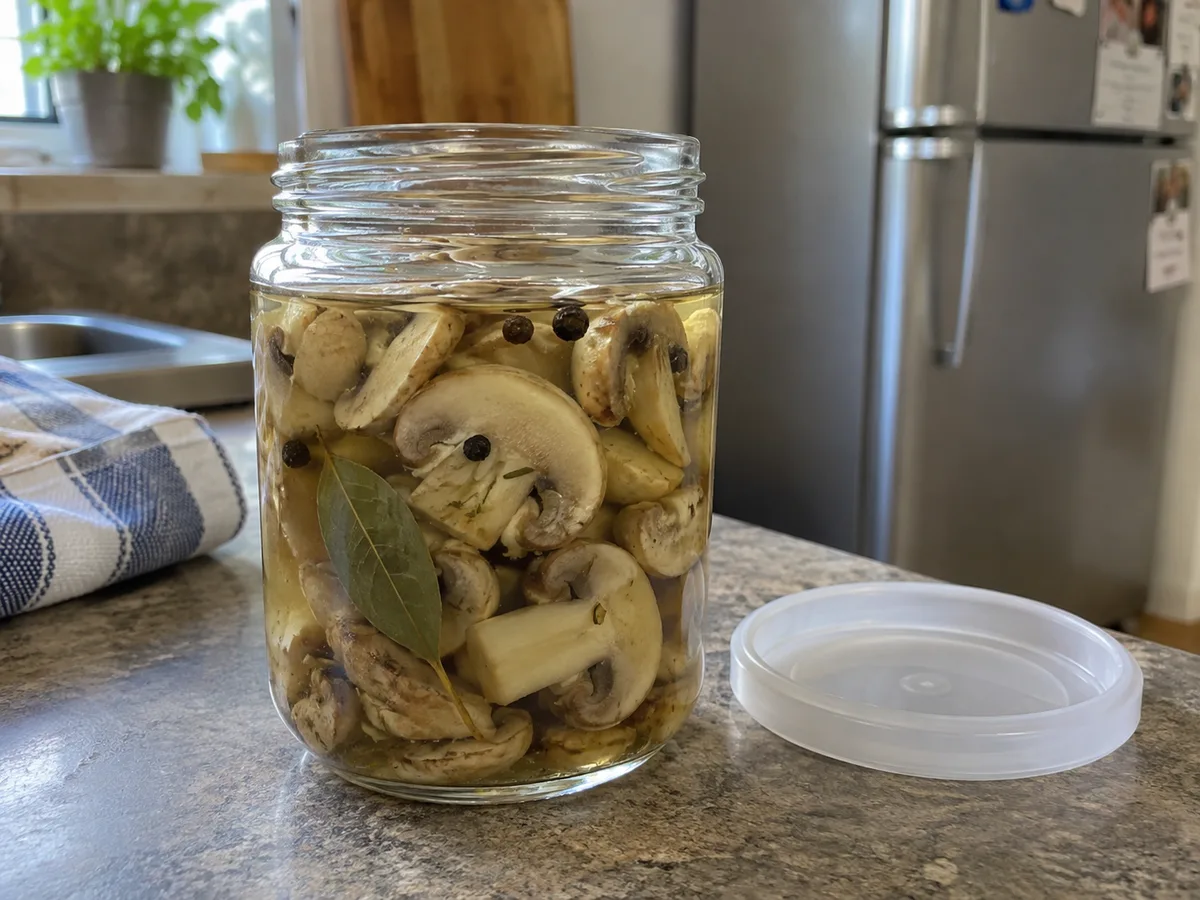
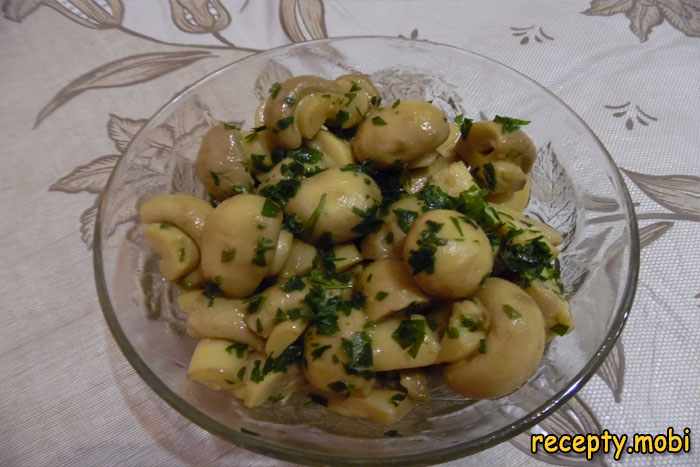
I pack the mushrooms and marinade into clean jars and close them with a plastic lid: no metal seal, no vacuum needed here. I cool them down fast by standing the jars in a sink of cold water, then move them to the fridge. The quicker a jar passes from 50 to 20 degrees, the firmer the mushrooms stay. Turning the jars upside down and wrapping them in a blanket is not needed: it does nothing for keeping quality, and the full explanation is in "Storage and safety".
Tips
- 1
VINEGAR AT THE END - the "secret" to a strong marinade. Vinegar added to boiling water for 5 or more minutes evaporates. Adding it just seconds before the mushrooms go in keeps all the acetic acid intact, so it works as a preservative at full strength.
- 2
BOILING WITHOUT SALT - the "secret" against bitterness. Salt at the pre-boiling stage makes some varieties (especially forest mushrooms) release bitterness too early. Boil in clean water, then use a salty marinade - the mushrooms turn out tender, with no off-flavours. The same trick works when freezing herbs for winter.
- 3
75% OF THE JAR - the "secret" to even marinating. Tightly packed mushrooms do not soak up the marinade in the middle. 75% mushrooms + 25% marinade on top - all the pieces float freely and are salted evenly.
- 4
FAST COOLING: the "secret" of the right texture. A jar left to cool slowly keeps stewing itself in its own residual heat, and the mushrooms go flabby. A sink of cold water and then the fridge: the mushrooms stay firm.
Comparison of preserving methods
With vegetables, choosing a preserving method is mostly a question of taste: you want crunchy pickles, you do one thing; you want a salad, you do another. Mushrooms do not work like that. Mushrooms are low-acid, pH 6.0-6.7, and that puts them in the category of foods where the rules are set by microbiology rather than by the cook: acidity decides whether you can seal a jar airtight at all, and where that jar is allowed to stand afterwards. So the table below compares methods not by flavour but by what each one actually delivers.

| Method | Shelf life and where to keep it | Who it suits |
|---|---|---|
| The marinade from this recipe, refrigerated | Refrigerator, +2...+4 C, up to 3 months | Anyone with a shelf in the fridge. |
| Freezing boiled mushrooms | Freezer, -18 C, 8-12 months | Anyone with more mushrooms than fridge space. |
| Pressure canner, cultivated mushrooms only | A dark cupboard at room temperature, about 12 months | Anyone who already owns a pressure canner. |
| Drying | A dry jar or a cloth bag, room temperature, humidity up to 70%, 1-2 years | Anyone who needs a store with no refrigeration at all. |
| Open salting under a weight | A cellar or the fridge, 0...+6 C, 6-8 months | Anyone with milk caps, woolly milkcaps, saffron milk caps or russula and a cold place to keep them. This is exactly the method Rospotrebnadzor, the Russian consumer health authority, calls the right one: a preserve that needs no airtight seal. |
What each method takes

The marinade from this recipe, refrigerated. The full marinade as written: 1 L water, 2 tbsp salt, 1 tbsp sugar, 4 tbsp 9% vinegar, bay leaf, allspice and black peppercorns, cloves. Clean jars, a snug plastic lid, fast cooling. Do not seal, do not invert, do not wrap. This is the main method on this page: the ratios, the spices, the boiling and the 5 minutes in the marinade all stay exactly as written. Only the ending changes: instead of sealing, inverting and burying the jars under a blanket, you cool them fast and refrigerate.
Freezing boiled mushrooms. Boil according to the species table, drain in a colander, let them shed their water and dry off, then pack into bags or containers in 300-400 g portions. The marinade is made separately and never goes into the freezer. Pour the marinade over the thawed mushrooms a day before serving: the flavour comes out exactly the same.
Pressure canner, cultivated mushrooms only. A home pressure canner, jars no larger than 0.5 L, 45 minutes. 11 psi on a dial gauge up to 600 m altitude; on a weighted gauge, 10 psi up to 300 m and 15 psi above that. Shop-bought mushrooms only: button mushrooms, oyster mushrooms. The NCHFP process is written for mushrooms in water or brine, and the marinade from this page cannot be carried into it. It is not an option for wild mushrooms under any process: NCHFP says it flatly, Do not can wild mushrooms, and the process is validated on cultivated mushrooms only.
Drying. Do not wash them, wipe them with a cloth, slice 5-7 mm thick, then a dehydrator at 45-50 C or an oven with the door ajar until they snap. Good candidates: porcini, birch bolete, red-capped scaber stalk, bay bolete, honey fungus. Different flavour, no marinade involved, but also no water, and nothing grows without water.
Open salting under a weight. An enamelled pot, a wooden tub or a wide jar, 40-50 g salt per 1 kg of mushrooms, a weight, and a layer of brine covering the mushrooms. There is no airtight seal by design: oxygen gets in, and the lid is only there to keep the dust out.
Important: only two rows in this table earn a place at room temperature, and both come with conditions. A pressure canner works for cultivated mushrooms, meaning shop-bought button and oyster mushrooms. That 45 minute process does not transfer to freshly picked wild mushrooms: a wild mushroom carries soil in from the forest, packed into its gills and its sponge layer; soil is the natural reservoir of botulism spores, and there is no physical way to wash it out. Drying earns a shelf, but there is no water in dried mushrooms, and with no water there is nothing to discuss. There is no method for sealing marinated wild mushrooms in a jar and standing it in a kitchen cupboard. It is not that we are withholding it: it does not exist.
How long to boil mushrooms before marinating: table by species
This is the step where the whole job usually falls apart. There is no universal time: a slippery jack turns to mush at the point where a milk cap is still raw, and an undercooked honey fungus will upset your stomach. The clock is a guide here, not a law; watch the mushroom. One rule covers almost every species: boil until the pieces sink to the bottom of the pot and stay down. The time in the Boiling separately column starts when the water comes back to the boil with the mushrooms in it, not when you put the pot on the stove.


| Mushroom | Soaking | Boiling separately | In the marinade |
|---|---|---|---|
| Porcini | No soaking. At most 10-15 minutes in cold salted water (1 tbsp salt per 1 L) to float the grubs out. Any longer and the sponge layer drinks up water and goes soggy in the jar. | 25-30 minutes | 5 minutes |
| Red-capped scaber stalk | No soaking, just a quick rinse: water turns the flesh spongy. | 25-30 minutes; pour off the first water after 5-7 minutes at a boil and top up with fresh boiling water | 5 minutes |
| Birch bolete | No soaking. 10 minutes in salted water for the worms, then straight into the colander. | 25-30 minutes | 5 minutes |
| Honey fungus, autumn | No soaking. 20-30 minutes in salted water to draw out the grit and the small forest life hiding under the gills. | 30 minutes; pour off the first water after 10 minutes | 5 minutes |
| Slippery jack | Never soak them: the cap works like a sponge, it will load up with water and collapse in the jar. Clean them completely dry and rinse only just before they go into the boiling water. | 20-25 minutes | 5 minutes |
| Chanterelles | Optional. If yours taste bitter: 20-30 minutes in cold milk or salted water. | 20-25 minutes | 5 minutes |
| Bay bolete | No soaking, just rinse. | 25-30 minutes, or pour off the first water after 7 minutes | 5 minutes |
| Button mushrooms | No soaking. Wipe them with a damp cloth or rinse for 10 seconds: they absorb water instantly and then give you a watery marinade. | 5-7 minutes for shop-bought cultivated ones, 15-20 minutes for field mushrooms | 15 minutes without vinegar, then 5 minutes with vinegar |
| Oyster mushrooms | No soaking, just rinse. | 15-20 minutes | 5 minutes |
| Saffron milk cap | No soaking: the milk of a saffron milk cap is mild and sweetish, not bitter. You can give them 1-2 hours in salted water to drive insects out of the gills. | 15-20 minutes | 5 minutes |
| Russula | 1 hour in cold salted water for grit and insects. Acrid species (the sickener and the bright red ones): 2-3 hours, plus a mandatory discard of the first water. | 25-30 minutes | 5 minutes |
| Milk caps | 2-3 days in cold water, no way around it. Change the water 2-3 times a day, keep it cold (no warmer than 10 C), and hold the mushrooms under a weight so they do not float. | 20-30 minutes, and discard all the cooking liquid | 5 minutes |
| Woolly milkcap | 2 days in cold water, changed 3-4 times a day, under a weight, kept cold. | 20-30 minutes, and discard all the cooking liquid | 5 minutes |
| Milk-white russula | 1-2 days in cold water with 2-3 changes a day. The milk-white russula is less bitter than a true milk cap, but the bitterness only goes completely in that time. | 20-30 minutes | 5 minutes |
| Man on horseback (Tricholoma equestre) | 3-4 hours in cold salted water (1 tbsp salt per 1 L), changing the water 2-3 times. This is not about bitterness, it is about sand: there is no other way to open the gills up. | 30 minutes and more: 10 minutes, drain and rinse, then another 20 | 5 minutes |
Notes by species
Porcini. Take young ones, caps up to 8 cm, with a firm white sponge layer. On older specimens cut the sponge off completely: it falls apart and clouds the marinade. Stems are denser than caps, so slice them into 1.5-2 cm rounds and drop them into the boiling water 5 minutes ahead of the caps. Skim the foam in the first 10 minutes, that is where all the forest silt collects. Boil them apart from other species; the cooking liquid should stay pale. Done when: every piece has sunk, the liquid is clear, and a cut surface slices cleanly without crumbling.

Red-capped scaber stalk. The cut surface goes blue and then black within a minute: that is oxidation, not a sign of poison. Throwing away the first water is what keeps the marinade from turning grey-black. Never boil them with porcini or slippery jacks, you will stain the whole batch. Strip the sponge layer off mature caps. Use stems from young mushrooms only; on old ones they are woody. Done when: they have sunk, the liquid has evened out in colour and stopped throwing foam.
Birch bolete. The softest mushroom on this list: 10 minutes too long at a boil and it is porridge, and yet you cannot undercook it either. Sort ruthlessly: young ones only, cap still a half-dome, sponge white. If it dents under your thumb, it goes in the soup, not in the jar. Boil the stems separately, they are twice as dense as the caps. Keep the boil gentle, with no big bubbles, or the mushrooms will knock each other to pieces. Done when: they have sunk but the cap still holds its shape on the slotted spoon.
Honey fungus, autumn. Those 30 minutes are about safety, not flavour: raw and undercooked honey fungus contains irritant compounds that only long boiling removes, and cutting the time short means an upset stomach. Do not shorten it. The first water is cloudy and bitter, so it goes down the drain. The mushrooms are brittle: do not stir with a spoon, shake the pot by its handles. The stems are tough, so leave only 1-2 cm below the cap. Sort by size, or the small ones will be falling apart before the big ones are cooked. But the real risk with honey fungus is the picking, not the boiling: funeral bell (Galerina marginata) grows in the same clumps on the same wood and contains amatoxins, the death cap poison. Take only mushrooms with a membranous ring on the stem and scales on the cap. Done when: they have sunk, the caps have darkened and turned slightly rubbery, and the murky grey liquid has lightened.
Slippery jack. Peeling the skin off the cap is not optional. This is not fussiness: the slimy skin is bitter, it throws a slippery haze, it drags the marinade dark, and in some people it loosens the bowels. Work a knife under it from the rim towards the centre while the mushroom is dry; on a wet cap it just tears. Wear gloves, the juice will not wash off your hands for a week. To keep the marinade pale, add 2 g citric acid per 1 L to the cooking water. Small ones under 4 cm go in whole, larger ones halved. Done when: they have sunk, the water around them no longer trails in threads, and the liquid stays clear.
Chanterelles. Chanterelles are the one mushroom people undercook more often than overcook: they are dense, and at the 15 minute mark they still squeak against your teeth. Hence 20-25 minutes minimum. They are almost never wormy, chitinmannose keeps the larvae out, so soaking for insects is pointless. Their cooking liquid goes yellow and stains everything else in the pot, so boil them alone. Cut big ones lengthways into 2-4 pieces; whole, they cook unevenly. Brush the grit out of the folds under the cap, water will not shift it. Done when: they have sunk and a knife goes into the base of the stem easily, with no crunch.
Bay bolete. They go blue almost the instant you cut them, and that is normal. But the blue bleeds into the liquid and turns the marinade a murky grey, so either add 2 g citric acid per 1 L to the cooking water or discard the first water. On mature caps the sponge layer is loose and waterlogged: cut it off entirely or it will shed into the jar in flakes. The velvety cap holds sand, so rinse it under running water rather than in a bowl. Done when: they have sunk, the liquid has stopped darkening, and the cut flesh is springy.

Button mushrooms. The only ones on this list that are easier to take straight through the 15 plus 5 routine than to boil separately first. Do not peel the cap, the flavour sits right under the skin. Small ones under 3 cm go in whole, medium ones halved, large ones quartered. They pink up in the air and then brown, so work in batches and sprinkle with lemon juice as you go. Field mushrooms get confused with the death cap and with the yellow stainer. On a true field mushroom the gills are pink or brown and never white, the cut stem does not go yellow, there is no carbolic smell, and there is no sac at the base. White gills mean the bin, no exceptions. Done when: they have shrunk by about a third, turned creamy beige, and sunk.

Oyster mushrooms. They grow in fused clusters, so pull them apart into single mushrooms by hand or the middle of the bunch stays raw. The stem is tough and stringy along its whole length: cut it back almost to the cap and do not be sentimental about it. Caps over 10 cm are already leathery and stay that way in the marinade, so stick to 7-8 cm. They shrink hard, roughly by half, so allow for it. The flesh is neutral and takes all of its flavour from the marinade, which is why the cloves and allspice come through more strongly here than on anything else. Done when: the rim of the cap has gone translucent, the mushrooms have sunk, and a skewer slides through the stem without resistance.
Saffron milk cap. Half the recipes out there suggest 5 minutes, or salting them raw. For a marinated jar that is not enough: give them 15-20 minutes. They turn green as they boil, sometimes blue-green, and that is normal, not spoilage. To keep the orange, add 2 g citric acid per 1 L of water. The mushroom is brittle, so do not scrub the cap with a brush, pick the pine needles off with a knife. The gills sit tight together and grit does not come out of them easily. Small ones under 5 cm look and eat the best in a jar. Done when: they have sunk, the cap has greened evenly, and the liquid has gone rusty brown.
Russula. The most fragile mushroom on the list, it crumbles in your hands on the way to the pot. Take only firm young specimens whose rim has not turned up yet, and peel the coloured skin off the cap, it carries bitterness. Keep the boil gentle and do not stir. The green, the bog and the grey russula all do well in a jar; the bright red and pink acrid ones stay bitter even after boiling. The main warning: the greenish russula gets mistaken for the death cap, which accounts for up to 90% of fatal mushroom poisonings and has no antidote. A russula has neither a ring on the stem nor a sac (volva) at the base, so do not cut a greenish mushroom, twist it out of the ground whole and look at the base of the stem. Any doubt at all: throw it away, one death cap is enough to poison the whole pot. Done when: they have sunk and the caps have darkened and firmed up. Cloudy cooking liquid is normal for russula.
Milk caps. The milk cap is conditionally edible: raw, its acrid milk burns the mouth and throat and brings on vomiting and stomach cramps. Soaking here is not for flavour, it stands in for detoxification, and you cannot cut it short. The 2-3 hour express versions are no good. Keep the water cold: in a warm room the mushrooms sour within a day, they smell acidic and go slimy, and a batch like that only goes in the bin. Pour off every drop of the cooking liquid, all the bitterness is in it. The black milk cap additionally contains necatorin, a compound with mutagenic activity in laboratory tests, so soak it at the long end of the range and boil it twice with a change of water. Soaked enough when: a fresh cut no longer beads with white milk, and the water stays clear between changes and does not foam. Boiled enough when: it has sunk and the edge of the flesh has gone translucent.

Woolly milkcap. The species name torminosus means causing colic, and that is not poetry: without soaking and a full boil with the water thrown away, this mushroom gives you gastroenteritis. Several countries in Western Europe treat it as poisonous and keep it off the market; here it has been eaten for centuries, but only through the full cycle of soaking and boiling. The rim of the cap is shaggy, and pine needles and sand lodge in the fringe: brush them out, rinsing will not do it. Take small ones, up to 4 cm; big woolly milkcaps go cottony in the jar. Soaked enough when: the cut gives no milk and the water in the bowl has stopped turning yellow. Boiled enough when: it has sunk and the pink rings on the cap have faded.
Milk-white russula. The milk-white russula pushes up out of the ground with the leaf litter still on it, so the cap always arrives caked in sand, needles and dirt. Scrub it under a strong jet of water and comb through the gills separately: sand in the jar ruins everything you have done. The flesh is dense, almost bone-hard, and that is a virtue: it does not cook to mush and it stays crisp in the marinade better than most. The blackening russula (the cut goes red first, then black) is a poor choice for marinating, it stains the marinade a dirty grey; salt that one instead. Done when: it has sunk but is still springy. Unlike other russula it does not soften, so go by the bottom of the pot and by the clock.
Man on horseback (Tricholoma equestre). Safety first here, because what is at stake is not flavour. For decades this was treated as a solid edible, but between 1992 and 2000 France documented 12 cases of severe rhabdomyolysis (breakdown of muscle tissue) after people ate it, and three of them died. Similar cases have been described in Poland. Every severe episode involved large portions eaten repeatedly, several meals in a row. In 2003 the French food safety agency recommended taking it off the list of edibles, and in 2005 France banned its sale. Boiling does not help, the toxin is heat stable. If you marinate it anyway: small portions, never two days running, and definitely not for children, pregnant women, anyone with kidney disease, or anyone taking statins. The practical part: this mushroom grows half buried in sand, and the sand sits between the gills and will not let go. Cut the stem off right at the cap and always discard the first water. Done when: they have sunk, the liquid has stayed almost clear, and there is no sand in the bottom of the pot after you drain it. If it crunches, rinse the batch and boil it again.
Tip: cook by the mushroom, not by the timer. Skim the foam, wait for the mushrooms to sink, take the pot off the heat. If they sink early, they are done early. Keep them in the marinade for exactly 5 minutes, as the recipe says: that is the step where rubbery mushrooms are made.
Storage and safety
This section is about why the last stage of the job is different for mushrooms than it is for cucumbers and tomatoes. There is no mystery to it, only numbers, and the numbers are simple.


Why mushrooms are a case of their own
The threshold below which Clostridium botulinum will not grow is the same for every regulator: pH 4.6. That is how the WHO puts it (C. botulinum does not develop in acidic conditions below pH 4.6), and USDA and FDA say the same. Now the mushrooms. The FDA table gives fresh mushrooms a pH of 6.00-6.70 and boiled ones 6.00-6.22. The first thing that follows: boiling does not change the acidity at all, not by a tenth of a unit. The second matters more. A gap of 1.4-2.1 units looks small right up until you remember that the pH scale is logarithmic: mushrooms have 25-125 times fewer hydrogen ions than it would take to stop the clostridium. That is not slightly above the threshold, it is a different class of food. USDA counts every mushroom as low-acid, wild and shop-bought alike.
Then comes the arithmetic of conditions. Clostridium needs three things at once to grow: a moist low-acid food, a temperature in the 4-49 C range, and less than 2% oxygen. A sealed jar of mushrooms standing in a kitchen cupboard hands it all three at once.
What the blanket actually does
Start with the physics. A blanket is insulation, not a heat source. A jar cannot get hotter than its contents at the moment you close it: if the marinade went in at 90-96 C, then 96 C is the ceiling and everything after that is cooling. A pressure canner does its work with pressure, not bedding: an extra 10-15 psi lifts the boiling point of water from 100 to 116-121 C. The hotter it is, the faster spores die: at 121 C you count in minutes, at 116 C it takes three times as long, and at 100 C, which is ordinary boiling water, you are already counting in hours. A blanket creates no pressure whatsoever, so no mini pressure canner appears under it under any circumstances.
Here are the numbers on spores. At 121 C, cutting their number tenfold takes 0.21 min. At 100 C the same step takes 27 minutes, and reliable sterilisation needs twelve of those steps: 5.4 hours of unbroken boiling. NCHFP puts the same thing more simply and says a low-acid food would need 7-11 hours in boiling water. A jar under a blanket holds 80-85 C for a couple of hours at best, and at 85 C a single step takes 14 hours. The effect on the spores is nil, and that is not a rounding error, it is a gap of several orders of magnitude.
But the uselessness is not even the worst of it. Boiling kills yeasts, moulds and lactic acid bacteria, meaning the competition, and leaves the botulism spores alive: the field has been cleared for them. A jar left on the counter crosses the 4-49 C danger zone in 2-3 hours; under a blanket it crawls through in 8-24 hours. And there is a separate detail: heating to 70-80 C is the laboratory way to wake clostridium spores up, the standard heat shock being 80 C for 10-20 minutes. So the routine of boil it and let it cool slowly first wakes the spores, and then gives them eight warm hours in an environment with no oxygen, no competition and plenty of protein. The blanket does not finish off the microflora, it works as a thermostat.
What hot filling and inverting really do
These steps do exactly what they do, and it is useful. A hot fill pushes the air out of the jar. As it cools the steam condenses, the pressure drops, and the lid gets pulled in with that familiar click: a vacuum. Inverting warms the lid and the neck with the heat that is already in the marinade, and it honestly exposes a bad seal: you will find a wet patch under the jar.
What they do not do: raise the temperature or kill spores. And here is the trap worth saying out loud: in a low-acid jar a good seal works against you, not for you. Anaerobic conditions are exactly what the clostridium is short of, and a firmly drawn-in lid hands them over. The click reads as it worked, when all it means is there is no air in there.
Straight talk about vinegar
Let us do the sums on the recipe as written. 4 tbsp of 9% vinegar is 60 ml, which is 5.4 g of acetic acid for the whole batch. In marinade with no mushrooms in it that is 0.51% acid and a pH of about 2.9: the marinade really is sour, and that is exactly why it feels like it is holding everything together. But in the jar the mushrooms take up 75% of the volume, only about 250 ml of marinade goes in with them, and it brings 1.27 g of acid to 750 g of mushrooms. A mushroom is 90% water, so it dilutes the acid, and its proteins, free amino acids and phosphates bind more of it on top. To hold the pH below 4.6, the buffering capacity of the mushrooms would have to be under 11.6 mmol/kg, and for mushrooms and vegetables it runs 20-60 mmol/kg. The equilibrium pH of a one-litre jar will almost certainly land above 4.6.
There is a second layer that rarely gets mentioned. The standard talks about equilibrium pH, the value that settles once the acid has spread through the whole mass. But acid moves into mushroom tissue by diffusion: in 5 minutes of boiling it travels about 0.5 mm, in an hour 1.9 mm, in a day 9 mm. The cap of a honey fungus or a slippery jack has a radius of 10-20 mm. So at the moment you close the jar the pH in the middle of the mushroom is around 6, and it stays there for days. Those are precisely the days the jar spends warm.
For scale, it is worth knowing that a tested boiling water bath recipe does exist: the NCHFP Marinated Whole Mushrooms. No water is added at all, the liquid phase runs about 4.2% acid, eight times stronger than our marinade, the caps are under 32 mm, the jars are 0.25 L only, and the mushrooms are cultivated only. And on top of all that the recipe still calls for 20 minutes in a boiling water bath. We cite it as a fact, but you cannot carry the ratios from this page into it: recipes like that are tested as a whole, and you do not swap individual numbers out of them.
What Rospotrebnadzor says
The agency's wording on mushrooms is blunt. Preserved mushrooms must not be closed with metal lids. They should be covered with parchment paper or with snug plastic lids. And most importantly: the only reliable way to avoid botulism in mushrooms is to preserve them so that an airtight seal is not needed at all. That is where the whole logic of this page comes from.
Some figures, so the weight of the question is clear. Russia, 2021: 148 people affected, 22 dead, a case fatality rate of 14.9%. First half of 2022: 65 affected, 6 dead. The agency names home-preserved mushrooms as the cause in more than half of all cases. A peer reviewed study covering 64 years in Ukraine (8614 cases, 659 deaths) puts preserved mushrooms at 13.19%, behind meat and fish, and notes separately that almost every case came from home preserving. The figures differ by methodology, but the conclusion is the same, and it is about the home-made jar.
Why the refrigerator version is safe
Three independent barriers are at work here, and each one closes off one of the clostridium's three conditions.
Barrier one, cold. C. botulinum starts growing at 4 C, which is why the fridge is set to +2...+4 C rather than somewhere vaguely cool. This is not slowing it down, it is stopping it. Barrier two, acid. The marinade does not take the food below 4.6, but it does make the environment acidic and it works alongside the cold, keeping mould and yeast down while it is at it. Barrier three, oxygen. A snug plastic lid gives no vacuum and lets air through, so no anaerobic environment forms in the jar, and without anaerobic conditions no toxin is produced at all. That is why a twist-off lid is the wrong choice here: with a hot fill it pulls in and removes that barrier. Not one of the three conditions is met, and that is exactly why the marinade, the spices, the boiling technique and the flavour all stay as written. Only the ending changes, and the risk goes away.
Tip: cool the jars fast, it is part of the method. Stand them on a rack in a single row and cover them with nothing; if the kitchen is hot, put them in a sink of water (start with warm and change to cold, so the glass does not crack from the shock). The goal is simple: get from 49 C down to 4 C in a couple of hours, not overnight. Once they are at room temperature, straight into the fridge. And write the date on the lid with a marker, because 3 months is a deadline, not a suggestion.
Important: for storage outside the fridge neither a sealing metal lid nor a twist-off will do: both create the very airtightness the clostridium is waiting for. For preserved mushrooms Rospotrebnadzor allows only parchment or snug plastic lids. But a non-airtight lid removes the anaerobic conditions, not the warmth: it does not earn a jar a cupboard shelf, and that jar still belongs in the fridge. What does earn a room-temperature shelf is a pressure canner: jars no larger than 0.5 L, 45 minutes, 11 psi on a dial gauge up to 600 m altitude (on a weighted gauge, 10 psi up to 300 m and 15 psi above), and cultivated mushrooms only, button and oyster. An important caveat: NCHFP tested those 45 minutes on mushrooms in water or brine. The vinegar and spice marinade from this page cannot be dropped into somebody else's validated process; processes like that are tested whole, not number by number. For freshly picked wild mushrooms there is no pressure canning process at all: NCHFP says plainly, do not can wild mushrooms, because a wild mushroom brings soil in on its gills and its sponge layer, and soil is the natural reservoir of spores. And one more thing, because people get it wrong constantly: acidification and heat processing are an and, not an or. Acid alone without a validated heat process earns no shelf, and heat alone without acid earns none either.
How to tell a jar has to go
The unpleasant part first. Botulinum toxin changes nothing about the look, the smell or the taste of the food. A jar can look flawless and still be lethal, and a bulging lid is far from guaranteed. Your senses are no help here: your nose and eyes catch mould and fermentation, not toxin.
Signs that send a jar to the bin with no discussion: the lid is domed or clicks under your finger; small bubbles rise from the bottom; the marinade has clouded and pulls in threads; there is white or coloured fluff on the surface; the smell is musty, yeasty or putrid; the caps are slimy and soft; the contents spurt when you open it. There is one rule: if in doubt, throw it out without tasting. The lethal dose of the toxin is measured in micrograms, so a spoonful to check is plenty. And no, you cannot boil it up and seal it again.
Disposal. Do not open a closed jar: put it in a sturdy bag, that bag inside a second one, tie it up and put it in the household waste. Not the compost, not the dog, not the chickens. If the jar has already leaked or cracked: contents into a separate pot, boil for 30 minutes, pour it down the drain, boil the pot and the spoon for 15 minutes, wipe the table down, bin the cloth, wash your hands with soap.
Important: botulism shows up 6-36 hours after the meal, and it does not look like ordinary food poisoning: double vision, drooping eyelids, dry mouth, trouble swallowing and speaking, and weakness that keeps building. There is usually no fever. Call an ambulance straight away and tell them you ate home-preserved mushrooms: the antitoxin works better the sooner it goes in. Do not throw out what is left in the jar, it will be taken for testing.
If the jars are already sealed the old way
This happens to plenty of people, and there is no need to panic. Point by point. Do not taste it, not even a trace: a touch on the tip of the tongue is not a test, the toxin cannot be tasted. Do not go by appearance, there may be no bulge. Move the jars into the fridge right now: cold stops the process. And boil the contents for at least 10 minutes before eating: the toxin itself, unlike the spores, is destroyed by heat. The WHO cites heating above 85 C for five minutes or more, and 10 minutes at 100 C gives you a margin.
This is emergency triage for something already done, not a preserving method. It cancels out neither the risk of getting the boiling wrong nor the fact that a jar which has stood in the warm for a month or more is better simply disposed of unopened.
Storage times
| Method | Where to keep it | How long |
|---|---|---|
| Mushrooms marinated by this recipe, ordinary lid | Refrigerator, +2...+4 C | Up to 3 months |
| An opened jar of marinated mushrooms | Refrigerator, mushrooms fully covered by the marinade | 5-7 days |
| Boiled mushrooms with no marinade | Freezer, -18 C, in 300-400 g portions | 8-12 months |
| Thawed mushrooms with marinade poured over | Refrigerator, marinade added a day before serving | 5-7 days |
| Dried mushrooms | A dry jar or a cloth bag, room temperature, humidity up to 70% | 1-2 years |
| Open-salted, under a weight and brine | A cellar or the fridge, 0...+6 C | 6-8 months |
| Pressure canned, jars up to 0.5 L, 45 minutes, 11 psi on a dial gauge (10 or 15 psi on a weighted gauge), cultivated mushrooms only, NCHFP process for mushrooms in water or brine | A dark cupboard, +10...+20 C | 12 months |
Troubleshooting: common problems and fixes

The jar has bulged: the lid is domed and clicks under your finger
Gas is being produced inside, and gas comes from live microbes. The mild version: yeasts and lactic acid bacteria off badly washed mushrooms, with plenty to eat and not enough acid to stop them. The lethal version: Clostridium botulinum, which lives precisely without air and is perfectly comfortable in a sealed jar. Acid gets lost for reasons that are easy to name: the vinegar went in at the start of the boil and evaporated for 15 minutes; the mushrooms went into the marinade wet and brought an extra 150-200 ml of water with them; the vinegar was measured short; 6% went in instead of 9% and nobody recalculated the volume.
There is one fix: throw it out without opening it and without tasting it. A bulging lid is no longer a suspicion, it is a result. No boiling it up and sealing it again. Dispose of it the way described above in the section on binning a jar. And yes, a jar out of the fridge that has bulged goes in the bin too: it means the cold broke down somewhere.
The marinade has gone cloudy, milky, or stringy like jelly
There are three causes and they are not in the same class. First: the mushrooms were badly washed, and sand and forest debris settle out as a white haze by day 2-3. Second: proteins and slime from the caps have gone into the marinade, which is routine with slippery jacks, honey fungus and bay bolete, especially if you did not skim the foam. Third: fermentation has started, and it announces itself with three signs at once: small bubbles rising from the bottom, a musty sour or yeasty smell, and a domed lid.
Look at the gas and the lid, not at the cloudiness. Bubbles or a bulge: in the bin with no tasting, the bulging jar rule applies. Lid normal, no bubbles, a clean sour smell: this is haze from sand and protein, the food is safe, it just looks bad. If the jar is less than 5-7 days old you can redo it: pour off the marinade, rinse the mushrooms in hot water, wash the jar and scald it with boiling water, make a fresh marinade to the recipe, boil the mushrooms in it for 5 minutes, pack them, cool fast and put them back in the fridge. If the jar has stood for a month and only clouded now, there is nothing to redo: something is living in there, throw it out.
The mushrooms have gone dark or black in the jar
That is oxidation, not spoilage. On the cut surface the enzyme polyphenol oxidase gets to work: oxygen plus the mushroom's tannins produce a dark pigment. Birch bolete, red-capped scaber stalk, bay bolete and bovine bolete darken by nature. They go blacker when you cleaned and cut slowly and the mushrooms sat in the air for 30-40 minutes; when you boiled them in aluminium or cast iron (iron plus tannins gives a grey-black colour); when some of the mushrooms stuck out above the marinade; when you did not acidify the cooking water.
Check the jar on four points: lid normal, marinade clear, smell sour and mushroomy, caps firm. If all four hold, the colour is cosmetic, eat away. For next time: clean and cut straight into a bowl of cold water with 1 tsp citric acid per 1 L, boil only in an enamelled or stainless pot, and use a stainless slotted spoon too. And here is what real spoilage looks like, where colour has nothing to do with it: black mushrooms plus cloudy marinade plus soft slimy caps plus a rotten smell. That jar goes in the bin whole, untasted.
The mushrooms are rubbery, they chew like an eraser
You overcooked them. Boiled long enough, mushroom protein tightens up and squeezes out water; the cap shrinks and toughens. It usually happens when people boil with a safety margin: 40-50 minutes to be sure, then another 5 in the marinade. The second source of rubber: old overgrown mushrooms with fibrous stems. The third: fresh mushrooms frozen raw, then thawed and only then boiled, because the ice tears the cells and the texture is gone.
A finished jar cannot be rescued, springiness does not physically come back. But the food is edible: mushrooms like this go into a creamy mushroom bake, into pie filling, fried with onion and sour cream, or chopped fine into a salad. Just do not serve them on their own. How not to repeat it: cook by the mushroom, not by the clock, using the guides in the table above (porcini and red-capped scaber stalk 25-30 minutes, honey fungus 30, chanterelles 20-25, slippery jacks 20-25, shop-bought button mushrooms 5-7), and take the pot off the heat as soon as the mushrooms sink. Keep them in the marinade for exactly 5 minutes, not for as long as you feel like.
The mushrooms taste bitter
Bitterness in a jar almost always comes from the basket, not from the pot. First: milk-cap species got in (milk caps, milk-white russula, woolly milkcaps, stinking russula, rufous milkcap) with their acrid milk, and those are supposed to soak for 2-3 days in cold water with the water changed 3-4 times a day. If they did not soak, the bitterness is there for good. Second: the bitter bolete, the porcini lookalike. Its sponge layer is pinkish underneath, its stem carries a dark net, and the cut flesh turns pink. Its bitterness comes out with neither soaking nor boiling nor vinegar, and one mushroom like that is enough to ruin a whole jar. Third, and rare: 10 cloves went in instead of 4, and the marinade tastes like a pharmacy.
Honestly: a bitter jar cannot be saved. The bitterness has already gone into the marinade and soaked right through the mushrooms, the soaking had to happen before the boiling, and picking out the couple of suspect pieces will not work now. The bitter bolete will not kill you, but eaten regularly it goes after your liver, and the taste is an honest warning. Pour it out and wash the jar. Only prevention works: soak milk-cap species for 2-3 days, change the water 3-4 times a day, and keep the bowl cold so it does not sour. Cut every porcini in half right there in the forest and look at the cut: if the flesh or the sponge layer turns pink, the mushroom stays in the forest.
The marinade came out mouth-puckeringly sour
You got the vinegar wrong. The recipe says 4 tbsp of 9%, which is exactly 60 ml per 1 L of water. The classic misses: reaching for 70% essence instead of 9% table vinegar (a factor of 7.8; 1 tbsp of essence is almost 8 tbsp of 9%); measuring with heaped spoons, which hold 20-22 ml instead of 15; adding it at the start, not smelling anything, and topping it up. The second scenario: the vinegar was right but the sugar was short. That 1 tbsp of sugar is not there for sweetness, it takes the edge off the acid; without it the same vinegar reads twice as harsh.
Do not dilute the marinade with water in the jar: the acid is the second barrier after cold here, and it also keeps mould and yeast down. The right move happens at the table, portion by portion: drain the marinade off the portion you are serving, cover the mushrooms with cold boiled water for 15-20 minutes, drain them in a colander, then dress with vegetable oil, onion rings and dill. The acid goes, the mushrooms stay. For the next batch: measure vinegar in a measuring cup, not a spoon. To make 9% from 70% essence: 1 part essence to 7 parts water. And do not skip the sugar.
Mould on the surface of the marinade
Mould needs air, and if it has grown then it had air, time and warmth. The sources: a badly washed jar, mushrooms poking above the liquid, a jar that stood in the warm instead of the fridge, mushrooms fished out with the same fork you were eating with, a lid with a stretched rim, a chip on the neck.
There is no scoop it off and eat what is underneath option here. It is not squeamishness: the threads run 2-3 cm down, and more to the point, moulds feed on acetic acid and raise the pH through the body of the jar. So the mould opens the door for the clostridium itself, and a mouldy jar is no longer a story about mould. Throw the whole thing out untasted: contents into a bag, tie it, into a second bag, into the household waste, not the compost and not to the animals. Fill the jar with boiling water and wash it with soda, and if you find a chip on the neck, bin the jar as well, or it will pull the same trick next year. For the future: only ever lift mushrooms out with a clean dry fork, and make sure whatever is left is always covered by marinade.
The lid did not pull in, there was no click
If you followed the refrigerator ending, there will be no click: no vacuum forms under a plastic lid even with a hot fill. That is the design, not a fault. A vacuum is not wanted here and is actually harmful: access to oxygen is one of the three barriers, the lid is there against smells and dust, and the cold does the work. So do not press the jar with your finger and do not chase a pop.
If the jar was sealed the old way and the lid did not pull in, then air got back in or was never driven out: you packed into cooled marinade, you did not press the sealer hard enough, the thread slipped, there is a chip on the neck, a reused lid has a tired gasket. The fix is simple and there is only one: that jar goes in the fridge and gets eaten within 2-3 days. Do not reseal it and do not put it in a cupboard, because nothing here belongs in a cupboard at all. At the first sign of trouble (bubbles, cloudiness, stringy liquid, an odd smell) throw it out without tasting.
The mushrooms have floated up and stick out above the marinade
Air is still trapped in the mushroom tissue and it works as a float. Usually that means one of three things: they are undercooked, because mushrooms float right up until they sink and once sunk they stay down; or the jar was short of marinade (mushrooms take 75% of the volume, the marinade goes to the top, and the air gap is no more than 1-1.5 cm); or air bubbles are stuck between the caps and nobody drove them out.
A piece of mushroom above the liquid has no protection at all: it darkens within 2-3 days, and in 7-10 days mould settles on it, and then the mould rule applies. On day one it is an easy fix: make a little extra marinade (per 0.5 L of water: 1 tbsp salt, 0.5 tbsp sugar, 1 bay leaf, 2 allspice, 3 black peppercorns, 2 cloves, and 2 tbsp of 9% vinegar at the end), top the jar up leaving 1 cm to the rim, let it cool and put it back in the fridge. A packing trick: fill the jar, tap the base against your palm and run a clean knife down the inside wall; the bubbles come out, the level drops, and that is the moment to top up with marinade. If the jar has stood for a week and there are already dark, filmed-over caps above the marinade, do not gamble: throw the lot out.
FAQ
Can I marinate frozen mushrooms with this recipe? +
Depends which. If they are mushrooms you boiled and froze by the method above, there is no need to boil them again: thaw them in the fridge, let them drain, and give them 5 minutes in the boiling marinade. If they were frozen raw, tip them into the boiling water straight from the freezer without thawing, because thawed they leak and turn to porridge. They are fine to use if they were clean when frozen and were kept at -18 C without thawing. Count the boiling time from the moment the water comes back to the boil; it is the same as for fresh, plus 5 minutes. Before they go into the marinade, drain them in a colander for 5-10 minutes, or the melt water will dilute the vinegar and weaken the marinade.
Can I mix different species in one jar? +
A mixed jar is fine, but boil each species in its own pot: porcini need 25-30 minutes, honey fungus 30, chanterelles 20-25, slippery jacks 20-25. Throw them all into one pot and the slippery jacks will fall apart before the porcini are cooked. Bring the boiled mushrooms together in the pan of marinade. Bear in mind that birch bolete and red-capped scaber stalk stain the brine dark, and porcini in a jar like that will look grey.
What are the cloves for and can I leave them out? +
Cloves supply eugenol, that unmistakable smell of shop-bought marinated mushrooms, and they also mute the earthy note of gilled species. Four buds per litre is the ceiling: from six upwards the marinade turns bitter and medicinal and the mushroom aroma disappears completely. You can leave them out; the flavour gets simpler and cleaner, and it makes no difference to shelf life. Spices are responsible for flavour, not for safety: safety here rests on the cold, the acid, and the oxygen that gets in under a non-airtight lid.
How many mushrooms fit in a one-litre jar and how much marinade do I need? +
A one-litre jar holds roughly 600-700 g of boiled mushrooms, which is that 75% of the volume; the other 300-350 ml is marinade. Do not tamp them down: the marinade will not work its way through, air pockets will sit at the bottom, and the mushrooms in them go dark and mouldy. Fill to the top so that not one cap stands above the liquid, leaving 1 cm to the rim. If you have marinade left over, that is fine; running short and topping up with water is far worse.
Do I have to peel the skin off slippery jack caps before marinating? +
For a marinade, yes. The slimy skin dissolves into the brine and leaves it cloudy and viscous, and on older slippery jacks it is bitter as well. Peel them dry, before washing: on a wet cap the skin will not lift, it tears. Small ones under 3 cm can be left as they are, and gloves will save your hands from the brown stains.
Can I marinate wormy mushrooms if I soak them in salted water? +
Salt (1 tbsp per litre, 20-30 minutes) does drive the larvae out, but it does nothing about what makes the mushroom risky. The worm holes are tunnels that carried rot and bacteria inside, and the protein around them has already started breaking down. Material like that is the first thing to spoil in any jar. If there are one or two tunnels and only in the stem, cut the stem off and marinate the cap; if the tunnels reach the cap, or a third of the mushroom is eaten through, it goes in the bucket.
Do I have to sterilise the jars if the marinade goes in boiling? +
Washing with soda and scalding with boiling water is mandatory, and here is why. There is no heat process inside the jar in this recipe: the hot fill warms the glass for a few seconds and after that everything only cools. So the cleanliness of the jar is the starting point for the whole product. One-litre jars can be held over steam for 10-15 minutes or put in the oven for 15 minutes at 120-130 C, and lids boiled for 5 minutes. But keep an honest fact in mind: sterilising the jar kills mould and yeast, and it does nothing to the botulism spores that arrive with the soil on the mushrooms. The fridge is what handles those.
Why are people told not to seal mushrooms with metal lids? +
An airtight tin lid creates an oxygen-free environment inside, and that is exactly the condition Clostridium botulinum needs before it starts producing toxin in a low-acid food. There is not enough acid in a jar of mushrooms to cover you, and the heat process that would kill the spores does not happen at home without a pressure canner. Rospotrebnadzor puts it plainly: preserved mushrooms are not to be closed with metal lids, use parchment or snug plastic lids. Plus a practical detail: unlacquered tin gets eaten through by vinegar in a couple of months, and you get rust and a metallic taste. The conclusion is simple: a snug plastic lid plus a fridge at +2...+4 C, and the question is closed. A twist-off is surplus here too: after a hot fill it pulls in and gives you the same airtightness as a sealed lid.
What should I do if a film appears in the jar or the marinade goes cloudy? +
Throw it out, contents and all, without tasting it and without trying to boil it up again. White fluff is mould, its threads run deep into the mushrooms, and boiling does not destroy mycotoxins. Cloudiness with bubbles means fermentation has started inside. A bulging lid condemns a jar in every case. And the reverse is true as well: botulinum toxin changes nothing about the look, the smell or the taste, so a jar that looks perfectly normal after a month in the warm is not safe just because of that.
- Comment
or post as a guest
Be the first to comment.