avg —
Decoupage of Easter Eggs

Instructions
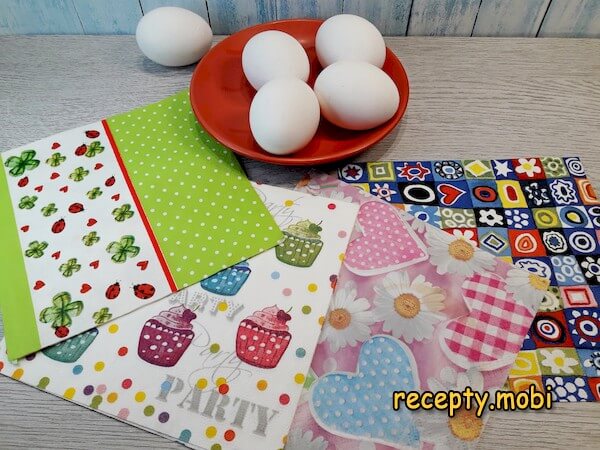
I get the ingredients ready, keeping in mind that 1 egg must be set aside so its white can be used as glue.
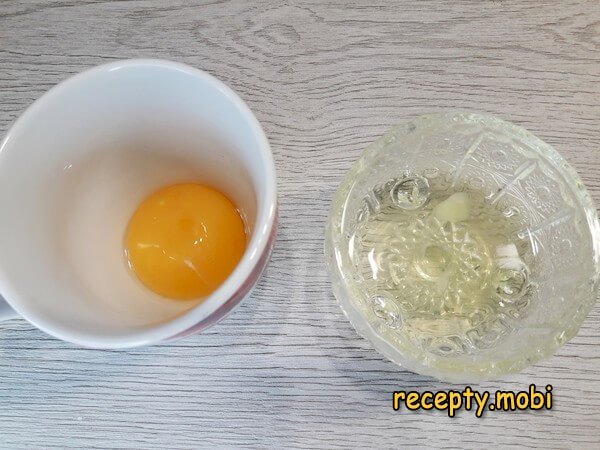
I separate that egg into white and yolk.
The remaining eggs I wash and place in a small pot with water, which should completely cover their tops.
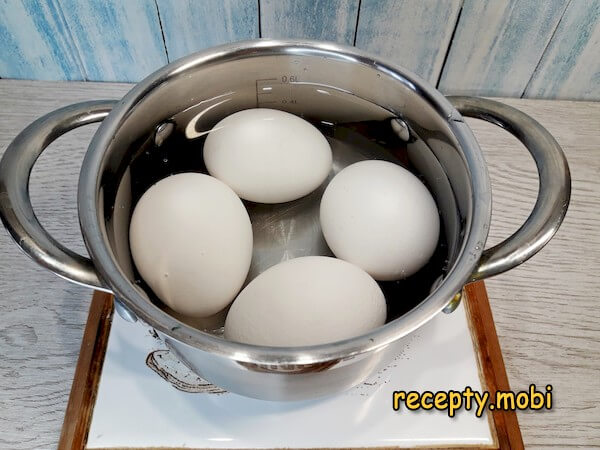
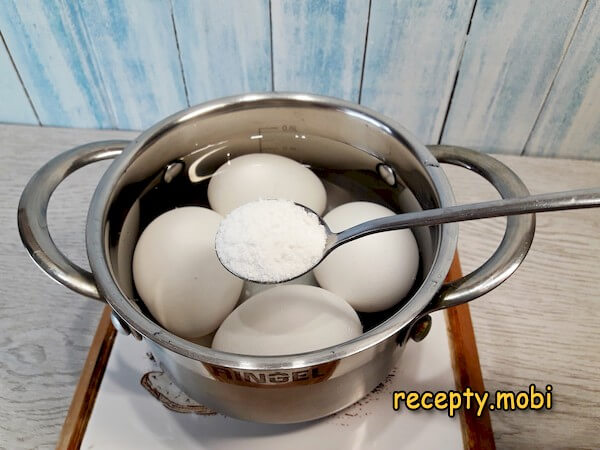
So that the shell does not crack, I add a small spoon of salt. From the moment the water starts to boil, I cook the eggs for 8–10 minutes.
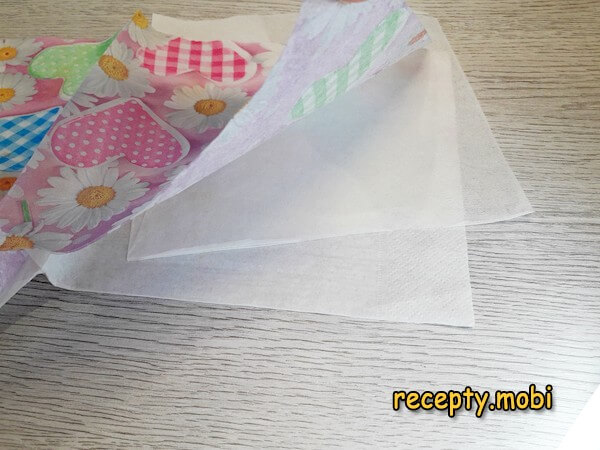
I separate the napkins into layers – the 2 lower white layers will not be needed.
Usually the paper fragments for decoupage are torn by hand (a ragged, uneven edge is less noticeable on the surface being covered).
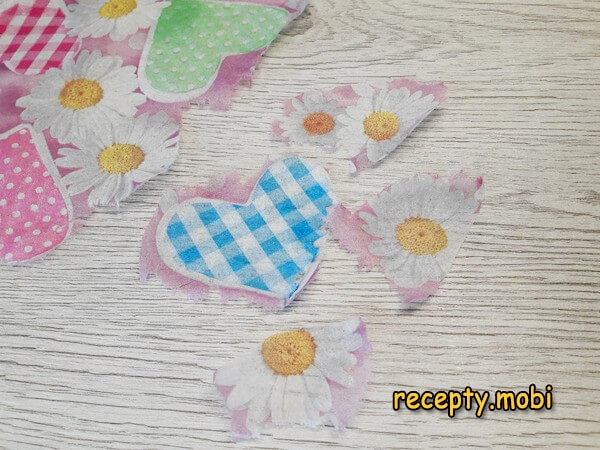
That said, pictures cut out with scissors also look lovely on the eggshell. Which way to prepare the motifs is a matter of taste.
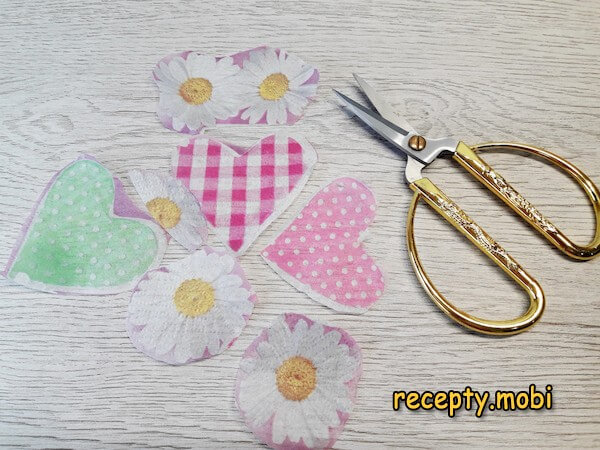
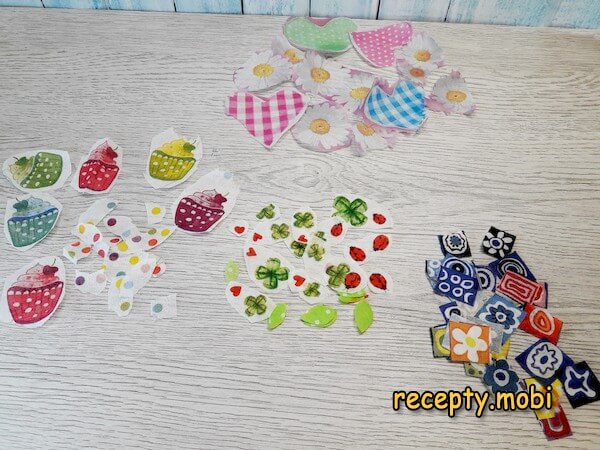
It is more convenient to cut out the pictures for all the eggs at once.
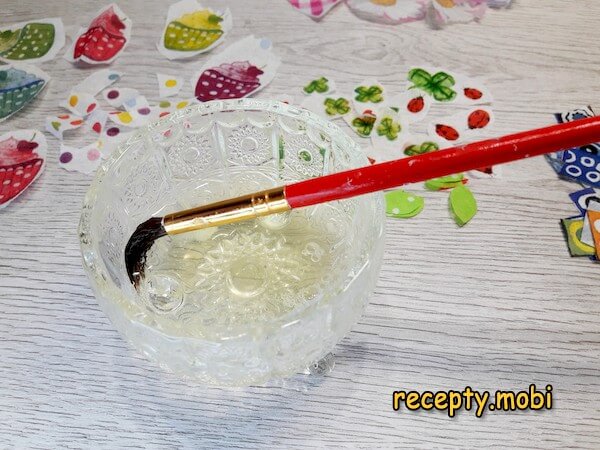
With a soft brush I whisk up the egg white.
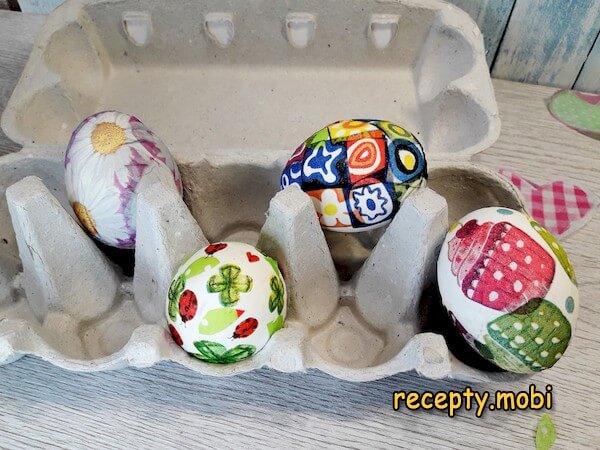
I place the motif on the egg and, very carefully so as not to tear the napkin, apply the white, moving the brush from the middle of the fragment towards its edges. Sometimes it is convenient to cover only half of the egg first, let it dry, and then continue gluing the second part (if you touch the thin layer of wet paper with your hands, you can deform it and the pattern will shift). An egg tray makes a good stand for drying.
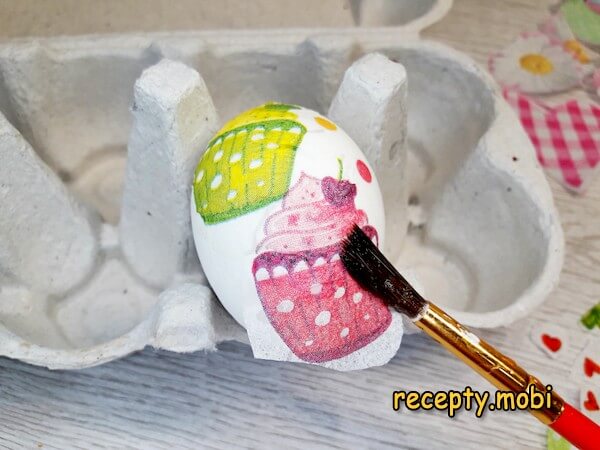
The fragments on the shell can be placed right next to one another, leaving no free spaces.
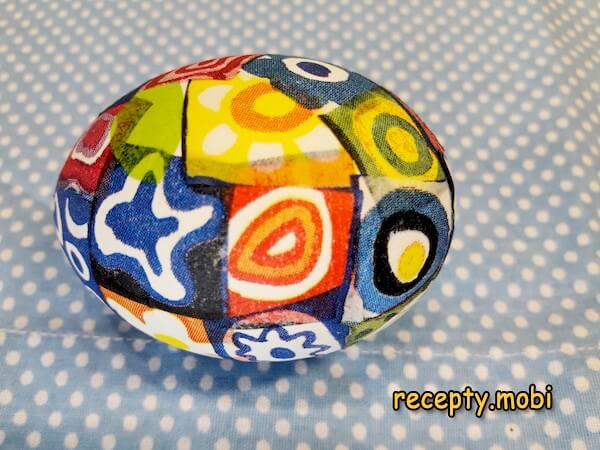
But you can also glue the pictures at some distance apart, so that the white surface shows through. It all depends on the chosen pattern or motif.
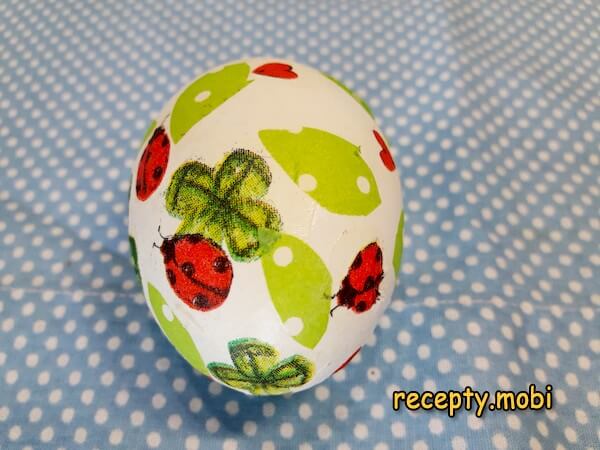
About 5 minutes are needed for the glued napkins to dry, after which you can safely pick up the eggs without worrying that the design will smudge.


Tips
- 1
EGG WHITE INSTEAD OF GLUE – the "secret" of safety. No varnishes or glues on a food product. Raw white dries out and holds the napkins firmly.
- 2
THREE-PLY NAPKINS – the "secret" of decoupage. I separate the top layer with the pattern; the lower 2 are not needed. Only thin printed paper sticks down smoothly.
- 3
FROM THE CENTRE TO THE EDGES – the "secret" of smoothness. If you start from the edges, the napkin creases. From the centre outwards it spreads without wrinkles or bubbles.
- 4
HALF FIRST, THEN THE SECOND – the "secret" of neatness. You cannot cover a whole egg cleanly in one go – the wet paper deforms. First one half and a dry-off, then the second. The same principle works in other ways of decorating Easter eggs.
FAQ
Which napkins should you choose? +
Ideally, three-ply paper napkins with a fine Easter pattern (small flowers, ornaments, rabbits, chicks). Alternatives: napkins with tulips (for a spring mood), polka-dot or check napkins (a vintage style), napkins with gold or silver foil, special thin decoupage cards, or decoupage rice paper (thin and strong). Do not use thick single-ply napkins (they will not stick down evenly) or napkins without a pattern (there is no point to the decoupage). For a classic look, three-ply napkins with a fine pattern are essential.
Which eggs should you use? +
Ideally, white chicken eggs (the pattern shows up brighter on a white shell). Alternatives: farm eggs (but a brown shell makes the pattern duller), quail eggs (for mini-decoupage with small fragments), or duck eggs (large, for a bigger surface). Before decoupage, boil the eggs with salt (1 teaspoon per litre of water) – the salt helps prevent the shell from cracking. Do not use cracked eggs (the decoupage will not come out even) or eggs with a dirty shell. For classic decoupage, white eggs with a smooth shell are best.
How long do decoupaged eggs keep? +
In the refrigerator in open packaging, up to 1 week. At room temperature, no more than a day. Decoupaged eggs are usually made for beauty, and as a decorative object (not for eating) they can be kept for 2–3 weeks in a cool, dry place. If you plan to eat them, follow the usual storage times for boiled eggs. I do not recommend the freezer – the yolk turns rubbery and the paper deforms.
Can you eat decoupaged eggs? +
Yes, you can – egg white is a safe, edible glue. However, before eating it is best to remove the napkin, or simply peel the egg as usual together with the shell. Printed paper napkins may contain components from the printing ink, so they should not end up in your stomach. For complete peace of mind, it is better to use decoupaged eggs as a pretty decoration for the Easter basket and to eat plain dyed eggs instead. Children especially love such eggs as an Easter keepsake rather than as food.
- Comment
or post as a guest
Be the first to comment.