avg —
Classic Greek Salad (Horiatiki / Xoriatiki)

Instructions
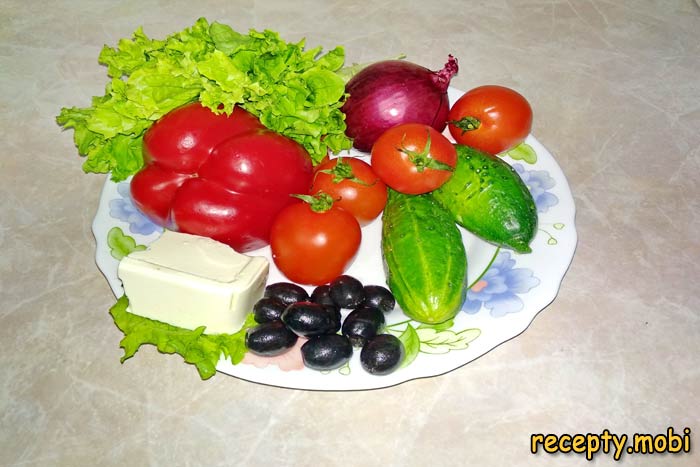
I wash all the vegetables thoroughly under cold running water and pat them dry with a paper towel. Dry vegetables do not “weep” in the finished salad and hold their shape when cut. Wet vegetables dilute the dressing and make it runny — a typical beginner’s mistake. Drying is an essential step for any vegetable salad.
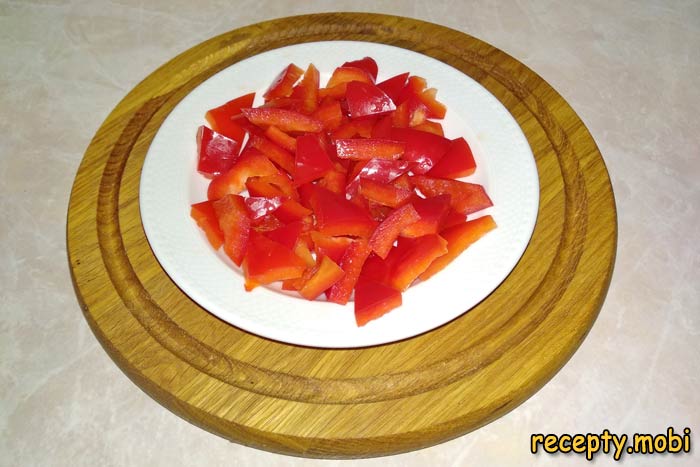
I cut the bell pepper into large pieces of 1.5–2 cm — exactly this size is authentic for Greek salad. I remove the seeds and the core completely, as they give an unpleasant bitterness. The colour of the pepper is up to you: red for sweetness, yellow for a neutral taste, green for a slight bitterness. Ideally, mix two colours for a pretty palette.
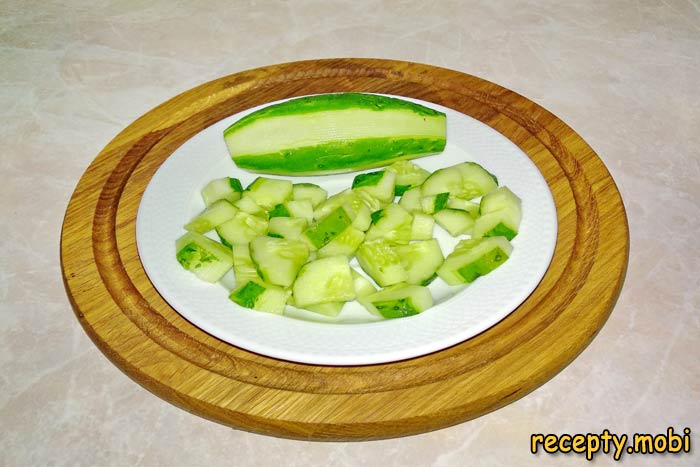
I partially peel the cucumber in strips for looks (optional), cut it lengthwise into quarters and slice it into pieces of 1.5–2 cm. If the cucumber has a bitter, tough skin, peel it completely; if the skin is thin and tender, leave it on for a nice green contrast. The cucumbers should be firm, without a watery, soft core.
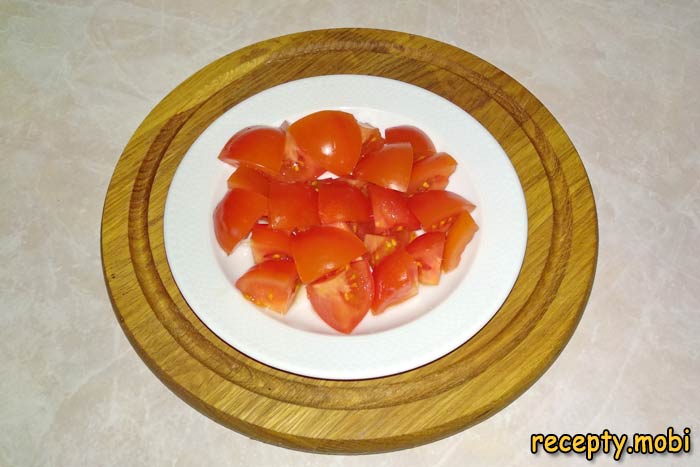
I cut the tomatoes into large wedges or quarters (cherry tomatoes in half). I use dense, meaty tomatoes (oxheart, plum, San Marzano) — watery varieties give a “soup” instead of a salad. Red, sweet tomatoes are the base of a Greek salad, so do not skimp on their quality.
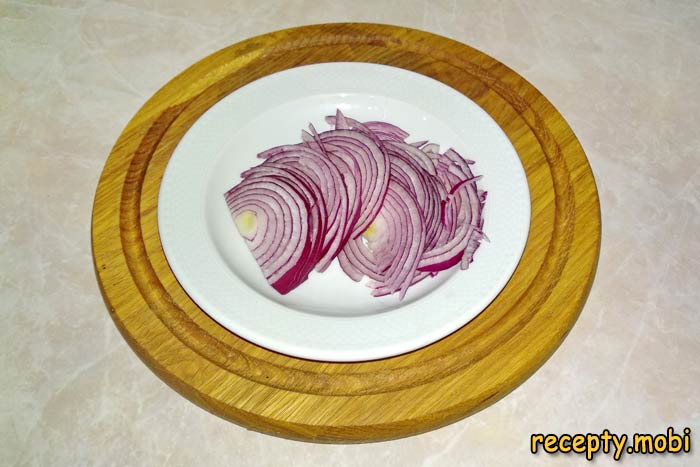
I slice the red onion into thin half rings of 2–3 mm. I use red onion specifically — it is sweeter than ordinary yellow onion and does not give a sharp bitterness in a fresh salad. If you have no red onion, soak ordinary white onion in water with vinegar for 5 minutes to soften it. Thin half rings give a pleasant sharpness rather than “chunks of onion”.
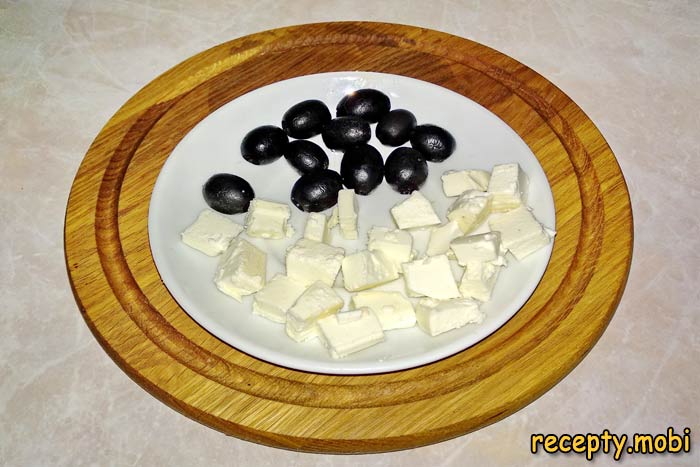
I cut the feta cheese into large cubes of about 1.5 cm — this cut is authentic for Greek salad. I use feta specifically (a salty sheep’s or goat’s cheese in brine) — do not replace it with mozzarella or other cheeses if you want the classic taste. Authentic feta has a salty, piquant flavour with a slight tang.
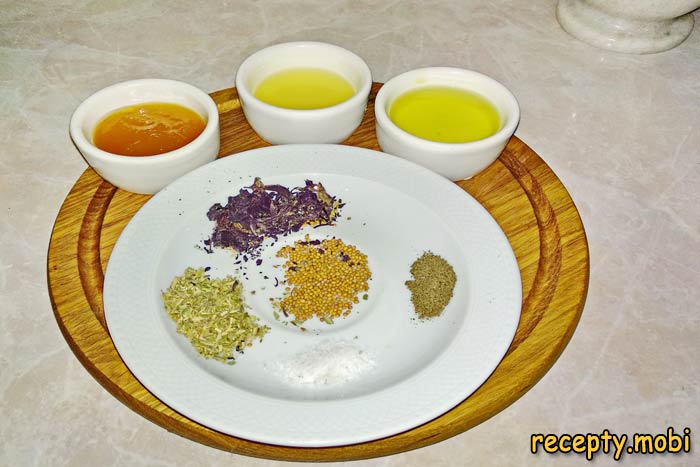
I prepare the ingredients for the Greek dressing: extra virgin olive oil, fresh lemon juice, runny honey, Dijon mustard, dried oregano, basil, sea salt and freshly ground pepper. I use only good-quality extra virgin oil — it gives the dressing its characteristic Greek aroma.
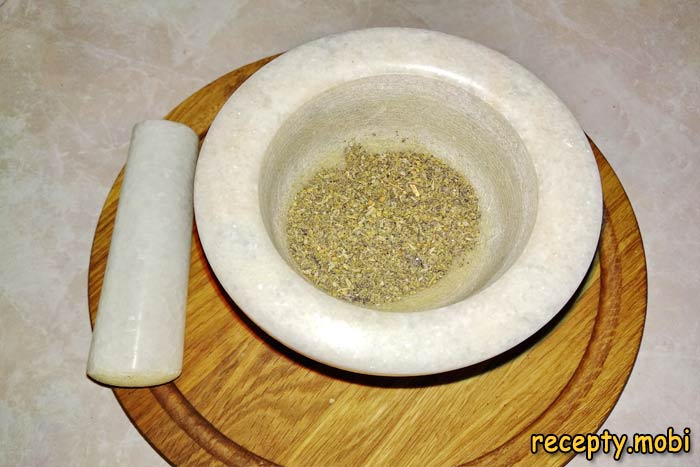
If the dry spices (oregano, basil) are coarsely ground, I crush them in a ceramic mortar to intensify the aroma. Grinding releases the essential oils and brings out the aroma of the spices. Without grinding, the spices will be “weak” in the dressing. You can use an ordinary mortar or simply rub them between your fingers.
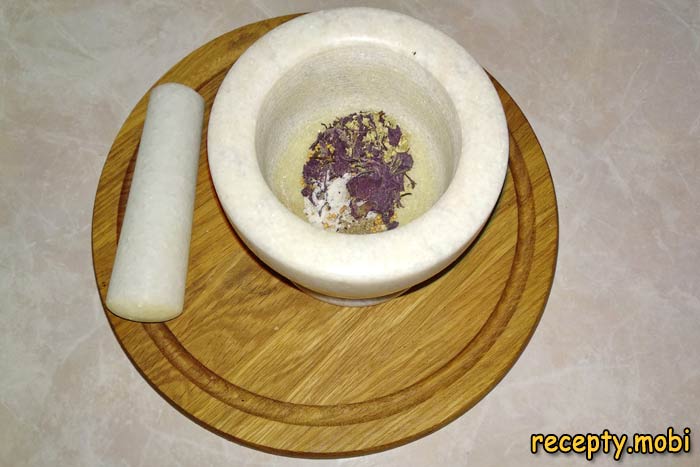
I thoroughly grind the dry spices in the mortar with circular movements of the pestle to a fine, aromatic mass. The finer they are, the stronger the aroma and the better it spreads through the dressing. Fresh herbs (fresh basil, parsley) I chop with a knife right before adding, to preserve their colour and aroma.
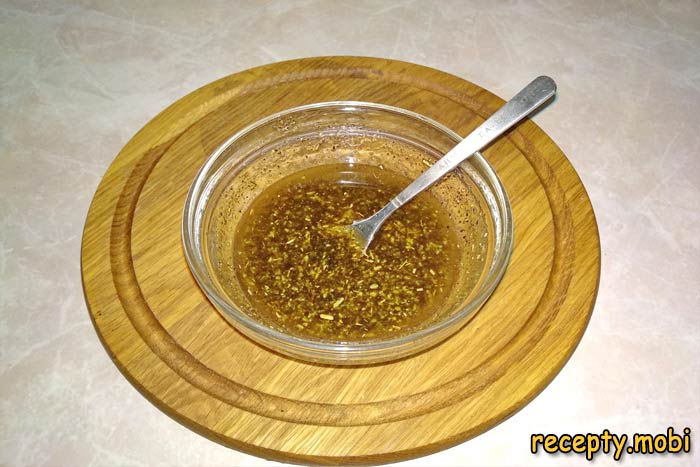
In a small bowl I mix the olive oil (3 tbsp), honey (1 tbsp), lemon juice (2 tbsp), mustard and the ground spices. I whisk thoroughly until smooth — the honey should dissolve completely. The authentic Greek dressing is simpler than Russian mayonnaise-based ones, yet it brings out the flavour of the vegetables better.
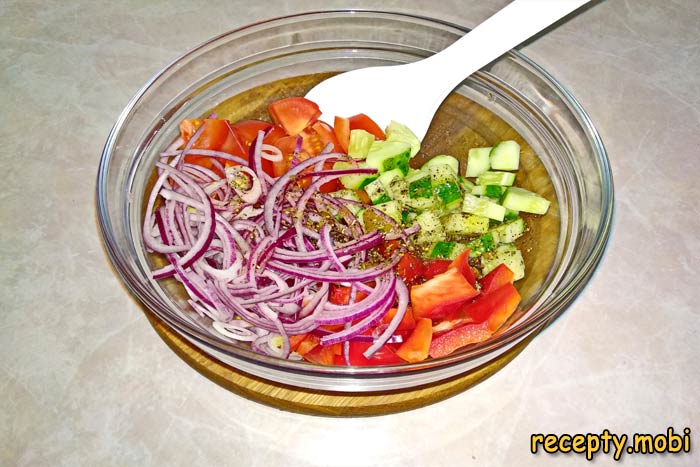
In a large bowl I combine the chopped vegetables (tomatoes, cucumbers, pepper, onion) — without the olives and cheese for now. I add the prepared dressing and gently fold it through 2–3 times from the bottom up. The olives and feta are added last, so that the feta does not crumble and the olives do not get “lost”.
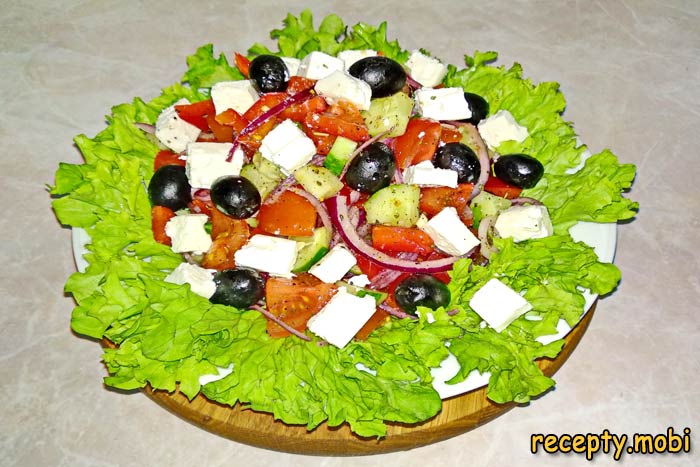
I arrange fresh lettuce leaves on a serving dish in the shape of a “nest”, with the dressed vegetables mounded in the centre. On top I place whole olives and large cubes of feta. The final touch — I sprinkle with oregano and drizzle with the remaining olive oil. The Greek salad is ready!


Tips
- 1
Cut all the ingredients large (1.5–2 cm) — this is the authentic rule of Greek salad, unlike the “Russian” Olivier with its fine dice.
- 2
Use red onion (milder than ordinary yellow) and good-quality, dense tomatoes — the basis of a tasty Greek salad.
- 3
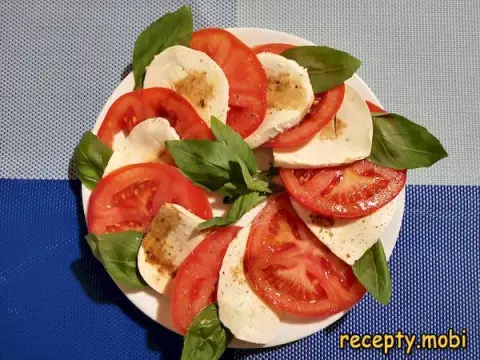
Do not replace the feta with mozzarella or other cheeses — only a sheep’s or goat’s cheese in brine will give the authentic taste. I use a similar principle for my tomato and cheese salad.
- 4
Serve immediately after making — after 30 minutes the vegetables release their juice and the salad “weeps”. It is ideal with grilled meat, fish or chicken.
FAQ
Can I make it without olives? +
Olives are an authentic, classic ingredient of Greek salad; without them the dish loses its character. If you do not like black olives, replace them with green olives (milder in taste), capers (salty and piquant) or sun-dried tomatoes (a Mediterranean flavour). Leaving out olives entirely changes the salad — it becomes “just a vegetable salad” without the Greek soul. It is better to try good-quality Greek Kalamata olives — they are more tender than the tinned ones.
What can I use instead of feta cheese? +
Brynza works well (a Russian-Balkan analogue of feta, very close in taste), as do Adyghe cheese (neutral and mild), halloumi (a firmer Cypriot cheese) and suluguni (milky with a slight saltiness). Mozzarella gives an Italian rather than Greek character — but it is tasty too. Feta is a salty cheese in brine made from sheep’s or goat’s milk, so substitutes made from cow’s milk will differ in taste. The authentic substitute is Balkan brynza.
Is Greek salad suitable for fasting (Lent)? +
In its classic form with feta — no, the cheese excludes the dish from a Lenten menu. Without the cheese, Greek salad becomes fully Lenten and vegan — vegetables, olives, olive oil and spices. It is an ideal Lenten dish: light, full of vitamins, with a rich flavour thanks to the olive oil and herbs. For the Lenten version, add more olives (to replace the richness of the cheese) and cut the vegetables a little smaller — that way the dressing comes through better.
What to serve Greek salad with? +
It is ideal as a light summer supper on its own, or as a side dish to grilled meat (kebabs, steak, chicken wings), baked fish (sea bream, sea bass, trout) or grilled prawns. With penne pasta or risotto it makes an Italian-style Mediterranean supper. It goes with a dry white wine (Riesling, Sauvignon Blanc, Greek Assyrtiko) or a rosé. Serve it with a piece of crusty ciabatta, focaccia or garlic bread to soak up the dressing — an authentic Greek meal.
- Comment
or post as a guest
Be the first to comment.