
 Write a comment
How to sterilize jars and lids
Everyone who is involved in canning berries, fruits, and vegetables should learn how to properly prepare jars and lids. Only in clean and sterile containers can winter preparations be stored for a long time. In this article, we will share proven methods of sterilization. So.
Preparing jars
First of all, thoroughly wash the glass jars in warm water - completely removing any traces of grease, dirt, and rust. For cleaning contaminants, use baking soda.
When the jars are completely clean, you can move on to the second stage - visual inspection. If you find chips and cracks on the glass, it's best to discard the jar. For canning, use containers that are free of any damage.
Method 1. Sterilization in a pot of boiling water
This method is convenient for processing containers of up to 1 liter, as it is problematic to fit larger jars in a pot of water.
Step-by-step instructions:
- Thoroughly wash the jars with clean water and baking soda.
- Place a towel at the bottom of a large pot.
- Fill the jars with water and immerse them in the pot so that they do not touch each other. You can also place the lids here for sterilization.
- Pour water into the pot up to the shoulders of the jars, heat until boiling. Reduce the heat to medium and boil for 20 minutes - this time is quite sufficient. If it's not possible to place the jars in the pot with water, you can simply lay them down.
- Remove the sterile containers from the pot, pour out the water, and use them immediately for their intended purpose.
Method 2. Sterilization over steam
When the inner walls begin to 'fog up' and drops gather at the bottom, you can finish the sterilization. Approximate processing time for jars with steam:
- half-liter — 6-8 min;
- 1-2 liter jars — 10-15 min;
- 3 liter — 20-25 min.
Sterilization methods:
We will need a container whose edges can hold an inverted jar. Fill the container with water halfway or less, place the jar upside down on the edge of the container so that its neck is above the water.
If you don’t have such a container, you can take any pot or kettle with water, place a colander on it, and set the jar upside down on it. If that option doesn’t work, simply place a potato masher in the pot with water and hang the jar on it. You need to ensure that steam from the boiling water enters the jar.
Place over heat, and bring to a boil. Hold over steam for at least 15 minutes. For three-liter jars, hold over steam for at least 20 minutes.
Method 3. Sterilization in a multicooker and steamer
First, wash the jars and the multicooker bowl well. If you previously cooked meat or some fragrant dishes in the multicooker, you need to eliminate foreign odors – add about three cups of water and a couple of lemon slices to the bowl, close the lid, and turn on any mode (Soup, Baking, Stewing) for a few minutes.
Pour water into the multicooker, place a steaming rack in the bowl, and place the jars neck down on it. If you have small jars and their size permits, you can close the multicooker lid, but it's not necessary. Set the ‘Steaming’ mode and process with steam:
- half-liter jars — 6-8 min;
- 1-2 liter jars — 10-15 min;
- 3 liter — 20-25 min.
Not all multicookers have a ‘Steaming’ mode. In this case, turn on any program, for example, ‘Soup’. It just needs to boil since the sterilization of the containers occurs under the influence of steam.
Method 4. Processing jars in the oven
This method is considered the most effective, as the containers are heated at high temperatures. You can fit more than a dozen small jars or a couple of 3-liter jars in the oven at the same time.
Place the jars in a cold oven - put them on the rack. It is advisable to position the jars neck down.
First, set the regulator to +90 degrees. After a few minutes, increase the temperature to +120..+130 degrees - hold the containers for 10-20 minutes.
Leave the jars in the turned-off oven until completely cool. Then use them for canning.
Method 5. Cold sterilization (rinsing)
If you don't want to spend time warming the jars in water or in the oven, you can go another way - treat the containers with alcohol. This method is considered quite effective and doesn't require much effort.
We wash the jars and dry them, placing them upside down on a rack. In a medium-sized container, pour in 50 ml of alcohol, cover tightly and shake well for 30 seconds to distribute the antiseptic over the entire surface. Pour the alcohol into the empty jars and dry this container.
You can also use vinegar for this purpose. For a half-liter jar, about 150 ml of 9% vinegar and 100 ml of water are needed. Pour the vinegar and water into the jar, close it tightly and shake for 20-30 seconds. With one such solution, you can process 15-20 jars.
The treatment with potassium permanganate is carried out in the same way. Make a saturated pink solution of potassium permanganate, pour it into the jar, close the lid and shake for about 20 seconds, treating the inner walls. This solution can be used to process more than 20 jars.
Method 6. Sterilization in a dishwasher
Considering the statement that full sterilization requires heating to 100 degrees, many consider sterilization in a dishwasher impossible, as it heats to 70 or 80 degrees. In fact, 70°C also kills microbes. Therefore, this option can be used as well.
However, not all dishwashers have such a heating temperature. If the maximum temperature in your appliance is below 70°C, it's better to use other sterilization methods.
First, wash the jars to remove dirt, load them into the dishwasher, set the highest possible temperature. Do not add detergent under any circumstances!
This method has its advantages: more jars are processed simultaneously than with other options; the process runs automatically, freeing up your time; there is no risk of burning yourself with steam or boiling water.
Sterilizing lids
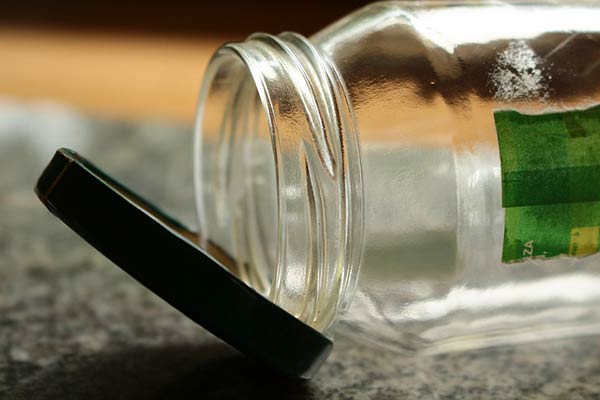
Some types of lids have a sealing ring that cannot be heated too much. Therefore, it is recommended to sterilize such lids at a temperature of about +100 degrees, not higher.
Simple tin lids and screw tops
During a visual inspection, discard lids with dents and rust.
Lids can be sterilized together with the jars if you use methods in boiling water, in steam, or in a multicooker. Just immerse them in boiling water. It’s also not difficult to sterilize them separately.
Pour water into a small pot, bring it to a boil. Then reduce the stove's power to minimum, lower the lids and boil for at least 10 minutes.
Remove the heated lids from the water with a spoon and immediately use them for canning.
Polyethylene lids
Polyethylene lids should not be kept in boiling water for too long - they can deform. They are thoroughly washed and then soaked in boiling water for no more than 15 seconds.

