Write a comment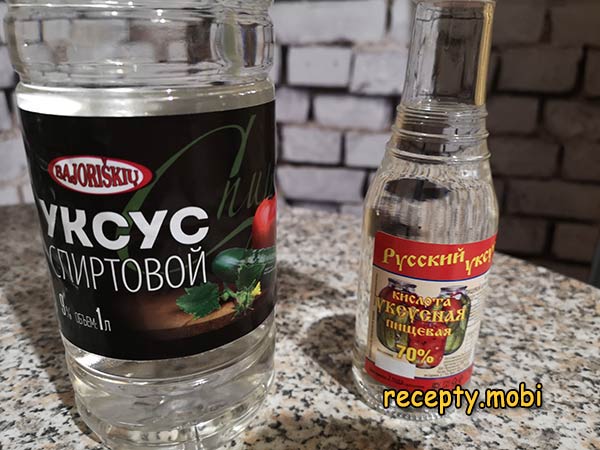
How to dilute 70% acetic acid to 9% vinegar, 6% and 3%
Culinary recipes often involve acetic acid of different concentrations: 70%, 9%, 6%, and even one-percent. It is unlikely that homemakers have bottles with different solutions in their kitchens, but if you have vinegar essence and know how to dilute 70% vinegar to 9% vinegar, you can achieve the desired proportion at home.
Essence refers to a concentrated aqueous solution of acetic acid, containing between 70% and 80%.
Table vinegar contains acid at an average of 3% to 15%.
The density differences of vinegar (1.0 g/cm3) and water (1.05 g/cm3) are so negligible that their mass is considered identical. Therefore, both the essence and its aqueous solution are calculated the same way by mass.
There can also be an equality between the volume of liquid and its weight, so it does not matter whether grams or milliliters are specified in the recipe.
How to properly dilute vinegar
First, calculate the necessary amount of water and vinegar according to the proposed schemes. The mixing process itself is very simple.
In the prepared container, first pour in the required amount of purified or cooled boiled water, and only after that, carefully add vinegar. Stir.
Do not use metal containers for dilution.
How many milliliters of vinegar in a spoon
How many milliliters of vinegar are in a tablespoon. Spoons made in the USSR hold 15 ml of vinegar. Now according to GOST 32583-2013, the capacity of a tablespoon must be 15 ± 2 ml, but in stores, they are sometimes found with a capacity of 18 ml. If the utensils were made abroad, the capacity of the spoon may well be 20 ml.
In a dessert spoon – 10 ± 2 ml.
In a tea spoon – 5 ± 1 ml.
In a coffee spoon – 3 ± 1 ml.
How many grams of vinegar in a spoon
Just as in the case with milliliters, the weight of concentrated 70% and table vinegar is:
- in a tablespoon – 15 grams;
- in a dessert spoon – 10 grams;
- in a tea spoon – 5 grams;
- in a coffee spoon – 3 grams.
How to measure vinegar with a spoon
Considering that the more common tablespoons have a capacity of 15 ml, it is not difficult to calculate the required amount of liquid.
- 10 ml of vinegar is 2/3 of a tablespoon.
- 20 ml is 1 tbsp. + 1 tsp.
- 25 ml is 1 tbsp. + 2 tsp.
- 30 ml is 2 tbsp.
- 40 ml is 2 tbsp. + 2 tsp.
- 50 ml is 3 tbsp. + 1 tsp.
- 60 ml is 4 tbsp.
- 70 ml is 4 tbsp. + 2 tsp.
- 80 ml is 5 tbsp. + 1 tsp.
- 90 ml is 6 tbsp.
- 100 ml is 6 tbsp. + 2 tsp.
Since the volume of tablespoons varies, for your convenience we offer two calculation options to obtain 9% table vinegar from concentrated 70% essence.
|
Concentrated acetic essence 70% |
Drinking water |
|
1 tbsp. with a capacity of 15 ml |
7 tbsp. or 21 tsp. |
|
1 tbsp. with a capacity of 20 ml |
7 tbsp. or 28 tsp. |
How to dilute 70% vinegar to 9% table
To obtain 9% vinegar from 70% vinegar, you need to add 1 part of concentrated vinegar to 7 parts of drinking water.
Example: To obtain 240 ml of 9% table vinegar, measure 210 ml of water and add to it 30 ml of 70% vinegar. That is, using a measuring glass of 30 ml, measure water 7 times (which gives 210 ml) and measure vinegar 1 time (30 ml).
|
Vinegar 70% |
Water |
|
10 grams |
70 grams |
|
20 grams |
140 grams |
|
50 grams |
350 grams |
|
100 grams |
700 grams |
Proportion calculations
To obtain solutions of table vinegar of different concentrations, dilute the 70% essence with water as follows:
|
Concentration of the solution |
Drinking water |
Vinegar 70% |
|
30% |
1.5 parts |
1 part |
|
10% |
6 parts |
1 part |
|
9% |
7 parts |
1 part |
|
8% |
8 parts |
1 part |
|
7% |
9 parts |
1 part |
|
6% |
11 parts |
1 part |
|
5% |
13 parts |
1 part |
|
4% |
17 parts |
1 part |
|
3% |
22.5 parts |
1 part |
How to dilute vinegar by formula
This method gives the most accurate result, but it is suitable for those who like to calculate.
How to dilute vinegar to the desired percentage concentration is calculated using a simple formula
W = K × Y : Z
Values of the formula:
W – the sought value (the required amount of essence for dilution).
K – the amount of solution to be obtained.
Y – the concentration of acid to be obtained (9%, 6%, 3%, etc.).
Z – the concentration of the available essence (70%, 80%)
Example of calculation:
You need to get 100 g of 9% table vinegar, and you have 70% essence available.
Multiply the required volume (100 ml) by the desired concentration (9%) and divide by the concentration of the acid you have (70%). We get:
100 × 9 : 70 = 12,8
So, you need to take 12.8 ml of vinegar essence and enough water so that the total volume is 100 ml. Let’s calculate:
100 – 12,8 = 87,2.
According to accurate calculations, to obtain 100 ml of 9% vinegar, you need to mix 12.8 ml (rounding to 13 ml) of 70% vinegar essence with 87.2 ml (rounding to 87 ml) of drinking water.
Precautions
Take precautions. When working with the essence, avoid getting the liquid on your skin and in your eyes, as it can cause chemical burns. If the concentrate gets on your skin, immediately rinse it off with plenty of running water for about 10 minutes. Then treat it with baking soda or soap and rinse.
Keep the solution tightly closed in a place inaccessible to children.